CONTENTS
OF THIS SECTION
Last updated
18/08/07 | | Nominated by N.Mahadeva | | Jaffna Remembers G.G.Ponnambalam 9 February 2003 | | Appreciation on 101st Birth Anniversary, 8 November 2002 | | (from S.Arumugam's Dictionary of Biography of the Tamils of Ceylon - published here with permission) Ganapathipillai Gangesar Ponnambalam was born on 8th November 1902. His father Gangesar was a Postmaster from Alvay, PointPedro (in Tamil Eelam) and his mother was from Navaly, Manipay. Ponnambalam had his education at St.Joseph’s College Colombo, and proceeded to Cambridge on a scholarship. There he passed the Natural Science Tripos and was also called to the Bar. Returning to Ceylon, he commenced practising as an Advocate in Colombo. He was a very able debater and soon became an outstanding Criminal Lawyer. He was made a King’s Counsel in 1948. Ponnambalam’s political career commenced in 1931. when he unsuccessfully contested the Mannar-Mullaitivu seat in the First State Council. However, he won the Point Pedro seat in the same Council, when elections were held in the North in 1934, after the lifting of the boycott. He made his name as an able speaker in the Council and retained his seat in the Second State Council 1936-1947. For a brief period he also acted for the Minister of Communications and Works. He won great acclaim soon after 1944. when he presented before the Soulbury Commission a logical case for equal representation for the minorities in the Council. He rose high in political esteem with his 50/50 slogan. His Tamil Congress Party swept the polls at the 1947 General Elections to the First Parliament . He secured the Jaffna seat, defeating Arunachalam Mahadeva by a majority of aver 9.000 votes In the House of Representatives, he was appointed Minister of Industries, Industrial Research and Fisheries in 1948. He held this position for over five years. Several large industrial ventures were mooted during his regime as Minister. Among them were the Kankesanturai Cement Factory, the Paranthan Caustic Soda Chemical Factory and the Valaichchenai Paper Factory. These developed into huge concerns in due course and were a monument to his diligence and forethought In the elections held in 1952, G.G.Ponnambalam won the Jaffna seat by a majority of about 4000 votes defeating Dr.E.M.V.Naganathan of the Federal Party. In the meanwhile, a new party had gained popularity in Jaffna. The majority became even less at the General Elections held in 1956, when only he of his Party, was elected and that too with a small majority. He then had to be a back-bencher, and was the only representative of the Tamil Congress in the House. He migrated to Malaysia and practised there for some time and passed away on 9th December 1977. The Sri Lankan Government honoured him by issuing a commemoration postage stamp value 75 cts., on 22nd May 1986. |
| One Hundred Tamils of the 20th Century G.G.Ponnambalam Q.C.
8 November 1902 – 9 December 1977 Appreciation on 102nd Birth Anniversary
Appathuray Vinayagamoorthy
Member of Parliament, President - All Ceylon Tamil Congress
8 November 2003 (in Sri Lanka Island) 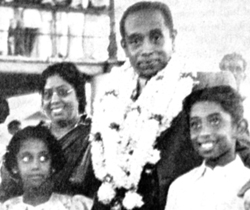
G.G.Ponnambalam Q.C. with son Kumar on right
The Birthday of late Mr. G. G. Ponnambalam Q.C. falls on 8 November 2003. He was born on 8 November 1902.
He inaugurated the All Ceylon Tamil Congress on 29th August 1944 to safeguard and look after the interests of Tamil speaking people in the whole of Sri Lanka.
After late Mr. Bandaranaike started the Sinhala Maha Saba he had no other alternative but to start the All Ceylon Tamil Congress. All Ceylon Tamil Congress is the oldest Tamil Party in Sri Lanka and it has three Representatives in Parliament now including the Honourable Gajendrakumar Ponnambalam, Grandson of late Mr. G. G. Ponnambalam Q.C.
His illustrious son Gaasinather Gangaser Ponnambalam also known as "Kumar" who was killed on 05th January 2000 inherited his father’s inborn Tamil pride and indomitable fighting spirit and carried it to its ultimate limits. Though he was not a Member of Parliament yet he was a mighty one man opposition to the Government of the day. He was honoured, posthumously as "MAAMANITHAR’ by Vellupillai Prabakaran representing the vanguard of Tamil Nationalism today.
G.G. Ponnarnbalam Q.C. entered Parliament in early 1930’s and he had been the spokesman in and out of Parliament for Sri Lankan Tamils including Indian Tamils from 1930 onwards. He foresaw what was in store for the Sri Lankan Tamil speaking minorities and as such he made representations to the Soulbury Commissioners in 1945 for a balanced representation.
Late Prof. Jayaratnam Wilson in his Book called "Sri Lankan Nationalism described late Mr. G.G. Ponnambalam in the following manner :-
"...This enormous void left by the ( Ramanathan and Arunachalam ) brothers had to be filled and G.G. Ponnambalam did so. He evolved his political credo not from them, but from Sir William Manning’s warning of the need for non-domination. The outcome was balanced representation, known as the "Fifty -Fifty" formula...
Late Mr. G.G. Ponnambalam in his Marathon Speech regarding balanced representation in the State Council in 1939 has stated:
"And what is the position of the Tamil Community? I want to repeat that our position is this. We are inhabitants of this country. We have lived here and a branch of the Tamil Community has lived here possibly longer than our brethren the Sinhalese. This is our home. We have as much right to claim to have permanent and vested interests in this country politically and otherwise as the Sinhalese people. We do not propose to be treated as undesirable aliens. We do not and will not tolerate being segregated in ghettos and treated like Semites in the Nazi States of Central Europe."
Had the principle of the balanced representation been accepted by the Soulbury Commissioners subsequent pogroms of l956, 1958, 1977 and 1983 could have been avoided and the obnoxious Sinhala Only Act which made Tamils Second Class Citizens and humiliated them would not have been passed in the Parliament.
It is only by giving balanced representation you can prevent a racial majority trampling upon the rights of the minorities in a Democratic Country. This Principle of balanced representation prevails in the United States of America in the selection of Senators.
The All Ceylon Tamil Congress fought the 1947 General Election before Ceylon got its independence and it made it clear in the Election Manifesto that it would extend responsive co- operation to whichever Government that may be formed after General Election which would support the fundamental policies of the All Ceylon Tamil Congress. At the General Election held in 1947 the UNP did not get an absolute majority and it got only 42 seats. At that time all the parties opposed to the UNP organized a Conference at the House of late Sri Nissanka in Colombo known as: "Yamuna Conference " to explore the possibilities of forming an alternative Government opposed to the UNP and this conference was presided over by late Mr. G.G. Ponnambalam. As there was disunity among the leftists, this conference could not achieve anything useful. late Mr. Peter Keuneman some years ago in an article which was published in the Saturday Review commented to the effect that had there been unity among the leftists forces at the Yamuna Conference, the history of the Sri Lanka would have been different.
His political opponents carried on a persistent campaign of vilification and character assassination against him stating he was responsible for the disfranchisement of several Indian Tamils in 1948. This is absolutely incorrect. The act which disfranchised the Tamils of Indian origin was the Ceylon Citizenship Act No. 18 of 1948 and the All Ceylon Tamil Congress and its Leader Mr. G. G. Ponnambalam vehemently opposed this act and voted against it. When this Act was passed Mr. Ponnambalam was in the opposition. Later when Tamil Congress decided to give responsive co-operation to the UNP Government it did so only after getting an undertaking from late Mr. D. S. Senanayake that he would consult the then Indian Prime Minister late Mr. Jawaharlal Nehru and bring a bill in Parliament to give citizenship rights to those who were deprived of their citizenship by the earlier Citizenship Act.
The subsequent piece of legislation known as the Indian and Pakistani Residents Citizenship Act which was passed in Parliament was the outcome of the undertaking given by late Mr. D. S. Senanayake to late Mr. Ponnambalam. Mr. Ponnambalam only supported this legislation which gave citizenship rights to Indian Citizens.
From 1930 onwards it was late Mr. G.G. Ponnambalam who fought for the rights of the Indians and safeguarded their self respect. When Sir Jackson Commission was appointed when Govindan was shot dead at the famous Mooloya Estate incident and when Nefsumoyar Estate was taken over it was G.G. Ponnambalam which spoke on behalf of the Indian Tamils and fought for their rights. Out of three days allotted to the Tamil Congress by the Soulbery Commission late Mr. G.G. Ponnambalam set apart one full day to represent matters relating to the rights of the Indian Tamils before the Soulbery Commission and as a result Soulbery Commission has recommended that 14% of the seats in Parliament be reserved for the Indian Citizens.
The separatist cry was not the brain-child of the TULF Leaders who opted for separation at the 1970 Vaddukoddai Conference. It was late Mr. S.W.R.D. Bandaranaike who laid the foundation stone for the Tamil separatist cry in this country by introducing the obnoxious Sinhala only Act in Parliament in 1956. Our Leader late Mr. G.G. Ponnambalam spoke against it and warned the Government and the Sinhala people that Sinhala only Act would lead to a parting of ways. He was the first person who has given the warning that if Tamils were not treated equally they would have no other alternative but to ask for separation and the pogroms of 1958, 1977 and 1983 which destroyed several thousand Tamils made the young Tamils to defend themselves to defend themselves and the Tamil Community.
In 1965-66 Premier Dudley Senanayake’s UNP Government had the honour of G.G. Ponnambalam, Q.C. agreeing to lead its delegation to the United Nations. The August Assembly was so spellbound by his oration that the US delegate, Ms. Frances Willis, rushed over to him, shook his hands and exclaimed "If that is the voice of an underdeveloped nation, we would all like to be underdeveloped."
G. G. Ponnambalam Q.C. at the Sarkaria Commission
1976 January 30, saw the dismissal of Kalaignar Karunanidhi’s Tamil Nadu Government by the Central Government of Indira Gandhi under charges of alleged corruption, and Justice Sarkaria, a sitting Judge of the Supreme Court of India was appointed as a one-man commission to head an inquiry. At Karunanidhi’s request G.G. Ponnambalam whose legal skills are legendary appeared before the Commission. After dwelling at length on the double standards adopted by Delhi in its center - state relationship (with reference to Punjab and Tamil Nadu) he challenged the Judge to allow him to cross - examine every witness who was going to testify and prove them liars. This demand was turned down promptly by the Judge. With devastating legal arguments G.G. went to expose the nature and operating procedures of the Kangaroo Court that was meant to do a fix-up job after Indira Gandhi had made up her mind to wreak political vengeance on Karunanidhi. He then led his top team of Tamil Nadu Lawyers on a walk-out and continued to boycott the hearings. It was legal hara-kiri for the Commission thereafter and Karunanidhi won his day. G.G. refused to accept even a red cent as payment from Karunanidhi by way of fees or travel expenses and even insisted on paying for his accommodation. Later at a great thanksgiving rally hosted by Karunanidhi at Seerani Arrangam at the Marina Beach, he declared that the high moral standards set for true friendship in the Sangam Tamil Literature had been totally rewritten by G.G. Ponnambalam.
He also defended at the Trial-at-Bar late Mr. Appapillai Amirthalingam and three other Members of Parliament and got them released, and it was thereafter Mr. Amirthalingam became the Leader of opposition in Parliament.
He was also an efficient Criminal Lawyer and appeared in several famous criminal cases. In the Ranjani Taxi Cab case he cross-examined the finger print expert who came from United Kingdom and after his cross-examination of the expert witness the law of finger prints was altered. The entire Tamil Community is really indebted to late G.G. Ponnambalam for the part he played in politics for nearly half a century.
Appreciation on 101st Birth Anniversary
by Appathuray Vinayagamoorthy
Member of Parliament President - All Ceylon Tamil Congress
in the Sri Lanka Island on 7 November 2002 101st Birthday of late Mr. G. G. Ponnambalam Q.C. falls of November 8, 2002. He inaugurated the All Ceylon Tamil Congress on 29th August 1944 to safeguard and look after the interests of Tamil speaking people in the whole of Sri Lanka.
After the late Mr. Bandaranaike started the Sinhala Maha Sabah he had no other alternative but to start the All Ceylon Tamil Congress. All Ceylon Tamil Congress is the oldest Tamil Party in Sri Lanka and it has three Representatives in Parliament now including the Hon’ble Gajendrakumar Ponnambalam, Grandson of late Mr. G. G. Ponnambalam Q.C.
He entered Parliament in early 1930’s and he has been the Spokesman in and out of Parliament for Sri Lankan Tamils including Indian Tamils from 1930 onwards. He foresaw what was in store for the Sri Lankan Tamil speaking minorities and as such he made representations to the Soulbury Commissioners in 1945 for a balanced representation.
late Prof. Jayaratnam Wilson in his Book called "Sri Lankan Nationalism" has described late Mr. G.G. Ponnambalam in the following manner :
"... This enormous void left by the (Ramanathan and Arunachalam) brothers had to be filled and G.G. Ponnambalam did so. He evolved his political credo not from them, but from Sir William Manning’s warning of the need for non-domination. The outcome was balanced representation, known as the "fifty-fifty" formula... There was no doubt that he was shaping the all - Sinhalese Ministry of 1936, which he characterized as the homogenous Board of Sinhalese - speaking Ministers - much to the embarrassment of the latter."
late. Mr. G. G. Ponnambalam in his Marathon Speech regarding balanced representation in the State Council in 1939 has stated.
"And what is the position of the Tamil Community? I want to repeat that our position is this. We are inhabitants of this country. We have lived here and a branch of the Tamil Community has lived here possibly longer than our brethren the Sinhalese. This is our home. We have as much right to claim to have permanent and vested interests in this country politically and otherwise as the Sinhalese people. We do not propose to be treated as undesirable aliens. We do not and will not tolerate being segregated in ghettos and treated like Semites in the Nazi States of Central Europe."
Had the principle of the balanced representation been accepted by the Soulbery Commissioners subsequent pogroms of 1956, 1958, 1977 and 1983 could have been avoided and the obnoxious Sinhala Only Act which made Tamils Second Class Citizens and humiliated them would not have been passed in the Parliament.
It is only by giving balanced representation you can prevent a racial majority trampling upon the rights of the minorities in a Democratic Country. This Principle of balanced representation prevails in the United States of America in the selection of Senators.
The All Ceylon Tamil Congress fought the 1947 General Election before Ceylon got its independence and it made it clear in the Election Manifesto that it would extend responsive co-operation to whichever Government that may be formed after General Election which would support the fundamental policies of the All Ceylon Tamil Congress. At the General Election held in 1947 the UNP did not get an absolute majority and it got only 42 seats. At that time all the parties opposed to the UNP organized a Conference at the House of late Sri Nissanka in Colombo known as ‘Yamuna Conference‘ to explore the possibilities of forming an alternative Government opposed to the UNP and this conference was presided over by late Mr. G. G. Ponnambalam. As there was disunity among the leftists, this conference could not achieve anything useful. Late Mr. Peter Keuneman some years ago in an article which was published in the Saturday Review commented to the effect that had there been unity among the leftists forces at the Yamuna Conference, the history of the Sri Lanka would have been different.
His political opponents carried on a persistent campaign of vilification and character assassination against him stating he was responsible for the disfranchisement of several Indian Tamils in 1948. This is absolutely incorrect. The act which disfranchised the Tamils of Indian origin was the Ceylon Citizenship Act No. 18 of 1948 and the All Ceylon Tamil Congress and its Leader Mr. G. G. Ponnambalam vehemently opposed this act and voted against it. When this Act was passed Mr. Ponnambalam was in the opposition. Later when Tamil Congress decided to give responsive co-operation to the U.N.P. Government it did so only after getting an undertaking from late Mr. D. S. Senanayake that he would consult the then Indian Prime Minister late Mr. Jawaharlal Nehru and bring a bill in Parliament to give citizenship rights to those who were deprived of their citizenship by the earlier Citizenship Act.
The subsequent piece of legislation known as the Indian and Pakistani Residents Citizenship Act which was passed in Parliament was the outcome of the undertaking given by late Mr. D. S. Senanayake to late Mr. Ponnambalam. Mr. Ponnambalam only supported this legislation which gave citizenship rights to Indian Citizens.
From 1930 onwards it was late Mr. G. G. Ponnambalam who fought for the rights of the Indians and safeguarded their self respect. When Sir Jackson Commission was appointed when Govindan was shot dead at the famous Mooloya Estate incident and when Nefsumoyar Estate was taken over it was G.G. Ponnambalam who spoke on behalf of the Indian Tamils and fought for their rights. Out of three days allotted to the Tamil Congress by the Soulbery Commission late Mr. G. G. Ponnambalam set apart one full day to represent matters relating to the rights of the Indian Tamils before the Soulbery Commission and as a result Soulbery Commission has recommended that 14% of the seats in Parliament be reserved for the Indian Citizens.
The separatist cry was not the brain-child of either Prabhakaran or that of the TULF Leaders who opted for separation at the 1970 Vaddukoddai Conference. It was late Mr. S. W. R. D. Bandaranaike who laid the foundation stone for the Tamil separatist cry in this country by introducing the obnoxious Sinhala Only Act in Parliament in 1956. Our Leader late Mr. G. G. Ponnambalam spoke against it and warned the Government and the Sinhala people that Sinhala Only Act would lead to a parting of ways. He was the first person who has given the warning that if Tamils were not treated equally they would have no other alternative but to ask for separation and the pogroms of 1958. 1977 and 1983 which destroyed several thousand Tamils made the young Tamils to arm themselves to defend themselves and the Tamil Community.
It was All Ceylon Tamil Congress and its Leader late G. G. Ponnambalam who produced Tamil Leaders like Chelvanayagam, Vanniyasingham, Sivasithamparam and Kumar Ponnambalam.
He also defended at the Trial-at-Bar late Mr. Appapillai Amirthalingam and three other Members of Parliament and got them released, it was thereafter Mr. Amirthalingam became the Leader of Opposition in Parliament.
He was also an efficient Criminal Lawyer and appeared in several famous criminal cases. In the Ranjani Taxi Cab case he cross-examined the finger print expert who came from United Kingdom and after his cross-examination of the expert witness the law of finger prints was altered. The entire Tamil Community is really indebted to late G. G. Ponnambalam for the part he played in politics for nearly half a century.
|
|

