  INDICTMENT AGAINST SRI LANKA INDICTMENT AGAINST SRI LANKA
SINHALA COLONISATION OF
TAMIL HOMELAND 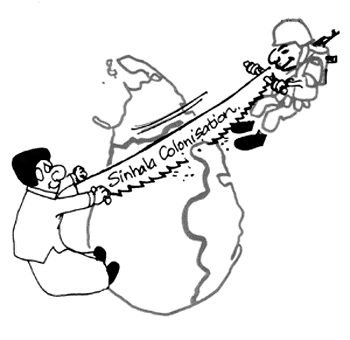
 Walter Schwarz, Minority Rights Group on Colonisation in Eastern Province, 1979 Walter Schwarz, Minority Rights Group on Colonisation in Eastern Province, 1979
Virginia Leary, International Commission of Jurists, (ICJ) on State Colonisation of Traditional Tamil Areas, June 1981 On forced eviction of Tamils - Robert Kilroy-Silk, M.P. and Roger Sims, M.P United Kingdom Parliamentary Human Rights Group Report, February 1985 "Sri Lanka has announced plan to colonise all Tamil areas with Sinhala settlers to reflect the nationwide population ratio of 75% Sinhalese and 25% other minority ethnic groups." Joint Memorandum submitted by a group of nine Non Governmental Organisations, February 1985 "All wars are fought for land.. By settling the (Sinhala) people in the Maduru Oya we were seeking to have in the Batticaloa zone a mass of persons opposed to a separate state." Sinhala Mahaveli Ministry Official, Herman Gunaratne in the Sri Lanka Sunday Times, 26 August 1990 "The Sinhala people should know that the so called state aided 'colonisation schemes' within Tamil areas having nothing to do with solving landlessness among the Sinhala poor" - Open Letter from the Central Committee of the Liberation Tigers of Tamil Eelam, to the Sinhala people, 22 September 1991 Government Policies Threaten Economic Future and Ancestral Homeland of Tamils - Professor Chelvadurai Manogaran, July 1996 Professor Chelvadurai Manogaran June 1997 Sinhala Colonisation in the Hereditary Tamil Regions of the Island of Sri Lanka - K.Satchithanandan, March 2000 Buddha’s Statues - Symbol of Sinhalese Hegemony, - A.Thangavelu, May 2005 Sinhala Colonisation of East Tamil Eelam - Arujna, Oru Paper Editorial, May 2007 Presentation on Post Resettlement Development Plan for The Eastern Region by M.S.Jayasinghe Advisor Sri Lanka Ministry of Nation Building and Estate Infrastructure Development President Rajapakse's Colonisation of East Tamil Eelam, 2007 - "...whilst the current landscape in the East is one of humanitarian crisis and endemic human rights abuses, the current focus on human rights issues, which whilst performing the essential task of exposing the authoritarianism and violence of the current regime, is insufficient to capture the cold calculations and reasoning in the intentions of the Sri Lankan State which has once again returned to the the logic of Sinhala colonisation.." David Rampton, Lecturer, SOAS, University of London
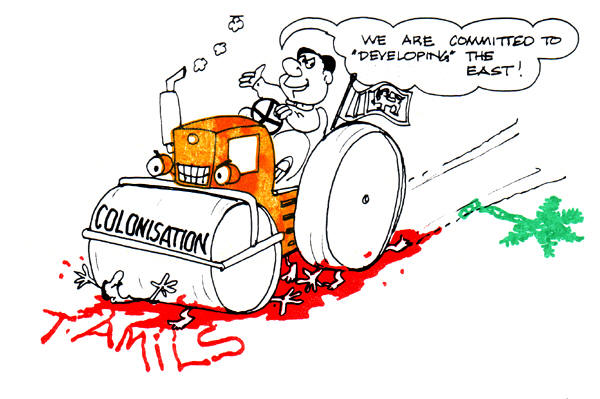
 Walter Schwarz: Minority Rights Group Report on Tamils of Sri Lanka, 1979 Walter Schwarz: Minority Rights Group Report on Tamils of Sri Lanka, 1979
"In 1978, Tamil spokesmen complained that the momentum of colonisation was greater than ever. They referred in particular to the Mahaveli Diversion project, supported by the World Bank, in the Eastern Province, under which Sinhalese families were being brought in from the South. They pointed out that the Maduruoya Scheme in the Eastern Province, backed by Canadian assistance, was having the same effect."
Virginia Leary on State Colonisation of Traditional Tamil Areas - Ethnic Conflict and Violence in Sri Lanka - Report of a Mission to Sri Lanka on behalf of the International Commission of Jurists, July/August 1981 "...Tamils have objected to State colonisation schemes which import large numbers of Sinhalese into traditional Tamil areas. The Tamil concern about colonisation is related to insecurity about their physical safety and to fears that Tamils will become a minority in their traditional homelands. The government maintains that since Sri Lanka is a single country citizens may freely move into any part of the country and that it is necessary to transplant some populations to more productive areas. The Tamils answer that they are not opposed to individual migration but only to large scale government colonisation schemes which change the ethnic composition of an area...
The government should give renewed attention to Tamil concern over government sponsored colonisation schemes which bring large numbers of Sinhalese into Tamil areas and thus change the ethnic composition in such areas. This is particularly important in view of the insecurity of Tamils due to communal violence against them in areas where they live as a minority..."
On forced eviction of Tamils - Robert Kilroy-Silk, M.P. and Roger Sims, M.P United Kingdom Parliamentary Human Rights Group Report on February 1985 "Witnesses also confirmed allegations made to us that whole villages have been emptied and neighbourhoods have been driven by the army from their homes and occupations and turned into refugees dependent on the government for dry rations... The human rights transgressed in such a course of action do not need to be detailed here...
More important is that rightly or wrongly it tends to lend credibility to the view so frequently put to us that it is the Government's objective either to drive the Tamils out of the north and east in sufficient numbers so as to reduce their majority in the north and in the east, a process that would be aided by the Government's announced policy of settling armed Sinhalese people in former Tamil areas... or to drive the Tamils out altogether.
We cannot make a judgement on this issue. We can say, without doubt, that the Government is driving Tamils from their homes and does intend to settle Sinhalese people in these areas. This, at least, lends support to the more extreme version believed by most Tamils."
Professor Chelvadurai Manogaran June 1997 [full text]
"Sri Lanka has announced plan to colonise all Tamil areas with Sinhala settlers to reflect the nationwide population ratio of 75% Sinhalese and 25% other minority ethnic groups." Joint Memorandum submitted by a group of nine Non Governmental Organisations, February 1985 [see full text] consisting of the Anti-Slavery Society for the Protection of Human Rights, Centre Europe - Tiers Monde, Disabled Peoples International, International Federation of Human Rights, International League for the Rights and Liberation of People, Pax Christi International, Pax Romana - International Catholic Movement for Intellectual and Cultural Affairs, International Movement of Catholic Students, International Movement of Catholic Students, International Movement for Fraternal Union among Races and People, and World Student Christian Federation at the UN Commission on Human Rights in February 1985
"The President of Sri Lanka has announced his Government's plan to colonise all Tamil areas with Sinhala settlers to reflect the nationwide population ratio of 75% Sinhalese and 25% other minority ethnic groups. This is calculated to undermine the numerical strength of Tamils in areas where they have traditionally lived.
The Minister of National Security told conference of District Ministers on January 8, 1985 that the only way to root out terrorism was to remove the concept of 'traditional homelands' and create parity between different communities. He announced that according to the plan 30,000 Sinhalese families will be settled in the Tamil north this year.
Under the plan 250 families would be selected from each of the Sinhala constituencies for resettlement in the northern province. Such settlements would be created this year in Killinochchi, Vavuniya, Mullaitivu and Mannar districts and extended to the Jaffna Peninsula next year.
The new settlers would be given military training and equipment to safeguard themselves. In fact, in certain predominantly Tamil areas like Vavuniya, Mannar, Mullaitivu and Trincomalee districts, guns have already been distributed. In its recent report the CRM has drawn attention to the arming of civilians: 'Civilians in the Trincomalee district have been given arms by police, ostensibly for their self-defence. Instances have been given reported of such individuals and groups using arms to terrorise persons of the Tamil community.'"
"All wars are fought for land.. By settling the (Sinhala) people in the Maduru Oya we were seeking to have in the Batticaloa zone a mass of persons opposed to a separate state." Sinhala Mahaveli Ministry Official, Herman Gunaratne in the Sri Lanka Sunday Times, 26 August 1990 The Sinhala Buddhist Dimbugala Priest
with Sinhala armed settlers in Maduru Oya, 1984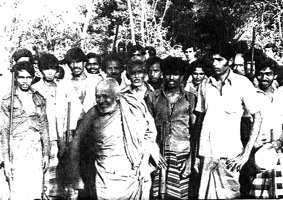 "All wars are fought for land...The plan for settlement of people in Yan Oya and Malwathu Oya basins was worked out before the communal riots of 1983. Indeed the keenest minds in the Mahaveli, some of whom are holding top international positions were the architects of this plan. My role was that of an executor...
We conceived and implemented a plan which we thought would secure the territorial integrity of Sri Lanka for a long time. We moved a large group of 45,000 land hungry (Sinhala) peasants into the Batticaloa and Polonnaruwa districts of Maduru Oya delta. The second step was to make a similar human settlement in the Yan Oya basin. The third step was going to be a settlement of a number of people, opposed to Eelam, on the banks of the Malwathu Oya.
By settling the (Sinhala) people in the Maduru Oya we were seeking to have in the Batticaloa zone a mass of persons opposed to a separate state...Yan Oya if settled by non separatists (Sinhala people) would have increased the population by about another 50,000. It would completely secure Trincomalee from the rebels..."
"The Sinhala people should know that the so called state aided 'colonisation schemes' within Tamil areas having nothing to do with solving landlessness among the Sinhala poor" - Open Letter from the Central Committee of the Liberation Tigers of Tamil Eelam, to the Sinhala people, 22 September 1991 ''The Sinhala people should know that the so called state aided 'colonisation schemes' within Tamil areas having nothing to do with solving landlessness among the Sinhala poor. The real aim of the Sri Lankan government is to use Sinhala settlers sometimes as a buffer, and sometimes as a cutting edge, in its war of aggression against the Tamil nation. The additional longer term purpose of these 'colonisation schemes' is to change the demography of the Tamil homeland and in this way, make the Tamils a manageable minority in their own land.
The Sri Lanka government has systematically armed these settlers - some of them ex-convicts - and often uses them to attack Tamil villagers in the surrounding areas... It seeks to exploit the Sinhala poor by arming them in such settlements, and using them as expendable pawns in its war of aggression again the Tamil nation. We appeal to the Sinhala poor not to become pawns in the 'colonisation schemes' which have been carefully designed by Sinhala chauvinistic forces to sow the seeds of discord and create everlasting enmity between the Tamil people and the Sinhala people.''
| 
