  INDICTMENT AGAINST SRI LANKA INDICTMENT AGAINST SRI LANKA
DESTRUCTION OF JAFFNA
PUBLIC LIBRARY - MAY/JUNE 1981 "Everyone has the right freely to participate in the cultural life of the community, to enjoy the arts and to share in scientific advance and its benefits." - Article 27.1 of the Universal Declaration of Human Rights  The Parliamentary Debate The Parliamentary Debate
Jaffna Public Library - A Konstradt for Many Tamils
History of the Jaffna Public Library
Rescuing the Library - 20 Years later , 19 August 2001
Remembering 20 Years Later - Sangam Research
யாழ்ப்பாணப் பொது நூலகம் - ஒரு வரலாற்றுத் தொகுப்பு
Destroying a Symbol: Checkered History of Sri Lanka’s Jaffna Public Library - Rebecca Knuth University of Hawaii USA, 24 August 2006
[see also Sachi Sri Kantha on Perversity of Pyromaniacs; part 1 – Revisiting the June 1981 Torching of Jaffna and Perversity of Pyromaniacs Part 2: Amirthalingam’s Speech on the Torching of Jaffna in May-June 1981]
 "...a large group of police (estimated variously from 100-200) went on rampage on the nights of May 31-June 1 (1981) and June 1-2 burning the market area of Jaffna, the office of the Tamil Newspaper, the home of the member of Parliament for Jaffna and the Jaffna Public Library... The widespread damage in Jaffna as a result of the actions of the police were evident during the visit of the ICJ observer in Jaffna in August... "...a large group of police (estimated variously from 100-200) went on rampage on the nights of May 31-June 1 (1981) and June 1-2 burning the market area of Jaffna, the office of the Tamil Newspaper, the home of the member of Parliament for Jaffna and the Jaffna Public Library... The widespread damage in Jaffna as a result of the actions of the police were evident during the visit of the ICJ observer in Jaffna in August...
The destruction of the Jaffna Public Library was the incident which appeared to cause the most distress to the people of Jaffna. The ICJ observer heard many comments from both Sinhalese and Tamils concerning the senseless destruction by arson of this most important cultural centre in the Tamil area. The Movement for Inter-racial Justice and Equality sent a delegation to Jaffna to investigate the June occurrences. The delegations report, in referring to the arson of the Public Library, stated, If the Delegation were asked which act of destruction had the greatest impact on the people of Jaffna, the answer would be the savage attack on this monument to the learning and culture and the desire for learning and culture of the people of Jaffna... There is no doubt that the destruction of the Library will leave bitter memories behind for many years.... The 95,000 volumes of the Public Library destroyed by the fire included numerous culturally important and irreplaceable manuscripts... The government should lead a major national and international effort to rebuild and develop the Jaffna Public Library destroyed by arson by police in June 1981. Such an effort would evidence the respect the government for the cultural rights of the Tamils, help to remedy a serious injustice done to the Tamil community and contribute to restoring Tamil confidence in the government... A primary concern of the government should be the physical security of the minority Tamil population and the avoidance of future communal violence so frequently directed against Tamils in the past... In this regard the government should pursue a vigorous policy of investigation and prosecution of police officers responsible for the burning of many areas in Jaffna in May/June 1981". - Virginia Leary: Ethnic Conflict and Violence in Sri Lanka - Report of a Mission to Sri Lanka on behalf of the International Commission of Jurists, July/August 1981
Burnt out shell of the Jaffna Public Library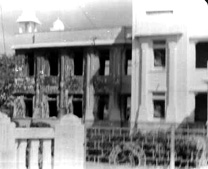
"With several high ranking Sinhalese security officers and two cabinet ministers, Cyril Mathew and Gamini Dissanayake (both self confessed Sinhala supremacists), present in the town (Jaffna), uniformed security men and plainclothes thugs carried out some well organised acts of destruction.
They burned to the ground certain chosen targets - including the Jaffna Public Library, with its 95,000 volumes and priceless manuscripts, a Hindu temple, the office and machinery of the independent Tamil daily newspaper Eelanadu.. Four people were killed outright. No mention of this appeared in the national newspapers, not even the burning of the Library, the symbol of the Tamils' cultural identity. The government delayed bringing in emergency rule until 2 June, by which time key targets had been destroyed. - Nancy Murray, the State against the Tamils in Sri Lanka - Racism and the Authoritarian State - Race & Class , Summer 1984
''More than 100 shops have been broken, burnt, looted; market squares in Jaffna and Chunnakam look as if they have been bombed in wartime; several houses have been looted and badly damaged; the house of the MP for Jaffna has been reduced to ruins; several deaths have occurred at the hands of the state armed personnel; the headquarters of the Tamil United Liberation Front in the heart of Jaffna has been destroyed; the public library in Jaffna - the second largest library in the island with over 90,000 volumes - has been reduced to ashes.
Even more reprehensible are the facts that these outrages should have taken place when cabinet ministers and several leaders of the security services were personally present in Jaffna directing affairs, and that a section of the security services, which had been sent there to maintain law and order, had been directly involved.'' - Statement of Sri Lanka Opposition Parties,in June 1981 quoted in Satchi Ponnambalam,Sri Lanka, the National Question and the Tamil Liberation Struggle, Zed, 1983
 "Today its rooms are thickly carpeted with half burnt pages, fluttering in the breeze which comes through broken windows. Inspecting the charred remains, I met a heart broken lecturer from the local teacher training college. 'The Sinhalese were jealous of the library, he said. 'I used to come here every day to prepare lectures and tutorials. Now I shall have to go to Colombo and some of these books aren't available even there'." - Francis Whelen, New Statesman and Nation, 17 July 1981, visiting Jaffna soon after the destruction of the Library "Today its rooms are thickly carpeted with half burnt pages, fluttering in the breeze which comes through broken windows. Inspecting the charred remains, I met a heart broken lecturer from the local teacher training college. 'The Sinhalese were jealous of the library, he said. 'I used to come here every day to prepare lectures and tutorials. Now I shall have to go to Colombo and some of these books aren't available even there'." - Francis Whelen, New Statesman and Nation, 17 July 1981, visiting Jaffna soon after the destruction of the Library
"It is regrettable that the government did not institute an independent investigation to establish responsibility for these killings (in May/June 1981) and take measures against those responsible. Instead, one police officer involved was promoted and emergency legislation was introduced facilitating further killings." - Orville H.Schell, Chairman of the Americas Watch Committee, and Head of the Amnesty International 1982 fact finding mission to Sri Lanka
''During the District Development Council elections in 1981, some of our party members took many people from other parts of the country to the North, created havoc and disrupted the conduct of elections in the North. It is this same group of people who are causing trouble now also. If you wish to find out who burnt the priceless collection of books at the Jaffna Library, you have only to look at the faces of those opposing us.'' - Sri Lanka President Premadasa speaking at a Muslim College in Puttalam in October 1991 in the aftermath of the impeachment resolution against him sponsored by UNP dissidents led by Mr.Lalith Athulathamudalai and Mr. Gamini Dissanayake.
The Parliamentary Debate ''The TULF MPs took their battle into parliament. They moved a vote of no confidence in the government, on the grounds that the May-June 1981 violence in Jaffna had been state sponsored and carried out by Sinhalese Ministers and high ranking government officials present on the spot.
The government responded by going on the offensive. What followed was the most racially poisonous verbal vendetta in Sri Lanka's parliamentary history. In the debate that followed one Sinhalese MP called for the return of the traditional death penalty which 'tears the offender's body limb by limb'.
They sought to remove the (Tamil) Leader of the Opposition. To general amazement they brought in a motion of no confidence in him on the grounds that he did not 'enjoy the confidence of the Government'!.. The Speaker overruled a point of order that the motion was not within the powers of the House.'' - Satchi Ponnamblam, Sri Lanka: The National Question and the Tamil Liberation Struggle, Zed 1983
"If there is discrimination in this land which is not their (Tamil) homeland, then why try to stay here.Why not go back home (India) where there would be no discrimination. There are your kovils and Gods.There you have your culture, education, universities etc. There you are masters of your own fate....
If the sleeping Sinhalese wake up to see the Tamils trying to establish a Tamil Eelam in Sri Lanka, then things may not be quite calm. It would be advisable for the Tamils not to disturb the sleeping Sinhala brother. Everybody knows that lions when disturbed are not peaceful." - Mr.W.J.M. Lokubandara, M.P. in Sri Lanka's Parliament, July 1981
"If we are governing, we must govern. If we are ruling, we must rule. Do not give into the minorities. We are born as Sinhalese and as Buddhists in this country. Though we are in a majority, we have been surrendering to the minority community for four years. Let us rule as a majority community". - Mrs. Wimala Kannangara M.P., Minister for Rural Development, in Sri Lanka's Parliament, July 1981
"Now, Sir... what should we do to this so called leader of the Tamils? If I were given the power, I would tie him to the nearest concrete post in this building and horsewhip him till I raise him to his wits. Thereafter let anybody do anything he likes - throw him into the Beire (lake) or into the sea, because he will be so mutilated that I do not think there will be life in him. That is war." - Mr.D.M. Chandrapala, Sinhala M.P. for Kundasale in Sri Lanka's Parliament, July 1981
"Since yesterday morning, we have heard in this honourable House about the various types of punishment that should be meted out to them (Tamil Parliamentary leaders).
The MP for Panadura (Dr Neville Fernando) said there was a punishment during the time of the Sinhalese kings, namely, two arecanut posts are erected, the two posts are then drawn toward each other with a rope, then tie each of the feet of the offender to each post and then cut the rope which result in the tearing apart the body. These people also should be punished in the same way..
...some members suggested that they should be put to death on the stake; some other members said that their passports shouldbe confiscated; still other members said that they should be stood at the Galle Face Green and shot. The people of this country want and the government is prepared to inflict these punishments on these people." - Mr. G.V.Punchinilame, Sinhala M.P. for Ratnapura in Sri Lanka's Parliament, July 1981. | 
