SRI LANKA'S LAWS Sri Lanka Constitution 1978 Certified on 31 August 1978
[with Amendments 1-16 Consolidated as of September 2000]  Preamble Preamble
Chapter I - The People, The State and Sovereignty
Chapter II - Buddhism
Chapter III - Fundamental Rights
Chapter IV - Language
Chapter V - Citizenship
Chapter VI - Directive Principles of State Policy and Fundamental Duties
Chapter VII - The Executive
Chapter VIII - The Executive - The Cabinet of Ministers
Chapter IX - The Executive - The Public Service
Chapter X - The Legislature - Parliament
Chapter XI - The Legislature - Procedure and Powers
Chapter XII - The Legislature - Amendment of the Constitution
Chapter XIII - The Referendum
Chapter XIV - Franchise and Elections
Chapter XV - The Judiciary
Chapter XVI - The Superior Courts
Chapter XVII - Finance
Chapter XVIIA - Provincial Councils
Chapter XVIII - Public Security
Chapter XIX - The Parliamentary Commissioner for Administration
Chapter XX - General
Chapter XXI - Transitional Provisions
Chapter XXII - Interpretation
Chapter XXIII - Repeal
Chapter XXIV - Promulgation of the Constitution
First Schedule - Names of Administrative Districts
Second Schedule - The National Flag
Third Schedule - National Anthem (in Sinhala)
Fourth Schedule - Oath of Office
Fifth Schedule
Sixth Schedule
Seventh Schedule

SVASTI The PEOPLE OF SRI LANKA having, by their Mandate freely expressed and granted on the sixth day of the waxing moon in the month of Adhi Nikini in the year two thousand five hundred and twenty-one of the Buddhist Era (being Thursday the twenty-first day of the month of July in the year one thousand nine hundred and seventy-seven), entrusted to and empowered their Representatives elected on that day to draft, adopt and operate a new Republican Constitution in order to achieve the goals of a DEMOCRATIC SOCIALIST REPUBLIC, and having solemnly resolved by the grant of such Mandate and the confidence reposed in their said Representatives who were elected by an overwhelming majority, to constitute SRI LANKA into a DEMOCRATIC SOCIALIST REPUBLIC whilst ratifying the immutable republican principles of REPRESENTATIVE DEMOCRACY, and assuring to all peoples FREEDOM, EQUALITY, JUSTICE, FUNDAMENTAL HUMAN RIGHTS and the INDEPENDENCE OF THE JUDICIARY as the intangible heritage that guarantees the dignity and well-being of succeeding generations of the People of SRI LANKA and of all the people of the World, who come to share with those generations the effort of working for the creation and preservation of a JUST AND FREE SOCIETY: WE, THE FREELY ELECTED REPRESENTATIVES OF THE PEOPLE OF SRI LANKA, in pursuance of such Mandate, humbly acknowledging our obligations to our People and gratefully remembering their heroic and unremitting struggle to regain and preserve their rights and privileges so that the Dignity and Freedom of the Individual may be assured, Just, Social, Economic and Cultural Order attained' the Unity of the Country restored, and Concord established with other Nations, do hereby adopt and enact this
CONSTITUTION
as the
SUPREME LAW
of the
DEMOCRATIC SOCIALIST REPUBLIC OF SRI LANKA
Chapter I - The People, The State and Sovereignty The State.
1. Sri Lanka (Ceylon) is a free, Sovereign, Independent and Democratic Socialist Republic and shall be known as the Democratic Socialist Republic of Sri Lanka.
Unitary State.
2. The Republic of Sri Lanka is a Unitary State.
Sovereignty of the People.
3. In the Republic of Sri Lanka sovereignty is in the people and is inalienable. Sovereignty includes the powers of government, fundamental rights and the franchise.
Exercise of Sovereignty.
4. The Sovereignty of the People shall be exercised and enjoyed in the following manner :-
(a) the legislative power of the People shall be exercised by Parliament, consisting of elected representatives of the People and by the People at a Referendum;
(b) the executive power of the People including the defence of Sri Lanka, shall be exercised by the President of the Republic elected by the People;
(c) the judicial power of the People shall be exercised by Parliament through courts, tribunals and institutions created and established, or recognized, by the Constitution, or created and established by law, except in regard to matters relating to the privileges, immunities and powers of Parliament and of its Members, wherein the judicial power of the People may be exercised directly by Parliament according to law;
(d) the fundamental rights which are by the Constitution declared and recognized shall be respected, secured and advanced by all the organs of government, and shall not be abridged, restricted or denied, save in the manner and to the extent hereinafter provided; and
(e) the franchise shall be exercisable at the election of the President of the Republic and of the Members of Parliament, and at every Referendum by every citizen who has attained the age of eighteen years, and who being qualified to be an elector as hereinafter provided, has his name entered in the register of electors.
Territory of the Republic.
5. The territory of the Republic of Sri Lanka shall consist of the 1[twenty-five] administrative districts, the names of which are set out in the First Schedule, and its 2[territorial waters: Provided that such administrative districts may be subdivided or amalgamated so as to constitute different administrative districts, as Parliament may by resolution determine].
The National Flag.
6. The National Flag of the Republic of Sri Lanka shall be the Lion Flag depicted in the Second Schedule.
The National Anthem.
7. The National Anthem of the Republic of Sri Lanka shall be "Sri Lanka Matha," the words and music of which are set out in the Third Schedule.
The National Day.
8. The National Day of the Republic of Sri Lanka shall be the fourth day of February.
Chapter II - Buddhism Buddhism 9. The Republic of Sri Lanka shall give to Buddhism the foremost place and accordingly it shall be the duty of the State to protect and foster the Buddha Sasana, while assuring to all religions the rights granted by Articles 10 and 14(1)(e).
Chapter III - Fundamental Rights Freedom of thought, conscience and religion 10. Every person is entitled to freedom of thought, conscience and religion, including the freedom to have or to adopt a religion or belief of his choice. Freedom from torture 11. No person shall be subjected to torture or to cruel, inhuman or degrading treatment or punishment. Right to equality 12. (1) All persons are equal before the law and are entitled to the equal protection of the law. (2) No citizen shall be discriminated against on the grounds of race, religion, language, caste, sex, political opinion, place of birth or any such grounds: Provided that it shall be lawful to require a person to acquire within a reasonable time sufficient knowledge of any language as a qualification for any employment or office in the Public, Judicial or Local Government Service or in the service of any public corporation, where such knowledge is reasonably necessary for the discharge of the duties of such employment or office: Provided further that it shall be lawful to require a person to have sufficient knowledge of any language as a qualification for any such employment of office where no function of that employment or office can be discharged otherwise than with a knowledge of that language. (3) No person shall, on the grounds of race, religion, language, caste, sex or any one such grounds, be subject to any disability, liability, restriction or condition with regard to access to shops, public restaurants, hotels, places of public entertainment and places of public worship of his own religion. (4) Nothing in this Article shall prevent special provision being made, by law, subordinate legislation or executive action, for the advancement of women, children or disabled persons. Freedom of speech, assembly, association, occupation, movement, &c 13 (1) No person shall be arrested except according to procedure established by law. Any person arrested shall be informed of the reason for his arrest. (2) Every person held in custody, detained or otherwise deprived of personal liberty shall be brought before the judge of the nearest competent court according to procedure established by law, and shall not be further held in custody, detained or deprived of personal liberty except upon and in terms of the order of suet. judge made in accordance with procedure established by law. (3) Any person charged with an offence shall he entitled to be heard, in person or by an attorney-at-law at a fair trial by a competent court. (4) No person shall be punished with death or imprisonment except by order of a competent court, made in accordance with procedure established by law. The arrest, holding in custody, detention or other deprivation of personal liberty of a person, pending investigation or trial, shall not constitute punishment. (5) Every person shall be presumed innocent until he is proved guilty: provided that the burden of proving particular facts may, , be placed on an accused person. (6) No person shall be held guilty of an offence on account of any act or omission which did not, at the time of such act or omission, constitute such an offence, and no penalty shall be imposed for any offence more severe than the penalty in force at the time such offence was committed. Nothing in this Article shall prejudice the trial and punishment of any person for any act or omission which, at the time when it was committed, was criminal according to the general principles of law recognised by the community of nations. It shall not be a contravention of this Article to require the imposition of a minimum penalty for an offence provided that such penalty does not exceed the maximum penalty prescribed for such offence at the time such offence was committed.
(7) The arrest' holding in custody, detention or other deprivation of personal liberty of a person, by reason of a removal order or a deportation order made under the provisions of the Immigrants and Emigrants Act or the Indo-Ceylon Agreement (Implementation) Act, No. 14 of 1967, or such other law as may be enacted in substitution therefor, shall not be a contravention of this Article. 14. (1) Every citizen is entitled to - - (a) the freedom of speech and expression including publication;
- (b) the freedom of peaceful assembly;
- (c) the freedom of association;
- (d) the freedom to form and join a trade union;
- (e) the freedom, either by himself or in association with others, and either in public or in private, to manifest his religion or belief in worship, observance, practice or teaching;
- (f) the freedom by himself or in association with others to enjoy and promote his own culture and to use his own language;
- (g) the freedom to engage by himself or in association with others in any lawful occupation, profession, trade, business or enterprise;
- (h) the freedom of movement and of choosing his residence within Sri Lanka; and
- (i) the freedom to return to Sri Lanka.
(2) A person who, not being a citizen of any other country, has been permanently and legally resident in Sri Lanka immediately prior to the commencement of the Constitution and continues to be so resident shall be entitled, for a period of ten years from the commencement of the Constitution, to the rights declared and recognised by paragraph (1) of this Article. 15. (1) The exercise and operation of the fundamental rights declared and recognised by Articles 13 (5) and 13 (6) shall be subject only to such restrictions as may be prescribed by law in the interests of national security. For the of this paragraph includes regulations made under the law for the time being to public security. (2) The exercise and operation of the fundamental right declared and recognised by Article 14(1) (a) shall be subject to such restrictions as may be prescribed by law in the interests of racial and religious harmony or in relation to parliamentary privilege, contempt of court, defamation or incitement to an offence. (3) The exercise and operation of the fundamental right declared and recognised by Article 14(1) (b) shall be subject to such restrictions as may be prescribed by law in the interests of racial and religious harmony. (4) The exercise and operation of the fundamental right declared and recognised by Article 14(1) (c) shall be subject to such restrictions as may be prescribed by law in the interests, of racial and religious harmony or national economy. (5) The exercise and operation of the fundamental right declared and recognised by Article 14 (1) (g) shall be subject to such restrictions as may be prescribed by law in the interests, of national economy or in relation to (a) the professional, technical, academic, financial and other qualifications necessary for practising any profession or carrying on any occupation, trade, business or enterprise' and the licensing and disciplinary control of the person entitled to such fundamental right, and (b) the carrying on by the State, a State agency or a public corporation of any trade, business,, industry, service or enterprise whether to the exclusion. complete or partial, of citizens or otherwise.
(6) The exercise and operation of the fundamental right declared and recognised by Article 14 (1) (h) shall be subject to such restrictions as may be prescribed by law the interests of national economy. (7) The exercise and operation of all the fundamental rights declared and recognised by Articles 12, 13(1) 13(2) and 14 shall be subject to such restrictions as may be prescribed by law in the interests of national security, public order and the protection of public health or morality, or for the purpose of securing due recognition and respect for the rights and freedoms of others, or of meeting the just. requirements of the general welfare of a democratic society. For the purposes of this paragraph " law " includes regulations made under the law for the time being relating to public security. (8) The exercise and operation of the fundamental rights declared and recognised by Articles 12(1), 13 and 14 shall, in their application to the members of the Armed Forces, Police Force and other Forces charged with the maintenance of public order, be subject to such restrictions as may be prescribed by law in the interests of the proper discharge of their duties and the maintenance of discipline among them. 16. (1) All existing written law and unwritten law shall be valid and operative notwithstanding any inconsistency with the preceding provisions of this Chapter. (2) The subjection of any person on the order of a competent court to any form of punishment recognised by any existing written law shall not be a contravention of the provisions of this Chapter. 17. Every person shall be entitled to apply to the Supreme Court, as provided by Article 126, in respect of the infringement or imminent infringement, by executive or administrative action, of a fundamental right to which I such person is entitled under the provisions of this Chapter.
Chapter IV - Language Official Language.
18. 3[(1)] The Official Language of Sri Lanka shall be Sinhala.
4[(2) Tamil shall also be an official language.
(3) English shall be the link language.
(4) Parliament shall by law provide for the implementation of the provisions of this Chapter].
National Languages.
19. The National Languages of Sri Lanka shall be Sinhala and Tamil.
Use of National Languages in Parliament and local authorities.
20. A Member of Parliament or 5[a member of a Provincial Council or a local authority] shall be entitled to perform his duties and discharge his functions in Parliament 6[or in such Provincial Council or local authority] in either of the National Languages.
Medium of instruction.
21. (1) A person shall be entitled to be educated through the medium of either of the National Languages:
Provided that the provisions of this paragraph shall not apply to an institution of higher education where the medium of instruction is a language other than a National Language.
(2) Where one National Language is a medium of instruction for or in any course, department or faculty of any University directly or indirectly financed by the State, the other National Language shall also be made a medium of instruction for or in such course, department or faculty for students who prior to their admission to such University, were educated through the medium of such other National Language:
Provided that compliance with the preceding provisions of this paragraph shall not be obligatory if such other National Language is the medium of instruction for or in any like course, department or faculty either at any other campus or branch of such University or of any other like University.
(3) In this Article "University" includes any institution of higher education.
7[Languages of administration.
22. (1) Sinhala and Tamil shall be the languages of administration through out Sri Lanka and Sinhala shall be the language of administration and be used for the maintenance of public records and the transaction of all business by public institutions of all the provinces of Sri Lanka other than the Northern and Eastern Provinces where Tamil shall be so used.
Provided that the President may, having regard to the proportion which the Sinhala or Tamil linguistic minority population in any unit comprising a division of an Assistant Government Agent, bears to the total population of that area, direct that both Sinhala and Tamil or a language other than the language used as the language of administration in the province in which such area may be situated, be used as the language of administration for such area.
(2) In any area where Sinhala is used as the language of administration a person other than an official acting in his official capacity, shall be entitled:
(a) to receive communications from, and to communicate and transact business with, any official in his official capacity, in either Tamil or English;
(b) if the law recognizes his right to inspect or to obtain copies of or extracts from any official register, record, publication or other document, to obtain a copy of, or an extract from such register, record, publication or other document, or a translation thereof, as the case may be, in either Tamil or English;
(c) where a document is executed by any official for the purpose of being issued to him, to obtain such document or a translation thereof, in either Tamil or English;
(3) In any area where Tamil is used as the language of administration, a person other than an official acting in his official capacity, shall be entitled to exercise the rights, and to obtain the services, referred to in sub paragraphs (a), (b) and (c) of paragraph (2) of this Article, in Sinhala or English.
(4) A Provincial Council or a local authority which conducts its business in Sinhala shall be entitled to receive communications from and to communicate and transact business with, any official in his official capacity, in Sinhala, and a Provincial Council or a local authority which conducts its business in Tamil shall be entitled to receive communications from and to communicate and transact business with, any official in his official capacity, in Tamil :
Provided, however, that a Provincial Council, local authority, public institution or any official receiving communications from transacting business with any other or Provincial Council, local authority, public institution or an official functioning in an area in which a different language is used as the Language of administration shall be entitled to receive communications from and to communicate and transact business in English.
(5) A person shall be entitled to be examined through the medium of either Sinhala or Tamil or a language of his choice at any examination for the admission of persons to the Public Service, Judicial Service, Provincial Public Service, Local Government Service or any public institution, subject to the condition that he may be required to acquire a sufficient knowledge of Tamil or Sinhala, as the case may be, within a reasonable time after admission to such service or public institution where such knowledge is reasonably necessary for the discharge of his duties:
Provided that a person may be required to have a sufficient knowledge of Sinhala or Tamil, as a condition for admission to any such service or public institution where no function of the office or employment for which he is recruited can be discharged otherwise than with a sufficient knowledge of such language.
(6) in this Article :-
"Official" means the President, any Minister, Deputy Minister, Governor, Chief Minister or Minister of the Board of Ministers of a Province, or any officer of a public institution; local authority or Provincial Council; and
"Public institution" means a department or institution of the Government, a public corporation or statutory institution.]
Language of Legislation.
8[23. (1) All laws and subordinate legislation shall be enacted or made and published in Sinhala and Tamil, together with a translation thereof in English:
Provided that Parliament shall, at the stage of enactment of any law determine which text shall prevail in the event of any inconsistency between texts.
Provided further that in respect of all other written laws and the text in which such written laws was enacted or adopted or made, shall prevail in the event of any inconsistency between such texts:
(2) All Orders, Proclamations, rules, by-laws, regulations and notifications made or issued under any written law other than by a Provincial Council or a local authority, and the Gazette shall be published in Sinhala and Tamil together with a translation thereof in English.
(3) All Orders, Proclamations, rules, by-laws, regulations and notifications made or issued under any written law by any Provincial Council or local authority, and all documents, including circulars and forms issued by such body or any public institution shall be published in the Language used in the administration in the respective areas in which they function, together with a translation thereof in English.
(4) All laws and subordinate legislation in force immediately prior to the commencement of the Constitution, shall be published in the Gazette in the Sinhala and Tamil Language as expeditiously as possible.]
Language of the courts.
24. 9[(1) Sinhala and Tamil shall be the languages of the Courts throughout Sri Lanka and Sinhala shall be used as the language of the courts situated in all the areas of Sri Lanka except those in any area where Tamil is the language of administration. The record and proceedings shall be in the language of the Court. In the event of an appeal from any court records shall also be prepared in the language of the court hearing the appeal, if the language of such court is other than the language used by the court from which the appeal is preferred:
Provided that the Minister in charge of the subject of Justice may, with the concurrence of the cabinet of Ministers direct that the record of any court shall also be maintained and the proceedings conducted in a language other than the language of the court;]
(2) Any party or applicant or any person legally entitled to represent such party or applicant may initiate proceedings, and submit to court pleadings and other documents, and participate in the proceedings in court, 10[in either Sinhala or Tamil.]
(3) Any judge, juror, party or applicant or any person legally entitled to represent such party or applicant, who is not conversant with the language used in a court, shall be entitled to interpretation and to translation into 11[Sinhala or Tamil] provided by the State, to enable him to understand and participate in the proceedings before such court, and shall also be entitled to obtain in 12[such language] or any such part of the record or a translation thereof, as the case may be, as he may be entitled to obtain according to law.
(4) The Minister in charge of the subject of Justice may, with the concurrence of the Cabinet of Ministers, issue, directions permitting 13[The use of English] in or in relation to the records and proceedings in any court for all purposes or for such purposes as may be specified therein. Every judge shall be bound to implement such directions.
(5) In this Article -
"Court" means any court or tribunal created and established for the administration of justice including the adjudication and settlement of industrial and other disputes, or any other tribunal or institution exercising judicial or quasi-judicial functions or any tribunal or institution created and established for the conciliation and settlement of disputes :
"judge" includes the President, Chairman, presiding officer and member of any court; and
"record" includes pleadings, judgments, orders and other judicial and ministerial acts.
Provision for adequate facilities for use of languages provided for in this Chapter.
25. The State shall provide adequate facilities for the use of the languages provided for in this Chapter.
Provision of any law inconsistent with this Chapter deemed to be repealed.
14[25a. In the event of any inconsistency between the provisions of any law and the provisions of this Chapter, the provisions of this Chapter shall prevail.]
Chapter V - Citizenship Citizenship of Sri Lanka 26. (1) There shall be one status of citizenship known as "the status of a citizen of Sri Lanka." (2) A citizen of Sri Lanka shall for all purposes be described only as a "citizen of Sri Lanka," whether such person became entitled to citizenship by descent or by virtue of registration in accordance with the law relating to citizenship. (3) No distinction shall be drawn between citizens of Sri Lanka for any purpose by reference to the mode of acquisition of such status, as to whether acquired by descent or by virtue of registration. (4) No citizen of Sri Lanka shall be deprived of his status of a citizen of Sri Lanka, except under and by virtue of the provisions of sections 19, 20, 21 and 22 of the Citizenship Act: Provided that the provisions of sections 23 and 24 of that Act shall also be applicable to a person who became entitled to the status of a citizen of Sri Lanka by virtue of registration under the provisions of section 11, 12 or 13 of that Act. (5) Every person who immediately prior to the commencement of the Constitution was a citizen of Sri Lanka, whether by descent or by virtue of registration in accordance with any law relating to citizenship, shall be entitled to the status and to the rights of a citizen of Sri Lanka as provided in the preceding provisions of this Article. (6) The provisions of all existing written laws relating to citizenship and all other existing written laws wherein reference is made to citizenship shall be read subject to the preceding provisions of this Article.
Chapter VI - Directive Principles of State Policy and Fundamental Duties Directive Principles of State Policy.
27. (1) The Directive Principles of State Policy herein contained shall guide Parliament, the President and the Cabinet of Ministers in the enactment of laws and the governance of Sri Lanka for the establishment of a just and free society.
(2) The State is pledged to establish in Sri Lanka a democratic socialist society, the objectives of which include -
(a) the full realization of the fundamental rights and freedoms of all persons;
(b) the promotion of the welfare of the People by securing and protecting as effectively as it may, a social order in which justice (social, economic and political) shall guide all the institutions of the national life ;
(c) the realization by all citizens of an adequate standard of living for themselves and their families, including adequate food, clothing and housing, the continuous improvement of living conditions and the full enjoyment of leisure and social and cultural opportunities ;
(d) the rapid development of the whole country by means of public and private economic activity and by laws prescribing such planning and controls as may be expedient for directing and coordinating such public and private economic activity towards social objectives and the public weal ;
(e) the equitable distribution among all citizens of the material resources of the community and the social product, so as best to subserve the common good ;
(f) the establishment of a just social order in which the means of production, distribution and exchange are not concentrated and centralised in the State, State agencies or in the hands of a privileged few, but are dispersed among, and owned by, all the People of Sri Lanka ;
(g) raising the moral and cultural standards of the People, and ensuring the full development of human personality ; and
(h) the complete eradication of illiteracy and the assurance to all persons of the right to universal and equal access to education at all levels.
(3) The State shall safeguard the independence, sovereignty, unity and the territorial integrity of Sri Lanka.
(4) The State shall strengthen and broaden the democratic structure of government and the democratic rights of the People by decentralizing the administration and by affording all possible opportunities to the People to participate at every level in national life and in government.
(5) The State shall strengthen national unity by promoting co-operation and mutual confidence among all sections of the People of Sri Lanka, including the racial, religious, linguistic and other groups, and shall, take effective steps in the fields of teaching, education and information in order to eliminate discrimination and prejudice.
(6) The State shall ensure equality of opportunity to citizens, so that no citizen shall suffer any disability on the ground of race, religion, language, caste, sex, political opinion or occupation.
(7) The State shall eliminate economic and social privilege and disparity, and the exploitation of man by man or by the State.
(8) The State shall ensure that the operation of the economic system does not result in the concentration of wealth and the means of production to the common detriment.
(9) The State shall ensure social security and welfare.
(10) The State shall assist the development of the cultures and the languages of the People.
(11) The State shall create the necessary economic and social environment to enable people of all religious faiths to make a reality of their religious principles.
(12) The State shall recognize and protect the family as the basic unit of society.
(13) The State shall promote with special care the interests of children and youth, so as to ensure their full development, physical, mental, moral, religious and social, and to protect them from exploitation and discrimination.
(14) The State shall protect, preserve and improve the environment for the benefit of the community.
(15) The State shall promote international peace, security and co-operation, and the establishment of a just and equitable international economic and social order, and shall endeavour to foster respect for international law and treaty obligations in dealings among nations.
Fundamental duties
28. The exercise and enjoyment of rights and freedoms is inseparable from the performance of duties and obligations, and accordingly it is the duty of every person in Sri Lanka -
(a) to uphold and defend the Constitution and the law ;
(b) to further the national interest and to foster national unity ;
(c) to work conscientiously in his chosen occupation ;
(d) to preserve and protect public property, and to combat misuse and waste of public property ;
(e) to respect the rights and freedoms of others ; and
(f) to protect nature and conserve its riches.
Principles of State Policy and fundamental duties not justiciable.
29. The provisions of this Chapter do not confer or impose legal rights or obligations, and are not enforceable in any court or tribunal. No question of inconsistency with such provisions shall be raised in any court or tribunal.
Chapter VII - The Executive The President of the Republic.
30. (1) There shall be a President of the Republic of Sri Lanka, who is the Head of the State, the Head of the Executive and of the Government, and the Commander-in-Chief of the Armed Forces.
(2) The President of the Republic shall be elected by the people, and shall hold office for a term of six years.
The election and the term of office of President.
31. (1) Any citizen who is qualified to be elected to the office of President may be nominated as a candidate for such office -
(a) by a recognized political party, or
(b) if he is or has been an elected member of the legislature, by any other political party or by an elector whose name has been entered in any register of electors.
(2) No person who has been twice elected to the office of President by the People shall be qualified thereafter to be elected to such office by the People.
(3) The poll for the election of the President shall be taken not less than one month and not more than two months before the expiration of the term of office of the President in office.
15[(3a) (i) Notwithstanding anything to the contrary in the preceding provisions of this Chapter, the President may, at any time after the expiration of four years from the commencement of his first term of office, by Proclamation, declare his intention of appealing to the People for a mandate to hold office, by election, for a further term.
(ii) Upon the making of a Proclamation under sub-paragraph (i) the Commissioner of Elections shall be required to take a poll for the election of the President.
(b) If, at any time after the date of Proclamation referred to in paragraph (a) and before the close of the poll at the election held in pursuance of such Proclamation, the President in office dies, such Proclamation shall be deemed to have been revoked with effect from the date of such death and the election to be held in pursuance of such Proclamation shall be deemed to be cancelled. The vacancy in the office of President caused by such death shall be filled in accordance with the provisions of Article 40.
(c) (i) If, at any time between the close of the poll at an election held under this paragraph and the declaration of the result of such election, a candidate at such election dies, the Commissioner of Elections shall proceed with the count and declare the result of such election, notwithstanding the death of such candidate.
(ii) If the person entitled to be declared elected as President is dead at the time of the declaration of the result of such election, the Commissioner of Elections shall not declare the result of such election but shall take a fresh poll for the election of the President.
(iii) If by reason of the death referred to in sub-paragraph (i) there is a vacancy in the office of President, the Prime Minister shall act in the office of President during the period between the occurrence of such vacancy and the assumption of office by the new President and shall appoint one of the other Ministers of the Cabinet to act in the office of Prime Minister :
Provided that if the office of Prime Minister be then vacant or the Prime Minister is unable to act, the Speaker shall act in the office of President.
(d) The person declared elected as President at an election held under this paragraph shall, if such person –
(i) is the President in office, hold office for a term of six years commencing on such date in the year in which that election is held (being a date after such election) or in the succeeding year, as corresponds to the date on which his first term of office commenced, whichever date is earlier ; or
(ii) is not the President in office, hold office for a term of six years commencing on the date on which the result of such election is declared.
(e) A person succeeding to the office of President under the provisions of Article 40 shall not be entitled to exercise the right conferred on a President by sub-paragraph (a) of this paragraph.
(f) For the purposes of this paragraph, the first term of office of the first President referred to in Article 160 shall be deemed to have commenced on February 4, 1978.]
16[(4) (Where a poll for the election of a President is taken, the term of office of the person elected as President at such election shall commence on the expiration of the term of office of the President in office :
Provided that notwithstanding anything to the contrary in Article 40 –
(a) if any person declared elected as President at a poll for the election of a President dies at any time after his being declared elected as President, and before the date on which his term of office would, but for his death, have commenced, the Commissioner of Elections, shall take a fresh poll for the election of a President. If the date fixed for such fresh poll is a date later than such first-mentioned date, the term of office of the person declared elected at such poll shall, notwithstanding the preceding provisions of this Article, be deemed to have commenced on such first-mentioned date. For the purposes only of Article 38 (1) (d), the date of commencement of the term of office of the new President shall be the date of his election ;
(b) where the President in office is not a candidate or is not re-elected, at a poll for the election of a President, his term of office shall be deemed to have expired on the date on which the result of such election is declared. The person elected as President at such election shall assume office forthwith, but not later than two weeks from such date :
Provided that the President in office, notwithstanding anything to the contrary in Article 30, shall continue to exercise, perform and discharge the powers, duties and functions of the office of President until the assumption of office by the person declared elected as President. If the office of President becomes vacant, by reason of the person declared elected as President failing to assume office, the President in office shall continue to exercise, perform and discharge the powers, duties and functions of the office of President, until the Prime Minister or if the office of Prime Minister be then vacant or if the Prime Minister be unable to act, the Speaker commences to act in the office of President in terms of Article 40 ;
(c) if by reason of the death referred to in sub-paragraph (a) there is a vacancy in the office of President, the Prime Minister shall act in the office of President during the period between the occurrence of such vacancy and the assumption of office by the new President and shall appoint one of the other Ministers of the Cabinet to act as Prime Minister:
Provided that if the office of Prime Minister be then vacant or the Prime Minister is unable to act, the Speaker shall act in the office of President. ]
(5) The election of the President shall be conducted by the Commissioner of Elections who shall fix the date for the nomination of candidates for such election and the date on which the poll shall be taken.
(6) Parliament shall by law make provision for -
(a) the nomination of candidates for the election of President ;
(b) the register of electors to be used at and the procedure for the election of the President ;
(c) the creation of offences relating to such election and the punishment therefor ;
(d) the grounds and manner of avoiding such election and of determining any disputed election ; and
(e) all other matters necessary or incidental thereto.
Assumption of office.
32. (1) The person elected or succeeding to the office of President shall assume office upon taking and subscribing the oath or making and subscribing the affirmation, set out in the Fourth Schedule, in Sri Lanka before the Chief Justice or any other Judge of the Supreme Court.
(2) Upon such assumption of office the President shall cease to hold any other office created or recognized by the Constitution and if he is a Member of Parliament, shall vacate his seat in Parliament. The President shall not hold any other office or place of profit whatsoever.
(3) The President shall, by virtue of his office, have the right at any time to attend, address and send messages to Parliament. In the exercise of such right the President shall be entitled to all the privileges, immunities and powers, other than the right to vote, of a Member of Parliament and shall not be liable for any breach of the privileges of Parliament, or of its Members.
Powers and functions of the President.
33. In addition to the powers and functions expressly conferred on or assigned to him by the Constitution or by any written law whether enacted before or after the commencement of the Constitution, the President shall have the power -
(a) to make the Statement of Government Policy in Parliament at the commencement of each session of Parliament ;
(b) to preside at ceremonial sittings of Parliament ;
(c) to receive and recognize, and to appoint and accredit, Ambassadors, High Commissioners, Plenipotentiaries and other diplomatic agents ;
17[(cc) to appoint as President’s Counsel, attorneys-at-law who have reached eminence in the profession and have maintained high standards of conduct and professional rectitude. Every President’s Counsel appointed under this paragraph shall be entitled to all privileges as were hitherto enjoyed by a Queen’s Counsel ;]
(d) to keep the Public Seal of the Republic, and to make and execute under the Public Seal, the Acts of Appointment of the Prime Minister and other Ministers of the Cabinet of Ministers, the Chief Justice and other Judges of the Supreme Court, such grants and dispositions of lands and immovable property vested in the Republic as he is by law required or empowered to do, and to use the Public Seal for sealing all things whatsoever that shall pass that Seal ;
(e) to declare war and peace ; and
(f) to do all such acts and things, not being inconsistent with the provisions of the Constitution or written law as by international law, custom or usage he is required or authorized to do.
Grant of pardon.
34. (1) The President may in the case of any offender convicted of any offence in any court within the Republic of Sri Lanka -
(a) grant a pardon, either free or subject to lawful conditions ;
(b) grant any respite, either indefinite for such period as the President may think fit, of the execution of any sentence passed on such offender ;
(c) substitute a less severe form of punishment for any punishment imposed on such offender ; or
(d) remit the whole or any part of any punishment imposed or of any penalty or forfeiture otherwise due to the Republic on account of such offence:
Provided that where any offender shall have been condemned to suffer death by the sentence of any court, the President shall cause a report to be made to him by the Judge who tried the case and shall forward such report to the Attorney-General with instructions that after the Attorney-General has advised thereon, the report shall be sent together with the Attorney-General's advice to the Minister in charge of the subject of Justice, who shall forward the report with his recommendation to the President.
(2) The President may in the case of any person who is or has become subject to any disqualification specified in paragraph (d), (e), (f), (g), or (h) of Article 89 or subparagraph (g) of paragraph (1) of Article 91 -
(a) grant a pardon, either free or subject to lawful conditions, or
(b) reduce the period of such disqualification.
(3) When any offence has been committed for which the offender may be tried within the Republic of Sri Lanka, the President may grant a pardon to any accomplice in such offence who shall give such information as shall lead to the conviction of the principal offender or of any one of such principal offenders, if more than one.
Immunity of President from suit.
35. (1) While any person holds office as President, no proceedings shall he instituted or continued against him in any court or tribunal in respect of anything done or omitted to be done by him either in his official or private capacity.
(2) Where provision is made by law limiting the time within which proceedings of any description may be brought against any person, the period of time during which such person holds the office of President shall not be taken into account in calculating any period of time prescribed by that law.
(3) The immunity conferred by the provisions of paragraph (1) of this Article shall not apply to any proceedings in any court in relation to the exercise of any power pertaining to any subject or function assigned to the President or remaining in his charge under paragraph (2) of Article 44 or to proceedings in the Supreme Court under paragraph (2) of Article 129 or to proceedings in the Supreme Court under Article 130 (a) 18[relating to the election the President or the validity of a referendum or to proceedings in the Court of Appeal under Article 144 or in the Supreme Court, relating to the election of a Member of Parliament:]
Provided that any such proceedings in relation to the exercise of any power pertaining to any such subject or function shall be instituted against the Attorney-General.
Salary and pension.
36. (1) Within one month of the commencement of the Constitution, Parliament shall by resolution determine the salary, allowances and pension entitlement of the holders of the office of President. Such pension shall be in addition to any other pension to which such person is entitled by virtue of any prior service.
(2) Upon the assumption of the office of President the holder of such office shall become entitled to the receipt of such salary and allowances and thereafter, of such pension as may be determined by Parliament. Any subsequent amendment, repeal or replacement of this Article, and any subsequent law or any provision thereof inconsistent with this Article shall not have retrospective operation.
(3) The salary, allowances and pension of the President shall be charged on the Consolidated Fund.
(4) Parliament may by resolution increase, but shall not reduce, the salary, allowances or pension entitlement of the holders of the office of President.
Exercise, performance and discharge of powers, duties and functions of the President by the Prime Minister.
37. (1) If the President is of the opinion that by reason of illness, absence from Sri Lanka or any other cause he will be unable to exercise, perform and discharge the powers, duties and functions of his office he may appoint the Prime Minister to exercise, perform and discharge the powers, duties and functions of the office of President during such period, and may also appoint one of the other Ministers of the Cabinet to act in the office of Prime Minister during such period:
Provided that if the office of Prime Minister be then vacant or the Prime Minister is unable to act, the President may appoint the Speaker to exercise, perform and discharge the powers, duties and functions of the office of President during such period.
(2) If the Chief Justice in consultation with the Speaker is of the opinion that the President is temporarily unable to exercise, perform and discharge the powers, duties and functions of his office and is unable to make an appointment in terms of paragraph (1) of this Article, he shall communicate in writing his opinion to the Speaker and thereupon the Prime Minister shall exercise, perform and discharge the powers, duties and functions of the office of President during such period, and shall appoint one of the Ministers of the Cabinet to act ill the office of Prime Minister during such period, notwithstanding the absence of such appointment as is provided for in paragraph (1) of this Article:
Provided that if the office of Prime Minister be then vacant or the Prime Minister is unable to act, the Speaker shall exercise, perform and discharge the powers, duties and functions of the office of President during such period.
(3) The provisions of the Constitution relating to the President (other than the provisions of paragraph (2) of Article 32) shall apply, in so far as they can be applied, to the person so exercising, performing and discharging the powers, duties and functions of the office of President.
(4) In this Article and in Articles 38 (1)(b) and 40 (1), "the Speaker" includes, during any period when Parliament is dissolved, the person who held the office of Speaker immediately before the dissolution of Parliament.
Vacation of office by President.
38. (1) The office of President shall become vacant -
(a) upon his death ;
(b) if he resigns his office by a writing under his hand addressed to the Speaker ;
(c) if he ceases to be a citizen of Sri Lanka ;
(d) if the person elected as President wilfully fails to assume office, within 19[two weeks] from the date of commencement of his term of office ;
(e) if he is removed from office as provided in the next succeeding paragraph ; or
(f) If the Supreme Court in the exercise of its pourers under Article 130 (a) determines that his election as President was void and does not determine that any other person was duly elected as President.
(2) (a) Any Member of Parliament may, by a writing addressed to the Speaker, give notice of a resolution alleging that the President is permanently incapable of discharging the functions of his office by reason of mental or physical infirmity or that the President has been guilty of-
(i) intentional violation of the Constitution,
(ii) treason,
(iii) bribery,
(iv) misconduct or corruption involving the abuse of the powers of his office, or
(v) any offence under any law, involving moral turpitude, and setting out full particulars of the allegation or allegations made and seeking an inquiry and report thereon by the Supreme Court.
(b) No notice of such resolution shall be entertained by the Speaker or placed on the Order Paper of Parliament unless it complies with the provisions of sub-paragraph (a) and -
(i) such notice of resolution is signed by not less than two-thirds of the whole number of Members of Parliament, or
(ii) such notice of resolution is signed by not less than one-half of the whole number of Members of Parliament, and the Speaker is satisfied that such allegation or allegations merit inquiry and report by the Supreme Court.
(c) Where such resolution is passed by not less than two-thirds of the whole number of Members (including those not present) voting in its favour, the allegation or allegations contained in such resolution shall be referred by the Speaker to the Supreme Court for inquiry and report.
(d) The Supreme Court shall, after due inquiry at which the President shall have the right to appear and to be heard, in person or by an attorney-at-law, make a report of its determination to Parliament together with the reasons therefor.
(e) Where the Supreme Court reports to Parliament that in its opinion the President is permanently incapable of discharging the functions of his office by reason of mental or physical infirmity or that the President has been guilty of any of the other allegations contained in such resolution, as the case may be, Parliament may by a resolution passed by not less than two-thirds of the whole number of Members (including those not present) voting in its favour remove the President from office.
Determination by the Supreme Court that the President was not duly elected or the election of the President was void.
39. (1) Where the Supreme Court in the exercise of its jurisdiction under Article 130 determines -
(a) that the election of the President was void and does not determine that any other person was duly elected, then, a poll for the election of the President shall be taken not later than three months from the date of the determination ; or
(b) that any other person was duly elected as President, then, such other person shall assume the office of President within one month of the date of the determination.
For the purposes of Article 38 (1) (d), the date of commencement of the term of office of the new President shall be the date of his election or the date of the determination, as the case may be.
(2) Upon the Supreme Court making any such determination as is referred to in paragraph (1) of this Article, the person who was exercising, performing and discharging the powers, duties and functions of the office of President shall forthwith cease to exercise, perform and discharge such powers, duties and functions. During the period intervening between the date of such determination and the assumption of office by the new President, the Prime Minister shall act in the office of President and shall appoint one of the other Minister of the Cabinet to act in the office of the Prime Minister:
Provided that if the office of Prime Minister be then vacant or the Prime Minister is unable to act, the Speaker shall act in the office of the President.
(3) For the purposes of Article 30(2) and notwithstanding the provisions of Article 31 (4), the term of office of the new President shall be deemed to have commenced on the date on which the term of office of the person whose election was determined to have been void or undue would, but for such determination, have commenced.
(4) The exercise, performance and discharge by any person of the powers, duties and functions of the office of the President shall not be invalid by reason only of the fact that the Supreme Court subsequently determines that the election of such person as President was void or undue.
(5) The provisions of this Article shall apply notwithstanding anything to the contrary in Article 40.
Vacation of office by President and election of succeeding President.
40. (1) (a) If the office of President shall become vacant prior to the expiration of his term of office, Parliament shall elect as President one of its Members who is qualified to be elected to the office of President. Any person so succeeding to the once of President shall hold office only for the unexpired period of the term of office of the President vacating office.
(b) Such election shall be held as soon as possible after, and in no case later than one month from, the date of occurrence of the vacancy. Such election shall be by secret ballot and by an absolute majority of the votes cast in accordance with such procedure as Parliament mar by law provide:
Provided that if such vacancy occurs after the dissolution of Parliament, the President shall be elected by the new Parliament within one month of its first meeting.
(c) During the period between the occurrence of such vacancy and the assumption of office by the new President, the Prime Minister shall act in the office of President and shall appoint one of the other Ministers of the Cabinet to act in the office of Prime Minister:
Provided that if the office of Prime Minister be then vacant or the Prime Minister is unable to act, the Speaker shall act in the office of President.
(2) The provisions of the Constitution relating to the President (other than the provisions of paragraph (2) of Article 32) shall apply, in so far as they can be applied, to an acting President.
(3) Parliament shall by law provide for all matters relating to the procedure for the election of the President by Parliament and all other matters necessary or incidental thereto.
President's staff.
41. (1) The President shall have the power to appoint such Secretaries, and, in consultation with the Cabinet of Ministers, such other officers and staff as are in his opinion necessary to assist him in the exercise, performance and discharge of the powers, duties and functions of his office, and to determine their terms and conditions of service.
(2) The salaries of such Secretaries, officers and staff shall be charged on the Consolidated Fund.
(3) Such Secretaries, officers and staff shall be deemed to be public officers except that the dismissal and disciplinary control of such Secretaries, officers and staff shall be vested in the President, who may delegate to any such Secretary his powers of dismissal and disciplinary control in respect of any such officers or staff.
(4) Every such Secretary, officer or member of the staff shall cease to hold office upon a new President assuming office.
(5) Where any such Secretary, officer or member of the staff so ceases to hold office, the Cabinet of Ministers may appoint such Secretary, officer or member of the staff to any post in the Public Service:
Provided that any such Secretary, office or member of the staff who immediately prior to his appointment as Secretary, officer of the staff was in the Public or Local Government Service or in the service of a public corporation shall be entitled to revert to such service without loss of seniority upon a new President assuming office.
(6) The proviso to paragraph (5) of this Article shall, mutatis mutandis, apply to any person referred to in that proviso upon -
(a) the President terminating the services of such person, otherwise than by dismissal on disciplinary grounds; or
(b) the resignation of such person, unless disciplinary proceedings are pending or contemplated against such person on the date of his resignation.
(7) For the purposes of paragraphs (5) and (6) of this Article any person who has continuously held the office of Secretary to the President, Secretary to any Ministry or any office in the President's staff' or any one or more of such offices shall be deemed to have continuously held the office which such person last held.
Chapter VIII - The Executive The Cabinet of Ministers 42. The President shall be responsible to Parliament for the due exercise, performance and discharge of his powers duties and functions under the Constitution and any written law, including the law for the time being relating to public security. 43. (1) There shall be a Cabinet of Ministers charged with the direction and control of the Government of the Republic, which shall be collectively responsible and answerable to Parliament. (2) The President shall be a member of the Cabinet of Ministers, and shall be the Head of the Cabinet of Ministers Provided that notwithstanding the dissolution of the Cabinet of Ministers under the provisions of the Constitution, the President shall continue in office. (3) The President shall appoint as Prime Minster the Member of Parliament who in his opinions ismost likely to command the confidence of Parliament. 44. (1) The President shall, from time to time, in consultation with the Prime Minister, where he considers such consultation to be necessary - (a) determine the number of Ministers of the Cabinet of Ministers and the Ministries and the assignment of subjects and functions to such Ministers; and (b) appoint from among the Members of Parliament, Ministers to be in charge of the Ministries so determined.
(2) The President may assign to himself any subject or function and shall remain in charge of any subject or function not assigned to any Minister under the provisions of paragraph (1) of this Article or the provisions of paragraph (1) of Article 45 and may for that purpose determine the number of Ministries to be in his charge, and accordingly, any reference in the Constitution or any written law to the Minister to whom such subject or function is assigned, shall be read and construed as a reference to the President. (3) The President may, at any time, change the assignment of subjects and functions and the composition of the Cabinet of Ministers. Such changes shall not affect the continuity of the Cabinet of Ministers, and the continuity of its responsibility to Parliament. 45. (1) The President may, from time to time, in consultation with the Prime Minister where he considers such consultation to be necessary - (a) appoint from among Members of Parliament. Ministers who shall not be Members of the Cabinet of Ministers; and (b) determine the assignment of subjects and functions to, and the Ministries, if any, which are to be in charge of, such Ministers.
(2) The President may at any time change any appointment or assignment made under paragraph (1) of this Article. (3) Every Minister appointed under this Article shall be responsible and answerable to the Cabinet of Ministers and to Parliament. (4) Any Minister of the Cabinet of Ministers may, by Notification published in the Gazette, delegate to any Minister who is not a member of the Cabinet of Ministers any power or duty pertaining to any subject or function assigned to him, or any power or duty conferred or imposed en him by any written law and it shall be lawful for such other Minister to exercise and perform any power or duty delegated to him under this paragraph, notwithstanding anything to the contrary in the written law by which that power or duty is conferred or imposed. 46. (1) The President may, from time to time, in consultation with the Prime Minister, where he considers such consultation to be necessary, appoint from among the Members of Parliament Deputy Ministers to assist the Ministers of the Cabinet of Ministers in the performance of their duties. (2) Any Minister of the Cabinet of Ministers may, by Notification published in the Gazette, delegate to his Deputy Minister any power or duty pertaining to any subject or function assigned to him, or any power or duty conferred or imposed on him by any written law and it shall be lawful for the Deputy Minister to exercise and perform any power or duty delegated to him under this paragraph notwithstanding anything to the contrary in the written law by which that power or duty is conferred or imposed on such Minister. 47. The Prime Minister, a Minister of the Cabinet of Ministers, any other Minister or Deputy Minister shall continue to hold office throughout the period during which the Cabinet of Ministers continues to function under the provisions of the Constitution unless he - (a) is removed by a writing under the hand of the President; (b) resigns his office by a writing under his hand addressed to the President; or (c) ceases to be a Member of Parliament.
18. (1) The Cabinet of Ministers functioning immediately prior to the dissolution of Parliament shall notwithstanding such dissolution continue to function and shall cease to function upon the conclusion of the General Election and accordingly, the Prime Minister, Ministers of the Cabinet of Ministers, other Ministers and Deputy Ministers shall continue to function unless they cease to hold office as provided in paragraph (a) or (b) of Article 47. (2) Notwithstanding the death, removal from office or resignation of the Prime Minister, during the period intervening between the dissolution of Parliament and the conclusion of the General Election, the Cabinet of Ministers shall continue to function with the other Ministers of the Cabinet as its members until the conclusion of the General Election. The President may appoint one such Minister to exercise, perform and discharge, or may himself exercise, perform and discharge the powers, duties and functions of the Prime Minister. If there is no such other Minister the President shall himself exercise perform and discharge the powers, duties and functions of the Cabinet of Ministers until the conclusion of the General Election. (3) On the death, removal from office or resignation, during the period intervening between the dissolution of Parliament and the conclusion of the General Election, of a Minister of the Cabinet of Ministers or any other Minister, the President may appoint any other Minister to be the Minister in charge of such Ministry or to exercise, perform and discharge the powers, duties and functions of such Minister or may himself take charge of such Ministry or exercise, perform and discharge such powers, duties and functions. 49. (1) On the Prime Minister ceasing to hold office by removal, resignation or otherwise, except during the period intervening between the dissolution of Parliament and the conclusion of the General Election, the Cabinet of Ministers shall, unless the President has in the exercise of his powers under Article 70, dissolved Parliament, stand dissolved and the President shall appoint a Prime Minister, Ministers of the Cabinet of Ministers, other Ministers and Deputy Ministers in terms of Articles 43, 44, 45 and 46 Provided that if after the Prime Minister so ceases to hold office Parliament is dissolved, the Cabinet of Ministers shall continue to function with the other Ministers of the Cabinet as its members, until the conclusion of the General Election. The President may appoint one such Minister to exercise, perform and discharge or may himself exercise, perform and discharge the powers, duties and functions of the Prime Minister, and the provisions of Article 48 shall, mutatis muttandis, apply. (2) If Parliament rejects the Statement of Government Policy or the Appropriation Bill or passes a vote of no-confidence in the Government, the Cabinet of Ministers shall stand dissolved, and the President shall, unless he has in the exercise of his powers under Article 70, dissolved Parliament, appoint a Prime Minister, Ministers of the Cabinet of Ministers, other Ministers and Deputy Ministers in terms of Articles 43, 44, 45 and 46. 50. Whenever a Minister of the Cabinet of Ministers, other Minister or Deputy Minister is unable to discharge the functions of his office, the President may appoint any Member of Parliament to act in place of the said Minister of the Cabinet of Ministers, other Minister or Deputy Minister. 51. There shall be a Secretary to the Cabinet of Ministers who shall be appointed by the President. The Secretary shall, subject to the direction of the President, have charge of the office of the Cabinet of Ministers, and shall discharge and perform such other functions and duties as may be assigned to him by the President or the Cabinet of Ministers. 52. (1) There shall be for each Ministry a Secretary who shall be appointed by the President. (2) The Secretary to the Ministry shall, subject to the direction and control of his Minister, exercise supervision over the departments of Government or other institutions in the charge of his Minister. (3) The Secretary to a Ministry shall cease to hold office upon the dissolution of the Cabinet of Ministers under the provisions of the Constitution or upon a determination by the President under Article 44 or Article 45 which results in such Ministry ceasing to exist. (4) Where the Secretary to a Ministry so ceases to hold office, the Cabinet of Ministers may appoint such Secretary to any other post in the Public Service: Provided that a person who immediately prier to his appointment as Secretary was in the Public or Local Government Service or in the service of any public corporation shall be deemed to have been temporarily released from such service and shall be entitled to revert to such service without loss of seniority upon his so ceasing to hold office as Secretary. (5) The proviso to paragraph (4) of this Article shall, mutatis mutandis, apply to a Secretary to a Ministry upon - (a) the President terminating his services, otherwise than by dismissal on disciplinary grounds, or (b) his resignation, unless disciplinary proceedings are pending or contemplated against him on the date of his resignation.
(6) For the purposes of paragraphs (4) and (5) of this Article any person who has continuously hold the office of Secretary to the President, Secretary to a Ministry or any other office in the President’s staff or any one or more of such offices shall be deemed to have continuously held the office which such person last held. (7) For the purposes of this Article, the Office of the Parliamentary Commissioner for Administration, the Office of the Secretary-General of Parliament, the Department of the Commissioner of Elections, the Department of the Auditor-General and the Office of the Secretary to the Cabinet of Ministers shall be deemed not to be departments of Government. 53. A person appointed to any office referred to in this Chapter shall not enter upon the duties of his office until he takes and subscribes the oath or makes and subscribes the affirmation set out in the Fourth Schedule.
Chapter IX - The Executive The Public Service 54. The President shall appoint all public officers required by the Constitution or other written law to be appointed by the President, as well as the Attorney-General and the Heads of the Army, the Navy, the Air Force and the Police Force. 55. (1) Subject to the provisions of the Constitution, the appointment, transfer, dismissal and disciplinary control of public officers is hereby vested in the Cabinet of Ministers, and all public officers shall hold office at pleasure. (2) The Cabinet of Ministers shall not delegate its powers of appointment, transfer, dismissal and disciplinary control in respect of Heads of Departments. (3) The Cabinet of Ministers may from time to time delegate its powers of appointment, transfer, dismissal and disciplinary control of other public officers to the Public Service Commission: Provided that the Cabinet of Ministers may, from time to time and notwithstanding any delegation under this Article, delegate to any Minister its power of transfer in respect of such categories of officers as may be specified, and upon such delegation, the Public Service Commission or any committee thereof shall not exercis1e such power in respect of such categories of officers. For the purposes of this proviso, “transfer” means the moving of a public officer from one post to another pos1t in the same service or in the same grade of the same Ministry or Department with no change in salary. (4) Subject to the provisions of the Constitution, the Cabinet of Ministers shall provide for and determine all matters relating to public officers, including the formulation of schemes of recruitment and codes of conduct for public officers, the principles to be followed in making promotions and transfers, and the procedure for the exercise and the delegation of the powers of appointment, transfer, dismissal and disciplinary control of public officers. (5) Subject to the jurisdiction conferred on the Supreme Court under paragraph (1) of Article l26 no court or tribunal shall have power or jurisdiction to inquire into, pronounce upon or in any manner call in question, any order or decision of the Cabinet of Ministers, a Minister, the Public Service Commission, a Committee of the Public Service Commission or of a public officer, in regard to any matter concerning the appointment, transfer, dismissal or disciplinary control of a public officer. (6) For the purposes of this Article and Articles 56 to 59 (both inclusive) “public officer” does not include a member of the Army, Navy or Air Force. 56. (1) There shall be a Public Service Commission which shall consist of not less than five persons appointed by the President. The President shall nominate one of the members of the Commission to be the Chairman. (2) No person shall be appointed or continue as a member of the Public Service Commission if he is a Member of Parliament. (3) Every person who, immediately before his appointment as a member of the Public Service Commission, was a public officer or a judicial officer shall, when such appointment takes effect, cease to hold such office, and shall be ineligible for further appointment as a public officer or judicial officer Provided that any such person shall, until he ceases to be a member of the Public Service Commission, or while continuing to be such a member, attains the age at which he would, if he were a public officer or a judicial officer, as the case may be, be required to retire, be deemed to be a public officer or a judicial officer, and to hold a pensionable office in the service of the State, for the purposes of any provision relating to the grant of pensions, gratuities or other allowances in respect of such service. (4) Every member of the Public Service Commission shall hold office for a period of five years from the date of his appointment, unless he earlier resigns his office by a writing under his hand addressed to the President, or is removed from office by the President for cause assigned, but shall be eligible for reappointment. (5) The President may grant leave from his duties to any members of the Public Service Commission and may appoint a person qualified to be a member of the Public Service Commission to be a temporary member for the period of such leave. (6) A member of the Public Service Commission shall be paid such salary as may be determined by Parliament. The salary payable to any such member shall be charged on the Consolidated Fund and shall not be diminished during his term of office. (7) There shall be a Secretary to the Public Service Commission who shall be appointed by the Commission. (8) The quorum for any meeting of the Commission shall be three members. (9) The Public Service Commission shall have power to act notwithstanding any vacancy in its membership, and no act or proceeding of the Commission shall be, or be deemed to be, invalid by reason only of any such vacancy or any defect in the appointment of a member. (10) For the purposes of Chapter IX of the Penal Code, a member of the Public Service Commission shall be deemed to be a public servant. 57. (1) Whenever the Cabinet of Ministers so directs the Chairman of the Public Service Commission shall appoint a Committee of the Public Service Commission to exercise the powers of the Commission in respect of such categories of public officers as are specified in such direction. (2) Upon a direction being made under paragraph (1) of this Article, the Chairman of the Public Service Commission shall appoint a Committee consisting of three members of the Public Service Commission. Where such Chairman is a member of the Committee so appointed, he shall be the Chairman of the Committee, and where he is not a member of the Committee so appointed, then such member of that Committee as may be nominated in writing by such Chairman, shall be the Chairman of that Committee. (3) Upon the appointment of any such Committee, the Public Service Commission shall cease to exercise its powers of appointment, transfer, dismissal and disciplinary control in respect of the categories of public officers specified in the direction for the appointment of such Committee. (4) There shall be a Secretary to each such Committee who shall be appointed by the Public Service Commission. (5) The quorum for any meeting of any such Committee shall be two members. (6) Any such Committee shall have power to act notwithstanding any vacancy in its membership and any act or proceeding of any such Committee shall not be, or be deemed to be, invalid by reason only of any such vacancy or any defect in the appointment of a member. 58. (1) The Public Service Commission or any Committee thereof may delegate to a public officer, subject to such conditions as may he prescribed by the Cabinet of Ministers, its powers of appointment, transfer, dismissal or disciplinary control of any category of public officers. (2) Any public officer aggrieved by any order of transfer or dismissal, or any other order relating to a disciplinary matter made by a public officer to whom the Public Service Commission or any Committee thereof has delegated its powers under the preceding paragraph shall have a right of appeal to the Public Service Commission or such Committee, as the ease may be. 59. The Cabinet of Ministers shall have the power to alter, vary or rescind - (a) any appointment, order of transfer or dismissal or any other order relating to a disciplinary matter made, on appeal or otherwise, by the Public Service Commission or a Committee thereof; (b) any order of transfer made by a Minister; or (c) any appointment made by a public officer to whom the Public Service Commission or any Committee thereof has delegated its powers under Article 58 (1). 60. Every person who, otherwise than in the course of his duty, directly or indirectly, by himself or by any other person, in any matter whatsoever, influences or attempts to influence any decision of the Public Service Commission, or of any Committee thereof, or of any member of such Commission or of any public officer exercising any powers delegated by such Commission or Committee, shall be guilty of an offence, and shall, on conviction by the High Court after trial without a jury be liable to a fine not exceeding one thousand rupees or to imprisonment for a term not exceeding one year or to both such fine and such imprisonment and fine: Provided that nothing in this Article shall prohibit any person from giving a certificate or testimonial to any applicant or candidate for any public office. 61. A person appointed to any office referred to in this Chapter shall not enter upon the duties of his office until he takes and subscribes the oath or makes and subscribes the affirmation set out in the Fourth Schedule.
Chapter X - The Legislature Parliament Parliament.
62. 20[(1) There shall be a Parliament which shall consist of two hundred and twenty-five Members elected in accordance with the provisions of the Constitution.]
(2) Unless Parliament is sooner dissolved, every Parliament shall continue for six years from the date appointed for its first meeting and no longer, and the expiry of the said period of six years shall operate as a dissolution of Parliament. (2) Unless Parliament is sooner dissolved, every Parliament shall continue for six years from the date appointed for its first meeting and no longer, and the expiry of the said period of six years shall operate as a dissolution of Parliament. 63. Except for the purpose of electing the Speaker, no Member shall sit or vote in Parliament until he has taken and subscribed the following oath, or made and subscribed the following affirmation, before Parliament :- “I . . . . do solemnly declare and affirm /swear that I will uphold and defend the Constitution of the Democratic Socialist Republic of Sri Lanka.”
64. (1) Parliament shall, at its first meeting after a General Election, elect three Members to be respectively the Speaker, the Deputy Speaker and Chairman of Committees (hereinafter referred to as the “Deputy Speaker “) and the Deputy Chairman of Committees thereof. (2) A Member holding office as the Speaker or the Deputy Speaker or the Deputy Chairman or Committees shall unless he earlier resigns his office by a writing under his hand addressed to the President or ceases to be a Member, vacate his office on the dissolution of Parliament. (3) Whenever the office of Speaker, Deputy Speaker or Deputy Chairman of Committees becomes vacant otherwise than as a result of a dissolution of Parliament, Parliament shall at its first meeting after the occurrence of the vacancy elect another Member to be the Speaker, the Deputy Speaker or the Deputy Chairman of Committees, as the case may be. (4) If Parliament, after having been dissolved, is summoned under paragraph (7) of Article 70, each of the Members mentioned in paragraph (2) of this Article shall, notwithstanding anything therein, resume and continue to hold his office while that Parliament is kept in session. (5) The Speaker, or in his absence the Deputy Speaker, or in their absence the Deputy Chairman of Committees, shall preside at sittings of Parliament. If none of them is present, a Member elected by Parliament for the sitting shall preside at that sitting of Parliament. 65. (1) There shall be a Secretary-General of Parliament who shall be appointed by the President and who shall hold office during good behaviour. (2) The salary of the Secretary-General shall be determined by Parliament, shall be charged on the Consolidated Fund and shall not be diminished during his term of office. (3) The members of the staff of the Secretary-General shall be appointed by him with the approval of the Speaker. (4) The salaries of the members of the staff of the Secretary-General shall be charged on the Consolidated Fund. (5) The office of the Secretary-General shall become vacant— (a) upon his death; (b) on his resignation in writing addressed to the President; (c) on his attaining the age of sixty years, unless Parliament otherwise provides by law (d) on his removal by the President on account of ill health or physical or mental infirmity; or (e) on his removal by the President upon an address of Parliament.
(6) Whenever the Secretary-General is unable to discharge the functions of his office. the President may appoint a person to act in the place of the Secretary-General. 66. The seat of a Member shall become vacant - (a) upon his death; (b) if, by a writing under his hand addressed to the Secretary-General of Parliament, he resigns his seat; (c) upon his assuming the office of President consequent to his election to such office, either by the People or by Parliament; (d) if he becomes subject to any disqualification specified in Article 89 or 91 (e) if he becomes a member of the Public Service or an employee of a public corporation or, being a member of the Public Service or an employee of a public corporation, does not cease to be a member of such Service or an employee of such corporation, before he sits in Parliament; (f) if, without the leave of Parliament first obtained, he absents himself from the sittings of Parliament during a continuous period of three months; (g) if his election as a Member is declared void under the law in force for the time being; (h) upon the dissolution of Parliament; or (i) upon a resolution for his expulsion being passed in terms of Article 81.
67. The privileges, immunities, and powers of Parliament and of its Members may be determined and regulated by Parliament by law, and until so determined and regulated, the provisions of the Parliament (Powers and Privileges) Act, shall, mutatis mutandis, apply. 68. (1) Ministers, Deputy Ministers and Members, including the Speaker, the Deputy Speaker and the Deputy Chairman of Committees, shall be paid such remuneration or allowance as may be provided by Parliament, by law or by resolution, and the receipt thereof shall not disqualify the recipient from sitting or voting in Parliament. (2) Until Parliament so provides, the remuneration payable to Ministers, Deputy Ministers and Members, including the Speaker, the Deputy Speaker and the Deputy Chairman of Committees, shall be the same as the remuneration paid to Ministers, Deputy Ministers and Members including the Speaker, the Deputy Speaker and the Deputy Chairman of Committees of the National State Assembly immediately prior to the commencement of the Constitution. 69. Parliament shall have power to act notwithstanding any vacancy in its membership, and its proceedings shall be valid notwithstanding that it is discovered subsequently that a person who was not entitled so to do sat or voted or otherwise took part in the proceedings.
Chapter XI - The Legislature Procedure and Powers 70. (1) The President may, from time to time, by Proclamation summon, prorogue and dissolve Parliament Provided that - (a) subject to the provisions of subparagraph (d), when a General Election has been held consequent upon a dissolution of Parliament by the President, the President shall not thereafter dissolve Parliament until the expiration of a period of one year from the date of such General Election, unless Parliament by resolution requests the President to dissolve Parliament; (b) the President shall not dissolve Parliament on the rejection of the Statement of Government Policy at the commencement of the first session of Parliament after a General Election (c) subject to the provisions of sub-paragraph (d), the President shall not dissolve Parliament after the Speaker has entertained a resolution complying with the requirements of sub-paragraphs (a) and (b) of paragraph (2) of Article 38, unless - (i) such resolution is not passed as required by sub-paragraph (c) of paragraph (2) of Article 38; (ii) the Supreme Court determines and reports that the President has not become permanently incapable of discharging the functions of his office or that the President has not been guilty of any of the other allegations contained in such resolution; (iii) the consequent resolution for the removal of the President is not passed as required by sub-paragraph (e) of paragraph (2) of Article 38; or (iv) Parliament by resolution requests the President to dissolve Parliament;
(d) where the President has not dissolved Parliament consequent upon the rejection by Parliament of the Appropriation Bill, the President shall dissolve Parliament if Parliament rejects the next Appropriation Bill. (2) Parliament shall be summoned to meet once at least in every year. (3) A Proclamation proroguing Parliament shall fix a date for the next session, not being more than two months after the date of the Proclamation: Provided that, at any time while Parliament stands prorogued, the President may by Proclamation - (i) summon Parliament for an earlier date, not being less than three days from the date of such Proclamation, or (ii) subject to the provisions of this Article, dissolve Parliament.
(4) All matters which, having been duly brought before Parliament, have not been disposed of at the time of the prorogation of Parliament, may be proceeded with during the next session. (5) (a) A Proclamation dissolving Parliament shall fix a date or dates for the election of Members of Parliament, and shall summon the new Parliament to meet on a date not later than three months after the date of such Proclamation. (b) Upon the dissolution of Parliament by virtue of the provisions of paragraph (2) of Article 62, the President shall forthwith by Proclamation fix a date or dates for the election of Members of Parliament, and shall summon the new Parliament to meet on a date not later than three months after the date of such Proclamation. (c) The date fixed for the first meeting of Parliament by a Proclamation under sub-paragraph (a) or subparagraph (b) may be varied by a subsequent Proclamation, provided that the date so fixed by the subsequent Proclamation shall be a date not later than three months after the date of the original Proclamation. (6) Where the poll for the election of the President is to be taken on a date which falls between the date of dissolution of Parliament and the date before which Parliament is required by paragraph (5) of this Article to be summoned to meet, Parliament shall, notwithstanding anything in that paragraph, be summoned to meet on a date not later than four months after the date of dissolution of Parliament. (7) If at any time after the dissolution of Parliament the President is satisfied that an emergency has arisen of such a nature that an earlier meeting of Parliament is necessary, he may by Proclamation summon the Parliament which has been dissolved to meet on a date not less than three days from the date of such Proclamation and such Parliament shall stand dissolved upon the termination of the emergency or the conclusion of the General Election, whichever is earlier. 71. Parliament may adjourn from time to time as it may determine by resolution or Standing Order, until it is prorogued or dissolved. 72. (1) Save as otherwise provided in the Constitution any question proposed for decision by Parliament shall be decided by the majority of votes of the Members present and voting. (2) The person presiding shall not vote in the first instance but shall have and exercise a casting vote in the event of an equality of votes. 73. If at any time during a meeting of Parliament the attention of the person presiding is drawn to the fact that there are fewer than twenty Members present, the person presiding shall, subject to any Standing Order, adjourn the sitting without question put. 74. (1) Subject to the provisions of the Constitution, Parliament may by resolution or Standing Order provide for— (i) the election and retirement 0f the Speaker, the Deputy Speaker and the Deputy Chairman of Committees, and (ii) the regulation of its business, the preservation of order at its sittings and any other matter for which provision is required or authorized to be so made by the Constitution. (2) Until Parliament otherwise provides by law or by resolution, the Standing Orders of the National State Assembly, operative immediately prior to the commencement of the Constitution, shall, mutatis mutandis, be the Standing Orders of Parliament. 75. Parliament shall have power to make laws, including laws having retrospective effect and repealing or amending any provision of the Constitution, or adding any provision to the Constitution: Provided that Parliament shall not make any law— (a) suspending the operation of the Constitution or any part thereof, or (b) repealing the Constitution as a whole unless such law also enacts a new Constitution to replace it.
76. (1) Parliament shall not abdicate or in any manner alienate its legislative power, and shall not set up any authority with any legislative power. (2) It shall not be contravention of the provisions of paragraph (1) of this Article for Parliament to make, in any law relating to public security, provision empowering the President to make emergency regulations in accordance with such law (3) It shall not be a contravention of the provisions of paragraph (1) of this Article for Parliament to make any law containing any provision empowering any person or body to make subordinate legislation for prescribed purposes, including the power— (a) to appoint a date on which any law or any part thereof shall come into effect or cease to have effect; (b) to make by order any law or any part thereof applicable to any locality or to any class of persons; and (c) to create a legal person, by an order or an act. In sub-paragraph (a) and (b) of this paragraph, “law” includes existing law. (4) Any existing law containing any such provision as aforesaid shall be valid and operative. 77. (1) It shall be the duty of the Attorney-General to examine every Bill for any contravention of the requirements of paragraphs (1) and (2) of Article 82 and for any provision Which cannot be validly passed except by the special majority prescribed by the Constitution; and the Attorney-General or any officer assisting the AttorneyGeneral in the performance of his duties under this Article shall be afforded all facilities necessary for the performance of such duties. (2) If the Attorney-General is of the opinion that a Bill contravenes any of the requirements of paragraphs (1) and (2) of Article 82 or that any provision in a Bill cannot be validly passed except by the special majority prescribed by the Constitution, he shall communicate such opinion to the President: Provided that in the case of an amendment proposed to a Bill in Parliament, the Attorney-General shall communicate his opinion to the Speaker at the stage when the Bill is ready to be put to Parliament for its acceptance. 78. (1) Every Bill shall be published in the Gazette at least seven days before it is placed on the Order Paper of Parliament. (2) The passing of a Bill or a resolution by Parliament shall be in accordance with the Constitution and the Standing Orders of Parliament. Any one or more of the Standing Orders may be suspended by Parliament in the circumstances and in the manner prescribed by the Standing Orders. (~) The Speaker shall endorse on every Bill passed by Parliament a certificate in the following form : — “This Bill (here state the short title of the Bill) has been duly passed by Parliament.” Such certificate may also state the majority by which such Bill was passed: Provided that where by virtue of the provisions of Article or Article 83 or Article 84 or Article 123 (2) a special majority is required for the passing of a Bill, the Speaker shall certify such Bill only if such Bill has been passed with such special majority: Provided further that where by virtue of Article 83, the Bill or any provision thereof requires the approval of the People at a Referendum, such certificate shall further state that the Bill or such provision shall not become law until approved by the People at a Referendum. 80. (1) Subject to the provisions of paragraph (2) of this Article, a Bill passed by Parliament shall become law when the certificate of the Speaker is endorsed thereon. (2) Where the Cabinet of Ministers has certified that any Bill or any provision thereof is intended to be submitted for approval by the People at a Referendum or where the Supreme Court has determined that a Bill or any provision thereof requires the approval of the People at a Referendum or where any Bill is submitted to the People by Referendum under paragraph (2) of Article 85, such Bill or such provision shall become law upon being approved by the People at a Referendum in accordance with paragraph (3) of Article 85 only when the President certifies that the Bill ore provision thereof has been so approved. The President shall endorse on every Bill so approved a certificate in the following form — “This Bill/provision has been 21[duly approved by the People at a Referendum.”
Every such certificate shall be final and conclusive, and shall not be called in question in any court. (3) Where a Bill becomes law upon the certificate of the President or the Speaker, as the case may be being endorsed thereon, no court or tribunal shall inquire into pronounce upon or in any manner call in question the validity of such Act on any ground whatsoever. 81. (1) Where a Special Presidential Commission of Inquiry established under the Special Presidential Commissions of Inquiry Law, No. 7 of 1978, and consisting of a member or members each of whom is a Judge of the Supreme Court, Court of Appeal, High Court or the District Court recommends that any person should be made subject to civic disability by reason of any act done or omitted to be done by such person before or after the commencement of the Constitution, Parliament may by resolution passed by not less than two-thirds of the whole number of Members (including those not present) voting in its favour - (a) impose civic disability on such person for a period not exceeding seven years, and (b) expel such person from Parliament, if he is a Member of Parliament.
Where a Special Presidential Commission of Inquiry consists of more than one member, a recommendation made by the majority of such members, in case of any difference of opinion, shall be, and shall be deemed for all purposes to be, the recommendation of such Commission of Inquiry. (2) No such resolution shall be entertained by the Speaker or placed on the Order Paper of Parliament unless introduced by the Prime Minister with the approval of the Cabinet of Ministers. (3) The Speaker shall endorse on every resolution passed in accordance with the preceding provisions of this Article a certificate in the following form — "This resolution has been duly passed by Parliament in accordance with the provisions of Article 81 of the Constitution."
Every such certificate shall be conclusive for all purposes and shall not be questioned in any court, and no court ore tribunal shall inquire into, or pronounce upon or in any manner call in question, the validity of such resolution on any ground whatsoever. (4) In this Article, “District Court” means a District Court created and established by existing law and includes a court that may be created by Parliament to exercise and perform powers and functions corresponding or substantially similar to the powers and functions exercised and performed by the District Court.
Chapter XII - The Legislature Amendment of the Constitution 82. (1) No Bill for the amendment of any provision of the Constitution shall be placed on the Order Paper of Parliament, unless the provision to be repealed, altered or added, and consequential amendments, if any, are expressly specified in the Bill and is described in the long title thereof as being an Act for the amendment of the Constitution. (2) No Bill for the repeal of the Constitution shall be placed on the Order Paper of Parliament unless the Bill contains provisions replacing the Constitution and is described in the long title thereof as being an Act for the repeal and replacement of the Constitution. (3) If in the opinion of the Speaker, a Bill does not comply with the requirements of paragraph (1) or paragraph (2) of this Article, he shall direct that such Bill be not proceeded with unless it is amended so as to comply with those requirements. (4) Notwithstanding anything in the preceding provisions of this Article, it shall be lawful for a Bill which complies with the requirements of paragraph (1) or paragraph (2) of this Article to be amended by Parliament provided that the Bill as so amended shall comply with those requirements. (5) A Bill for the amendment of any provision of the Constitution or for the repeal and replacement of the Constitution, shall become law if the number of votes cast in favour thereof amounts to not less than two-thirds of the whole number of Members (including those not present) and upon a certificate by the President or the Speaker, as the case may be, being endorsed thereon in accordance with the provisions of Article 80 or 79. (6) No provision in any law shall, or shall be deemed to, amend, repeal or replace the Constitution or any provision thereof, or be so interpreted or construed, unless enacted in accordance with the requirements of the preceding provisions of this Article. (7) In this Chapter, “amendment” includes repeal, alteration and addition. 83. Notwithstanding anything to the contrary in the provisions of Article 82— (a) a Bill for the amendment or for the repeal and replacement of or which is inconsistent with any of the provisions of Articles 1, 2, 3, 6, 7, 8, 9, 10 and 11, or of this Article, and (b) a Bill for the amendment or for the repeal and replacement of or which is inconsistent with the provisions of paragraph (2) of Article 30 or of paragraph (2) of Article 62 which would extend the term of office of the President or the duration of Parliament, as the case may be, to over six years,
shall become law if the number of votes cast in favour thereof amounts to not less than two-thirds of the whole number of Members (including those not present), is approved by the People at a Referendum and a certificate is endorsed thereon by the President in accordance with Article 80. 84. (1) A Bill which is not for the amendment of any provision of the Constitution or for the repeal and replacement of the Constitution, but which is inconsistent with any provision of the Constitution may he placed on the Order Paper of Parliament without complying with the requirements of paragraph (1) or paragraph (2) of Article 82. (2) Where the Cabinet of Ministers has certified that a Bill is intended to be passed by the special majority required by this Article or where the Supreme Court has determined that a Bill requires to be passed by such special majority, such Bill shall become law only if the number of votes cast in favour thereof amounts to not less than two-thirds of the whole number of Members (including those not prescnt) and a certificate by the President or the Speaker, as the case may be, is endorsed thereon in accordance with the provisions of Article 80 or 79. (3) Such a Bill when enacted into law shall not, and shall not be deemed to, amend, repeal or replace the Constitution or any provision thereof, and shall not be so interpreted or construed, and may thereafter be repealed by a majority of the votes of the Members present and voting.
Chapter XIII - The Referendum Submission of Bills to People by Referendum. 85. (1) The President shall submit to the People by Referendum every Bill or any provision in any Bill which the Cabinet of Ministers has certified as being intended to be submitted to the People by Referendum, or which the Supreme Court has determined as requiring the approval of the People at a Referendum if the number of votes cast in favour of such Bill amounts to not less than two-thirds of the whole number of Members (including those not present). (2) The President may in his discretion submit to the People by Referendum any Bill (not being a Bill for the repeal or amendment of any provision of the Constitution, or for the addition of any provision to the Constitution, or for the repeal and replacement of the Constitution, or which is inconsistent with any provision of the Constitution), which has been rejected by Parliament. (3) Any Bill or any provision in any Bill submitted to the People by Referendum shall be deemed to be approved by the People if approved by an absolute majority of the valid votes cast at such Referendum: Provided that when the total number of valid votes cast does not exceed two-thirds of the whole number of electors entered in the register of electors, such Bill shall be deemed to be approved only if approved by not less than one-third of the whole number of such electors. 86. The President may, subject to the provisions of Article 85, submit to the People by Referendum any matter which in the opinion of the President is of national importance. 87. (1) Every Referendum shall be conducted by the Commissioner of Elections who shall communicate the result thereof to the President. (2) Parliament shall by law provide for all matters relating to the procedure for the submission of Bills and of matters of national importance to the People by Referenda, the register of electors to be used at a Referendum, the creation of offences relating thereto and the punishment therefor, and all other matters necessary or incidental thereto.
Chapter XIV - Franchise and Elections Right to be an elector. 88. Every person shall, unless disqualified as hereinafter provided, be qualified to be an elector at the election of the President and of the Members of Parliament or to vote at any Referendum :
Provided that no such person shall be entitled to vote unless his name is entered in the appropriate register of electors.
Disqualification to be an elector. 89. No person shall be qualified to be an elector at an election of the President, or of the Members of Parliament or to vote at any Referendum, if he is subject to any of the following disqualifications, namely-
(a) if he is not a citizen of Sri Lanka ;
(b) if he has not attained the age of eighteen years on the qualifying date specified by law under the provisions of Article 101 ;
(c) if he is under any law in force in Sri Lanka found or declared to be of unsound mind ;
(d) if he is serving or has during the period of seven years immediately preceding completed serving of a sentence of imprisonment (by whatever name called) for a term not less than six months imposed after conviction by any court for an offence punishable with imprisonment for a term not less than two years or is under sentence of death or is serving or has during the period of seven years immediately preceding completed the serving of a sentence of imprisonment for a term not less than six months awarded in lieu of execution of such sentence :
Provided that if any person disqualified under this paragraph is granted a free pardon such disqualification shall cease from the date on which the pardon is granted ;
(e) if a period of seven years has not elapsed since -
(i) the last of the dates, if any, of his being convicted of any offence under section 52 (1) or 53 of the Ceylon (Parliamentary Elections) Order in Council, 1946, or of such offence under the law for the time being relating to Referenda or to the election of the President or of Members of Parliament as would correspond to an offence under either of the said two sections ;
(ii) the last of the dates, if any, of his being convicted of a corrupt practice under the Ceylon (Parliamentary Elections) Order in Council, 1946, or of such offence under the law for the time being relating to Referenda or to the election of the President or of Members of Parliament as would correspond to the said corrupt practice ;
(iii) the last of the dates, if any, being a date after the commencement of the Constitution, of a report made by a Judge finding him guilty of any corrupt practice under the Ceylon (Parliamentary Elections) Order in Council, 1946, or under any law for the time being relating to Referenda or to the election of the President or of Members of Parliament ;
(iv) the last of the dates, if any, of his being convicted or found guilty of bribery under the provisions of the Bribery Act or of any future law as would correspond to the Bribery Act ;
(f) if a period of five years has not elapsed since -
(i) the last of the dates, if any, of his being convicted of any offence under the provisions of sections 77 to 82 (both inclusive) of the Local Authorities Elections Ordinance or for such offence under any future law as would correspond to any offence under the said sections ; or
(ii) the last of the dates, if any, of his being convicted of an offence under the provisions of sections 2 and 3 of the Public Bodies (Prevention of Corruption) Ordinance or of such offence under any future law as would correspond to the said offence ;
(g) if a period of three years has not elapsed since –
(i) the last of the dates, if any, of his being convicted of an illegal practice under the Ceylon (Parliamentary Elections) Order in Council, 1946, or of such offence under the law for the time being relating to Referenda or to the election of the President or of Members of Parliament as would correspond to the said illegal practice ;
(ii) The last of the dates, if any, being a date after the commencement of the Constitution, of a report made by a Judge finding him guilty of any illegal practice under the Ceylon (Parliamentary Elections) Order in Council, 1946, or under any law for the time being relating to Referenda or to the election of the President or of Members of Parliament ;
(h) if a resolution for the imposition of civic disability upon him has been passed in terms of Article 81, and the period of such civic disability specified in such resolution has not expired ;
(i) if a period of seven years has not elapsed since –
(i) the date of his being convicted of any offence under the provisions of sections 188 to 201 (both inclusive) of the Penal Code or for such other offence under any future law as would correspond to any offence under the said sections, or
(ii) the date of his being convicted of an offence of contempt against, or in disrespect of, the authority of any Special Presidential Commission of Inquiry consisting of such member or members specified in Article 81 by reason of -
(1) the failure of such person, without cause which in the opinion of such Commission is reasonable, to appear before such Commission at the time and place mentioned in any summons which such Commission is empowered by law to issue, or
(2) the refusal of such person to be sworn or affirmed, or the refusal or failure of such person, without cause which in the opinion of such Commission is reasonable, to answer any question put to such person touching the matters directed to be inquired into by such Commission, or
(3) the refusal or failure of such person, without cause which in the opinion of such Commission is reasonable, to produce and show to such Commission any document or thing which is in the possession or power of such person and which in the opinion of such Commission is necessary for arriving at the truth of the matters to be inquired into by such Commission.
(j) if the period of his disqualification imposed under Article 116 has not elapsed. Qualification for election as Member of Parliament. 90. Every Person who is qualified to be an elector shall be qualified to be elected as a Member of Parliament unless he is disqualified under the provisions of Article 91.
Disqualification for election as Member of Parliament.
91. No person shall be qualified to be elected as a Member of Parliament or to sit and vote in Parliament –
(a) if he is or becomes subject to any of the disqualifications specified in Article 89 ;
(b) if he -
(i) stands nominated as a candidate for election for more than one electoral district at a General Election,
(ii) stands nominated as a candidate for election by more than one recognized political party or independent group in respect of any electoral district,
(iii) stands nominated as a candidate for election for an electoral district and before the conclusion of the election for that electoral district he stands nominated as a candidate for election for any other electoral district, or
(iv) being a Member of Parliament, except in the circumstances referred to in Article 70 (7) or Article 155 (4) (i), stands nominated as a candidate for election for any electoral district ;
(c) if he is the President of the Republic;
(d) if he is -
(i) a judicial officer,
(ii) the Parliamentary Commissioner for Administration,
(iii) the Secretary-General of Parliament or a member of his staff,
(iv) a member of the Public Service Commission,
(v) the Commissioner of Elections,
(vi) the Auditor-General,
22[(vii) a public officer holding any office created prior to November 18, 1970, the initial of the salary scale of which was, on November 18, 1970, not less than Rs. 6,720 per annum, or such other amount per annum as would, under any subsequent revision of salary scales, correspond to such initial,
(viii) a public officer holding any office created after November 18, 1970, the initial of the salary scale of which is, on the date of the creation of that office, not less than the initial of the salary scale applicable, on that date, to an office referred to in item (vii) or such other amount per annum as would, under any subsequent revision of salary scales, correspond to the first-mentioned initial,
(ix) an officer in any public corporation holding any office created prior to November 18, 1970, the initial of the salary scale of which was, on November 18, 1970, not less than Rs. 7,200 per annum or such other amount per annum as would, under any subsequent revision of salary scales, correspond to such initial,
(x) an officer in any public corporation holding any office created after November 18, 1970, the initial of the salary scale of which is, on the date of creation of that office, not less than the initial of the salary scale applicable on that date to an office referred to in item (ix) or such other amount per annum as would, under any subsequent revision of salary scales, correspond to the first mentioned initial,
(xi) a member of the Regular Force of the Army, Navy or Air Force, or
(xii) a police officer or a public officer exercising police functions;]
(e) if he has any such interest in any such contract made by or on behalf of the State or a public corporation as Parliament shall by law prescribe ;
(f) if he is an undischarged bankrupt or insolvent, having been declared bankrupt or insolvent ;
(g) if during the preceding seven years he has been adjudged by a competent court or by a Special Presidential Commission of Inquiry to have accepted a bribe or gratification offered with a view to influencing his judgment as a Member of Parliament or as a member of the legislature prior to the commencement of the Constitution.
(2) For the purposes of sub-paragraph (g) of paragraph (1) of this Article, the acceptance by a Member of Parliament of any allowance or other payment made to him by any trade union or other organization solely for the purpose of his maintenance shall be deemed not to be the acceptance of a bribe or gratification. Disqualification for election as President. 92. Every person who is qualified to be an elector shall be qualified to be elected to the office of President unless he is subject to any of the following disqualifications -
(a) if he has not attained the age of thirty years;
(b) if he is not qualified to be elected as a Member of Parliament under sub-paragraph (d), (e), (f) or (g) of paragraph (1) of Article 91 ;
(c) if he has been twice elected to the office of President by the People; and
(d) if he has been removed from the office of President under the provisions of sub-paragraph (e) of paragraph (2) of Article 38.
Election to be free, equal and secret. 93. The voting for the election of the President of the Republic and of the Members of Parliament and at any Referendum shall be free, equal and by secret ballot.
Election of the President. 94. (1) At the election of the President every voter while casting his vote for any candidate may-
(a) where there are three candidates for election, specify his second preference ; and
(b) where there are more than three candidates for election, specify his second and third preferences.
(2) The candidate, if any, who receives more than one-half of the valid votes cast shall be declared elected as President
(3) Where no candidate is declared elected under paragraph (2) of this Article, the candidate or candidates, other than the candidates who received the highest and second highest number of such votes, shall be eliminated from the contest, and -
(a) the second preference of each voter whose vote had been for a candidate eliminated from the contest, shall, if it is for one or the other of the remaining two candidates, be counted as a vote for such candidate and be added to the votes counted in his favour under paragraph (2), and
(b) the third preference of each voter referred to in sub-paragraph (a) whose second preference is not counted under that sub-paragraph shall, if it is for one or the other of the remaining two candidates, be counted as a vote for such candidate and be added to the votes counted in his favour under sub-paragraph (a) and paragraph (2),
and the candidate who receives the majority of the votes so counted shall be declared elected as President.
(4) Where an equality is found to exist between the votes received by two or more candidates and the addition of one vote would determine-
(a) which candidate is to be declared elected under this Article ; or
(b) which candidate is not to be eliminated under this Article, then the determination of the candidate to whom such additional vote shall be deemed to have been given for the purpose of such determination shall be made by lot.
Delimitation Commission. 95. (1) Within three months of the commencement of the Constitution, the President shall for the delimitation of electoral districts, establish a Delimitation Commission consisting of three persons appointed by him who he is satisfied are not actively engaged in politics. The President shall appoint one of such persons to be the Chairman.
(2) If any member of the Delimitation Commission shall die or resign or if the President is satisfied that any such member has become incapable of discharging his functions as such, the President shall, in accordance with the provisions of paragraph (1) of this Article, appoint another person in his place.
Electoral districts. 96. (1) The Delimitation Commission shall divide Sri Lanka into not less than twenty and not more than 23[twenty-five] electoral districts, and shall assign names thereto.
(2) Each Province of Sri Lanka may itself constitute an electoral district or may be divided into two or more electoral districts.
(3) Where a Province is divided into a number of electoral districts the Delimitation Commission shall have regard to the existing administrative districts so as to ensure as far as is practicable that each electoral district shall be an administrative district or a combination of two or more administrative districts or two or more electoral districts together constitute an administrative district.
(4) The electoral districts of each Province shall together be entitled to return four members, (independently of the number of members which they are entitled to return by reference to the number of electors whose names appear in the registers of electors of such electoral districts), and the Delimitation Commission shall apportion such entitlement equitably among such electoral districts.
(5) In the event of a difference of opinion among the members of the Delimitation Commission, the opinion of the majority thereof shall prevail and shall be deemed to be the decision of the Commission. Where each member of the Commission is of a different opinion, the opinion of the Chairman shall be deemed to be the decision of the Commission. Any dissentient member may state his reasons for such dissent.
(6) The Chairman of the Delimitation Commission shall communicate the decisions of the Commission together with the reasons, if any, stated by a dissentient member to the President.
24[96A]
Proclamation of names &c. of electoral districts. 97. The President shall by Proclamation publish the names and boundaries of the electoral districts and the number of members, which each such electoral district is entitled to return by virtue of the provisions of paragraph (4) of Article 96 in accordance with the decision of the Delimitation Commission. The electoral districts specified in the Proclamation shall come into operation at the next ensuing General Election of Members of Parliament and shall thereafter be the electoral districts of Sri Lanka for all the purposes of the Constitution and of any law for the time being in force relating to the election of Members of Parliament.
Number of Members to be returned by the several electoral districts and their appointment among such electoral districts.
98. (1) The several electoral districts shall together be entitled to return one hundred and ninety-six members.
(2) The apportionment of the number of members that each electoral district shall be entitled to return shall, in the case of thirty-six members, be determined in accordance with the provisions of paragraph (4) of Article 96.
(3) The apportionment of the number of members that each electoral district shall be entitled to return out of the balance number of one hundred and sixty members shall be determined in accordance with the succeeding provisions of this Article.
(4) The total number of electors whose names appear in the registers of electors of all the electoral districts shall be divided by one hundred and sixty. The whole number, resulting from such division (any fraction not being taken into account) is hereinafter referred to as the "qualifying number".
(5) The total number of electors whose names appear in the register of electors of each electoral district shall be divided by the qualifying number and each electoral district shall be entitled to return such number of members as is equivalent to the whole number resulting from the division of the total number of such electors in that electoral district by the qualifying number and the balance number of such electors, if any, after such division shall be dealt with, if necessary, in accordance with paragraph (6) of this Article.
(6) Where the total number of members to be returned by all the electoral districts ascertained by reference to the qualifying number in accordance with paragraph (5) of this Article is less than one hundred and sixty members, the apportionment of the entitlement among the electoral districts of the balance number of members shall be by reference to the balance number of such electors and in the case of any electoral district not entitled to return a single member according to the determination made under paragraph (5), the total number of electors whose names appear in the register of electors of such electoral district, the electoral district having the highest of such balance number of such electors or such total number of such electors, being entitled to return one more member and so on until the total number of member to be returned number one hundred and sixty.
(7) Where in making an apportionment under paragraph (6) of this Article an equality is found to exist between two or more balance number of such electors or two or more total number of such electors or any combination of them and the addition of one such elector would entitle one electoral district to return an additional member, the determination of the electoral district to which one such elector shall be deemed to be added shall be determined by lot.
25[(8) The Commissioner of Elections, as soon as possible after the certification of the registers of electors for all the electoral districts, shall, by Order published in the Gazette, certify the number of members which each electoral district is entitled to return by virtue of the Proclamation under Article 97 and this Article. ]
(9) For the purposes of this Article "the register of electors" means the register of electors for the time being in operation on the basis of which an election is being held. Proportional Representation. [(99) 26(1) At any election of Members of Parliament, the total number of members which an electoral district is entitled to return shall be the number specified by the Commissioner of Elections in the Order published in accordance with the provisions of paragraph (8) of Article 98.
(2) Every elector at an election of Members of Parliament, shall, in addition to his vote, be entitled to indicate his preferences for not more than three candidates nominated by the same recognized political party or independent group.
(3) Any recognized political party, or any group of persons contesting as independent candidates (hereinafter referred to as an "independent group") may for the purpose of any election of Members of Parliament for any electoral district, submit one nomination paper setting out the names of such number of candidates as is equivalent to the number of members to be elected for that electoral district, increased by three.
(4) Each elector whose name appears in the register of electors shall be entitled to only one vote notwithstanding that his name appears in the electoral register in more than one electoral district.
(5) The recognized political party or independent group which polls the highest number of votes in any electoral district shall be entitled to have the candidate nominated by it, who has secured the highest number of preferences, declared elected.
(6) (a) Every recognized political party and independent group polling 27[less than one twentieth of the total votes] polled at any election in any electoral district shall be disqualified from having any candidates of such party or group being elected for that electoral district.
(b) The votes polled by the disqualified parties and independent groups, if any, shall be deducted from the total votes polled at the election in that electoral district and the number of votes resulting from such deduction is hereinafter referred to as the "relevant number of votes."
(7) The relevant number of votes shall be divided by the number of members to be elected for that electoral district reduced by one. If the number resulting from such division is an integer, that integer, or if that number is an integer and fraction, the integer immediately higher to that integer and fraction is hereinafter referred to as the "resulting number."
(8) The number of votes polled by each recognised political party and independent group (other than those parties or groups disqualified under paragraph (6) of this Article) beginning with the party or group which polled the highest number of votes shall then be divided by the resulting number and the returning officer shall declare elected from each such party or group, in accordance with the preferences secured by each of the candidates nominated by such party or group (the candidate securing the highest number of preferences being declared elected first, the candidate securing the next number of preferences being declared next and so on) such number of candidates (excluding the candidate declared elected under paragraph (5) of this Article) as is equivalent to the whole number resulting from the division by the resulting number of the votes polled by such party or group. The remainder of the votes, if any, after such division, shall be dealt with if necessary, under paragraph (9) of this Article.
(9) Where after the declaration of the election of members as provided in paragraph (8) of this Article there are one or more members yet to be declared elected, such member or members shall be declared elected by reference to the remainder of the votes referred to in paragraph (8) to the credit of each party or group after the declaration made under that paragraph and the votes polled by any party or group not having any of its candidates declared elected under paragraph (8), the candidate nominated by the party or group having the highest of such votes, who has secured the highest or next highest number of preferences being declared elected a member and so on until all the members to be elected are declared elected.
(10)(a) Where the number of votes polled by each recognised political party or independent group is less than the resulting number referred to in paragraph (7) of this Article the party or group which has polled the highest number of votes shall be entitled to have the candidate, nominated by that party or group (excluding the candidate declared elected under paragraph (5) of this Article) who has secured the highest number of preferences declared elected and if there are one or more members yet to be declared elected, the party or group having the next highest number of votes polled shall be entitled to have the candidate nominated by that party or group who has secured the highest number of preferences declared elected and so on, until all the members to be elected for that electoral district are declared elected under the provisions of this paragraph.
(b) After the determination under paragraph (a) if there are one or more members yet to be declared elected in respect of that electoral district the provisions of that paragraph shall, mutatis mutandis, apply to the election of such members.
(11) Where under paragraph (5) or (9) or (10) of this Article an equality is found to exist between the votes polled by two or more recognised political parties or two or more independent groups or any combination of them and the addition of a vote would entitle the candidate of one such party or group to be elected, the determination of the party or group to which such additional vote shall be deemed to have been given shall be made by lot.
(12) For the purposes of this Article the number of votes polled shall be deemed to be the number of votes counted other than rejected votes.
(13) (a) Where a Member of Parliament ceases, by resignation, expulsion or otherwise, to be a member of a recognized political party or independent group on whose nomination paper (hereinafter referred to as the "relevant nomination paper") his name appeared at the time of his becoming such Member of Parliament, his seat shall become vacant upon the expiration of a period of one month from the date of his ceasing to be such member :
Provided that in the case of the expulsion of a Member of Parliament his seat shall not become vacant if prior to the expiration of the said period of one month he applies to the Supreme Court by petition in writing, and the Supreme Court upon such application determines that such expulsion was invalid. Such petition shall be inquired into by three Judges of the Supreme Court who shall make their determination within two months of the filing of such petition. Where the Supreme Court determines that the expulsion was valid the vacancy shall occur from the date of such determination.
(b) Where the seat of a Member of Parliament becomes vacant as provided in Article 66 (other than paragraph (g) of that Article) or by virtue of the preceding provisions of this paragraph the candidate from the relevant recognized political party or independent group who has secured the next highest number of preferences shall be declared elected to fill such vacancy.
28[(14) * * * * ]
Election of Members of Parliament on the basis of the total number of votes polled at a General Election.
29[99A. After the one hundred and ninety six members referred to in Article 98 have been declared elected at a General Election of Members of Parliament, the Commissioner of Elections shall forthwith apportion the balance twenty nine seats among the recognized political parties and independent groups contesting such General Election in the same proportion as the proportion which the number of votes polled by each such party or group at such General Election bears to the total number of votes polled at such General Election and for the purposes of such apportionment, the provisions of paragraphs (4), (5), (6) and (7) of Article 98 shall, mutatis mutandis, apply.
Every recognised political party or independent group contesting a General Election shall submit to the Commissioner of Elections within the nomination period specified for such election a list of persons qualified to be elected as Members of Parliament, from which it may nominate persons to fill the seats, if any, which such party or group will be entitled to, on such apportionment. The Commissioner of Elections shall cause every list submitted to him under this Article to be published forthwith in the Gazette and in one Sinhala, Tamil and English newspaper upon the expiry of the nomination period.
Where a recognized political party or independent group is entitled to a seat under the apportionment referred to above, the Commissioner of Elections shall by a notice, require the Secretary of such recognized political party or group leader of such independent group to nominate within one week of such notice, persons qualified to be elected as Members of Parliament (being persons whose names are included in the list submitted to the Commissioner of Elections under this Article or in any nomination paper submitted in respect of any electoral district by such party or group at that election) to fill such seats and shall declare elected as Members of Parliament, the persons so nominated.
30[The Commissioner of Elections shall before issuing the aforesaid notice determine whether the number of members belonging to any community, ethnic or otherwise, elected to Parliament under Article 98 is commensurate with the national population ratio and request the Secretary of such recognized political party or group leader of such independent group in so nominating persons to be elected as Members of Parliament to ensure as far as practicable, that the representation of all communities is commensurate with its national population ratio.
For the purposes of this Article the number of votes polled at a General Election shall be deemed to be the number of votes actually counted and shall not include any votes rejected as void.]
Penalty for sitting and voting in Parliament when disqualified.
100. Any person who -
(a) having been elected a Member of Parliament but not having been at the time of such election qualified to be so elected, shall sit or vote in Parliament ; or
(b) shall sit or vote in Parliament after his seat therein has become vacant or he has become disqualified from sitting or voting therein,
knowing or having reasonable grounds for knowing that he was so disqualified or that his seat has become vacant, as the case may be, shall be liable to a penalty of five hundred rupees for every day upon which he so sits or votes to be recovered as a debt due to the Republic by an action instituted by the Attorney-General in the District Court of Colombo.
Parliament may make provision in respect of elections.
101. (1) The Parliament may by law make provision for -
(a) the registration of electors;
(b) the prescribing of a qualifying date on which a person should be resident in any electoral district to be entered in the register of electors of that electoral district;
(c) the prescribing of a qualifying date on which a person should have attained the age of eighteen years to qualify for the purposes of registration as an elector;
(d) the preparation and revision of registers of electors;
(e) the procedure for the election of Members of Parliament;
(f) the creation of offences relating to such elections and the punishment therefor;
(g) the grounds for avoiding such elections, and where an election has been held void the manner of holding fresh elections;
(h) the form and manner in which vacancies shall be filled when all the candidates whose names appearing in the nomination paper of a recognized political party or independent group have been exhausted 31[by election or otherwise or where a recognized political party or independent group has been proscribed under Article 157A ; and ]
(i) the manner of determination of disputed elections and such other matters as are necessary or incidental to the election of Members of Parliament:
Provided that no such law shall add to the disqualifications specified in Articles 89 and 91.
(2) Until Parliament by law makes provision for such matters, the Ceylon (Parliamentary Elections) Order in Council, 1946 as amended from time to time, shall, subject to the provisions of the Constitution, mutatis mutandis, apply.
Public officer or an officer of a public corporation not to function during period of election.
102. When a public officer or an officer of a public corporation is a candidate at any election, be shall be deemed to be on leave from the date on which he stands nominated as a candidate until the conclusion of the election. Such a public officer or an officer of a public corporation shall not during such period exercise, perform or discharge any of the powers, duties or functions of his office.
Commissioner of Elections.
103. (1) There shall be a Commissioner of Elections who shall be appointed by the President and who shall hold office during good behaviour.
(2) The salary of the Commissioner of Elections shall be determined by Parliament, shall be charged on the Consolidated Fund and shall not be diminished during his term of office.
(3) The office of the Commissioner of Elections shall become vacant -
(a) upon his death
(b) on his resignation in writing addressed to the President;
(c) on his attaining the age of sixty years ;
(d) on his removal by the President on account of ill health or physical or mental infirmity ; or
(e) on his removal by the President upon an address of Parliament.
(4) Whenever the Commissioner of Elections is unable to discharge the functions of his office, the President may appoint a person to act in the place of the Commissioner of Elections.
(5) The President may in exceptional circumstances permit a Commissioner of Elections who has reached the age of sixty years to continue in office for a period not exceeding twelve months.
Powers, duties and functions of Commissioner of Elections
104. The Commissioner of Elections shall exercise, perform or discharge all such powers, duties or functions as may be conferred or imposed on or vested in him by the law for the time being in force relating to elections to the office of President of the Republic and of Members of Parliament, and to Referenda, or by any other written law.
Chapter XV - The Judiciary Establishment of Courts, &c.
105. (1) Subject to the provisions of the Constitution, the institutions for the administration of justice which protect, vindicate and enforce the rights of the People shall be -
(a) the Supreme Court of the Republic of Sri Lanka,
(b) the Court of Appeal of the Republic of Sri Lanka,
(c) the High Court of the Republic of Sri Lanka and such other Courts of First Instance, tribunals or such institutions as Parliament may from time to time ordain and establish.
(2) All courts, tribunals and institutions created and established by existing written law for the administration of justice and for the adjudication and settlement of industrial and other disputes, other than the Supreme Court, shall be deemed to be courts, tribunals and institutions created and established by Parliament. Parliament may replace or abolish, or, amend the powers, duties, jurisdiction and procedure of, such courts, tribunals and institutions.
(3) The Supreme Court of the Republic of Sri Lanka and the Court of Appeal of the Republic of Sri Lanka shall each be a superior court of record and shall have all the powers of such court including the power to punish for contempt of itself, whether committed in the court itself or elsewhere, with imprisonment or fine or both as the court may deem fit. The power of the Court of Appeal shall include the power to punish for contempt of any other court, tribunal or institution referred to in paragraph (1) (c) of this Article, whether committed in the presence of such court or elsewhere:
Provided that the preceding provisions of this Article shall not prejudice or affect the rights now or hereafter vested by any law in such other court, tribunal or institution to punish for contempt of itself.
(4) Parliament may by law provide for the creation and establishment of courts, tribunals or institutions for the adjudication and settlement of matters relating to the discipline of bhikkus or any dispute between bhikkus or any other dispute relating to the performance of services, in, or in relation to, temples. Such law may, notwithstanding anything to the contrary in this Chapter or Chapter XVI, make provision –
(a) for the appointment, transfer, dismissal and disciplinary control of the member or members of such courts, tribunals or institutions by the President or by such other person or body of persons as may be provided for in such law ;
(b) for the exclusion of the jurisdiction of any other institution referred to in paragraph (1) of this Article in relation to such matters and disputes.
In this paragraph the expressions "bhikku" and "temple" shall have the same meanings as in the Buddhist Temporalities Ordinance, as at the commencement of the Constitution.
Public sittings.
106. (1) The sittings of every court, tribunal or other institution established under the Constitution or ordained and established by Parliament shall subject to the provisions of the Constitution be held in public, and all persons shall be entitled freely to attend such sittings.
(2) A judge or presiding officer of any such court, tribunal or other institution may, in his discretion, whenever he considers it desirable -
(a) in proceedings relating to family relations,
(b) in proceedings relating to sexual matters,
(c) in the interests of national security or public safety, or
(d) in the interests of order and security within the precincts of such court, tribunal or other institution.
exclude therefrom such persons as are not directly interested in the proceedings therein.
Independence of the Judiciary
Appointment and removal of Judges of the Supreme Court and Court of Appeal.
107. (1) The Chief Justice, the President of the Court of Appeal and every other Judge, of the Supreme Court and Court of Appeal shall be appointed by the President of the Republic by warrant under his hand.
(2) Every such Judge shall hold office during good behaviour, and shall not be removed except by an order of the President made after an address of Parliament supported by a majority of the total number of Members of Parliament (including those not present) has been presented to the President for such removal on the ground of proved misbehaviour or incapacity :
Provided that no resolution for the presentation of such an address shall be entertained by the Speaker or placed on the Order Paper of Parliament, unless notice of such resolution is signed by not less than one-third of the total number of Members of Parliament and sets out full particulars of the alleged misbehaviour or incapacity.
(3) Parliament shall by law or by Standing Orders provide for all matters relating to the presentation of such an address, including the procedure for the passing of a such resolution, the investigation and proof of the alleged misbehaviour or incapacity and the right of such Judge to appear and to be heard in person or by representative.
(4) Every person appointed to be or to act as Chief Justice, President of the Court of Appeal or a Judge of the Supreme Court or Court of Appeal shall not enter upon the duties of his office until he takes and subscribes or makes and subscribes before the President, the oath or the affirmation set out in the Fourth Schedule.
(5) The age of retirement of Judges of the Supreme Court shall be sixty-five years and of Judges of the Court of Appeal shall be sixty-three years.
The salaries of the Judges of the Supreme Court and Court of Appeal.
108. (1) The salaries of the Judges of the Supreme Court and of the Court of Appeal shall be determined by Parliament and shall be charged on the Consolidated Fund.
(2) The salary payable to, and the Pension entitlement of, a Judge of the Supreme Court and a Judge of the Court of Appeal shall not be reduced after his appointment.
Acting Appointments.
109. (1) If the Chief Justice or the President of the Court of Appeal is temporarily unable to exercise, perform and discharge the powers, duties and functions of his office, by reason of illness, absence from Sri Lanka or any other cause, the President shall appoint another Judge of the Supreme Court, or of the Court of Appeal, as the case may be, to act in the office of Chief Justice, or President of the Court of Appeal, respectively, during such period.
(2) If any Judge of the Supreme Court or of the Court of Appeal is temporarily unable to exercise, perform and discharge the powers, duties and functions of his office, by reason of illness, absence from Sri Lanka or any other cause, the President may appoint another person to act as a Judge of the Supreme Court or Court of Appeal, as the case may be, during such period.
Performance or discharge of other duties or functions by judges.
110. (1) A Judge of the Supreme Court or Court of Appeal may be required by the President of the Republic to perform or discharge any other appropriate duties or functions under any written law.
(2) No Judge of the Supreme Court or Court of Appeal shall perform any other office (whethr paid or not) or accept any place of profit or emolument, except as authorized by the Constitution or by written law or with the written consent of the President.
(3) No person who has held office as a permanent Judge of the Supreme Court or of the Court of Appeal may appear, plead, act or practise in any court, tribunal or institution as an attorney-at-law at any time without the written consent of the President.
Appointment, removal and disciplinary control of Judges of the High Court.
32111. [(1) There shall be a High Court of Sri Lanka, which shall exercise such jurisdiction and powers as Parliament may by law vest or ordain. ]
(2) The Judges of the High Court shall be appointed by the President of the Republic by warrant under his hand and be removable and be subject to disciplinary control by the President on the recommendation of the Judicial Service Commission established under this Chapter.
(3) Subject to the provisions of paragraph (2) of this Article, Parliament may by law provide for matters relating to the retirement of the Judge of such High Court.
Commissioners of the High Court.
33[111A. (1) Where the Minister in charge of the subject of Justice represents to the President that it is expedient that the number of the Judges exercising the jurisdiction and powers of the High Court in any judicial zone should be temporarily increased the President may, by warrant, appoint one or more Commissioners of the High Court to exercise the jurisdiction and powers of the High Court within such judicial zone as is specified in the warrant of appointment of such Commissioner of the High Court.
(2) Every Commissioner of the High Court appointed under paragraph (1) shall hold office for the period specified in his warrant of appointment and shall be removable, and be subject to disciplinary control, by the President, on the recommendation of the Judicial Service Commission.
(3) Every Commissioner of the High Court appointed under paragraph (1) may, during his tenure of office, exercise, according to law, such jurisdiction and powers as is, or are, vested or ordained in the High Court by Parliament, and shall be invested with all the rights, powers, privileges and immunities (except such rights and privileges as relate to tenure of office) of a Judge of the High Court, and for this purpose, a reference to a "Judge of the High Court" in the Constitution or other written law shall, unless the context otherwise requires, be deemed to include a reference to a "Commissioner of the High Court” ]
The Judicial Service Commission.
112. (1) There shall be a Judicial Service Commission (in this Chapter referred to as the "Commission") which shall consist of the Chief Justice who shall be the Chairman, and two Judges of the Supreme Court appointed by the President of the Republic.
(2) The quorum for any meeting of the Commission shall be two members.
(3) The Commission shall have power to act notwithstanding any vacancy in its membership, and no act or proceeding by the Commission shall be, or be deemed to be, invalid by reason only of any such vacancy or any defect in the appointment of a member.
(4) A Judge of the Supreme Court appointed as a member of the Commission shall, unless he earlier resigns his office, or is removed therefrom as hereinafter provided or ceases to be a Judge of the Supreme Court, hold office for a period of five years from the date of his appointment, but shall be eligible for reappointment.
(5) The President may for cause assigned remove from office any member of the Commission appointed by him.
(6) The President may grant to any member of the Commission leave from his duties, and may appoint a person qualified to be a member of the Commission to be a temporary member for the period of such leave.
(7) A member of the Commission may be paid such salary or allowance as may be determined by Parliament. Any salary or allowance payable to a member shall be charged on the Consolidated Fund and shall not be diminished during his term of office. The salary so payable shall be in addition to the salary or other emoluments attached to, and received from his substantive appointment.
(8) The Judicial Service Commission may make-
(a) rules regarding schemes for recruitment and procedure for 34[the appointment of judicial officers, and scheduled public officers,] and,
(b) provision for such matters as are necessary or expedient for the exercise, performance and discharge of the powers, duties and functions of such Commission.
Secretary to the Commission.
113. (1) There shall be a Secretary to the Commission who shall be appointed by the President in consultation with the Cabinet of Ministers.
(2) No person holding the office of Secretary of the Commission shall be a judge of any Court of First Instance, either during or after his tenure of office as Secretary.
Fiscal for the whole island.
35[113A. There shall be a Fiscal who shall be the Fiscal for the whole Island, and shall exercise supervision and control over Deputy Fiscals attached to all Courts of First Instance. ]
Appointment of other judicial officers.
114. (1) The appointment, transfer, dismissal and disciplinary control of judicial officers, and (notwithstanding, anything to the contrary in Chapter IX) of scheduled public officers, is vested in the Commission.
(2) It shall be competent to the Judicial Service Commission by Order published in the Gazette, to delegate its powers under paragraph (1) of this Article in respect of such class or category of judicial officers or scheduled public officers as may be specified, to a Committee of not less than three Judges, each of whom shall be a Judge of the Supreme Court or of the Court of Appeal, and one of whom shall be nominated by the Chief Justice as Chairman.
(3) Any judicial officer or scheduled public officer may resign his office by writing under his hand addressed to the Chairman of the Commission.
(4) The Commission may, by Order published in the Gazette, delegate to the Secretary to the Commission 36[the power to make transfers in respect of scheduled public officers,] other than transfers involving increase of salary, or to make acting appointments in such cases and subject to such limitations as may be specified in the Order.
(5) The Chairman of the Judicial Service Commission or any Judge of the Supreme Court authorized by the Chairman of the Commission shall have full power and authority to inspect any Court of First Instance or the records, registers or other documents maintained in such court and to hold such inquiry as may be necessary.
(6) In this Article –
“appointment" includes an acting or temporary appointment;
"judicial officer" does not include a Judge of the Supreme Court or of the Court of Appeal or of the High Court;
"scheduled public officer" means the Registrar of the Supreme Court, 37[the Registrar of the Court of Appeal, the Fiscal, the Registrar of any Court of First Instance] or any public officer employed in the Registry of the Supreme Court, the Court of Appeal or any Court of First Instance, included in a category specified in the Fifth Schedule or in such other categories as may be specified by Order made by the Minister in charge of the subject of Justice, and approved by Parliament, and published in the Gazette.
Interference with Judicial Service Commission an offence.
115. Every person who, otherwise than in the course of his duty, directly or indirectly, by himself or by any other person, in any manner whatsoever, influences or attempts to influence any decision of the Commission or of any member thereof, shall be guilty of an offence and shall, on conviction by the High Court after trial without a jury, be liable to a fine not exceeding one thousand rupees or to imprisonment for a term not exceeding one year or to both such fine and such imprisonment :
Provided that nothing in this Article shall prohibit any person from giving a certificate or testimonial to any applicant or candidate for any judicial office.
Interference with judiciary an offence.
116. (1) Every judge, presiding officer, public officer or other person entrusted by law with judicial powers or functions or with functions under this Chapter or with similar functions under any law enacted by Parliament shall exercise and perform such powers and functions without being subject to any direction or other interference proceeding from any other person except a superior court, tribunal, institution or other person entitled under law to direct or supervise such judge, presiding officer, public officer or such other person in the exercise or performance of such powers or functions.
(2) Every person who, without legal authority, interferes or attempts to interfere with the exercise or performance of the judicial powers or functions of any judge, presiding officer, public officer or such other person as is referred to in paragraph (1) of this Article, shall be guilty of an offence punishable by the High Court on conviction after trial without a jury with imprisonment of either description for a term which may extend to a period of one year or with fine or with both such imprisonment and fine and may, in addition, be disqualified for a period not exceeding seven years from the date of such conviction from being an elector and from voting at a Referendum or at any election of the President of the Republic or at any election of a Member of Parliament or any local authority or from holding any public office and from being employed as a public officer.
Immunity of members of the Commission.
117. No suit or proceeding shall lie against any member of the Commission for any act which in good faith is done or is purported to be done by him in the performance of his duties or discharge of his functions under the Constitution.
Chapter XVI - The Superior Courts The Supreme Court General jurisdiction of Supreme Court.
118. The Supreme Court of the Republic of Sri Lanka shall be the highest and final superior Court of record in the Republic and shall subject to the provisions of the Constitution exercise – (a) jurisdiction in respect of constitutional matters;
(b) jurisdiction for the protection of fundamental rights;
(c) final appellate jurisdiction;
(d) consultative jurisdiction;
(e) jurisdiction in election petitions;
(f) jurisdiction in respect of any breach of the privileges of Parliament; and
(g) jurisdiction in respect of such other matters which Parliament may by law vest or ordain.
Constitution of Supreme Court. 119. (1) The Supreme Court shall consist of the Chief Justice and of not less than six and not more than ten other Judges who shall be appointed as provided in Article 107.
(2) The Supreme Court shall have power to act notwithstanding any vacancy in its membership, and no act or proceeding of the Court shall be, or shall be deemed to be, invalid by reason only of any such vacancy or any defect in the appointment of a Judge.
Constitutional jurisdiction of the Supreme Court.
120. The Supreme Court shall have sole and exclusive jurisdiction to determine any question as to whether any Bill or any provision thereof is inconsistent with the Constitution:
Provided that-
(a) in the case of a Bill described in its long title as being for the amendment of any provision of the Constitution, or for the repeal and replacement of the Constitution, the only question which the Supreme Court may determine is whether such Bill requires approval by the People at a Referendum by virtue of the provisions of Article 83;
(b) where the Cabinet of Ministers certifies that a Bill which is described in its long title as being for the amendment of any provisions of the Constitution, or for the repeal and replacement of the Constitution, intended to be passed with the special majority required by Article 83 and submitted to the People by Referendum, the Supreme Court shall have and exercise no jurisdiction in respect of such Bill ;
(c) where the Cabinet of Ministers certifies that any provision of any Bill which is not described in its long title as being for the amendment of any provision of the Constitution, or for the repeal and replacement of the Constitution is intended to be passed with the special majority required by Article 84, the only question which the Supreme Court may determine is whether such Bill requires approval by the People at a Referendum by virtue of the provisions of Article 83 or whether such Bill is required to comply with paragraphs (1) and (2) Of Article 82; or
(d) where the Cabinet of Ministers certifies that any provision of any Bill which is not described in its long title as being for the amendment of any provision of the Constitution or for the repeal and replacement of the Constitution is intended to be passed with the special majority required by Article 84, the only question which the Supreme Court may determine is whether any other provision of such Bill requires to be passed with the special majority required by Article 84 or whether any provision of such Bill requires the approval by the People at a Referendum by virtue of the provisions of Article 83 or whether such Bill is required to comply with the provisions of paragraphs (1) and (2) of Article 82.
Ordinary exercise of constitutional jurisdiction in respect of Bills.
121. (1) The jurisdiction of the Supreme Court to ordinarily determine any such question as aforesaid may be invoked by the President by a written reference addressed to the Chief Justice, or by any citizen by a petition in writing addressed to the Supreme Court. Such reference shall be made, or such petition shall be filed, within one week of the Bill being placed on the Order Paper of the Parliament, and a copy thereof shall at the same time be delivered to the Speaker. In this paragraph "citizen " includes a body, whether incorporated or unincorporated, if not less than three-fourths of the members of such body are citizens.
(2) Where the jurisdiction of the Supreme Court has been so invoked no proceedings shall be had in Parliament in relation to such Bill until the determination of the Supreme Court has been made, or the expiration of a period of three weeks from the date of such reference or petition, whichever occurs first.
(3) The Supreme Court shall make and communicate its determination to the President and to the Speaker within three weeks of the making of the reference or the filing of the petition, as the case may be.
Special exercise of constitutional jurisdiction in respect of urgent Bills. 122. (1) In the case of a Bill which is, in the view of the Cabinet of Ministers, urgent in the national interest, and bears an endorsement to that effect under the hand of the Secretary to the Cabinet –
(a) the provisions of Article 78 (1) and of Article 121, shall subject to the provisions of paragraph (2) of this Article, have no application;
(b) the President shall by a written reference addressed to the Chief Justice, require the special determination of the Supreme Court as to whether the Bill or any provision thereof is inconsistent with the Constitution. A copy of such reference shall at the same time be delivered to the Speaker;
(c) the Supreme Court shall make its determination within twenty-four hours (or such longer period not exceeding three days as the President may specify) of the assembling of the Court, and shall communicate its determination only to the President and the Speaker.
(2) The provisions of paragraph (2) of Article 121 shall, mutatis mutandis, apply to such Bill.
Determination of Supreme Court in respect of Bills. 123. (1) The determination of the Supreme Court shall be accompanied by the reasons therefor, and shall state whether the Bill or any provision thereof is inconsistent with the Constitution and if so, which provision or provisions of the Constitution.
(2) Where the Supreme Court determined that the Bill or any provision thereof is inconsistent with the Constitution, it shall also state-
(a) whether such Bill is required to comply with the Provisions Of paragraphs (1) and (2) of Article 82; or
(b) whether such Bill or any provision thereof may only be passed by the special majority required under the provisions of paragraph (2) of Article 84; or
(c) whether such Bill or any provision thereof requires to be passed by the special majority required under the provisions of paragraph (2) of Article 84 and approved by the People at a Referendum by virtue of the provisions of Article 83,
and may specify the nature of the amendments which would make the Bill or such provision cease to be inconsistent.
(3) In the case of a Bill endorsed as provided in Article 122, if the Supreme Court entertains a doubt whether the Bill or any provision thereof is inconsistent with the Constitution, it shall be deemed to have been determined that the Bill or such provision of the Bill is inconsistent with the Constitution, and the Supreme Court shall comply with the provisions of paragraphs (1) and (2) of this Article.
(4) Where any Bill, or the provision of any Bill, has been determined, or is deemed to have been determined to be inconsistent with the Constitution, such Bill or such provision shall not be passed except in the manner stated in the determination of the Supreme Court:
Provided that it shall be lawful for such Bill to be passed after, such amendment as would make the Bill cease to be inconsistent with the Constitution.
Validity of Bills and legislative process not to be questioned. 124. Save as otherwise provided in Articles 120, 121 and 122, no court or tribunal created and established for the administration of justice, or other institution, person or body of persons shall in relation to any Bill, have power or jurisdiction to inquire into, or pronounce upon, the constitutionality of such Bill or its due compliance with the legislative process, on any ground whatsoever. Constitutional jurisdiction in the interpretation of the Constitution. 125. (1) The Supreme Court shall have sole and exclusive jurisdiction to hear and determine any question relating to the interpretation of the Constitution, and accordingly, whenever any such question arises in the course of any proceeding in any other court or tribunal or other institution empowered by law to administer justice or to exercise judicial or quasi-judicial functions, such question shall forthwith be referred to the Supreme Court for determination. The Supreme Court may direct that further proceedings be stayed pending the determination of such question.
(2) The Supreme Court shall determine such question within two months of the date of reference and make any such consequential order as the circumstances of the case may require.
Fundamental rights jurisdiction and its exercise. 126. (1) The Supreme Court shall have sole and exclusive jurisdiction to hear and determine any question relating to the infringement or imminent infringement by executive or administrative action of any fundamental right or language right declared and recognized by Chapter III or Chapter IV.
(2) Where any person alleges that any such fundamental right or language right relating to such person has been infringed or is about to be infringed by executive or administrative action, he may himself or by an attorney-at-law on his behalf, within one month thereof, in accordance with such rules of court as may be in force, apply to the Supreme Court by way of petition in writing addressed to such Court praying for relief or redress in respect of such infringement. Such application may be proceeded with only with leave to proceed first had and obtained from the Supreme Court, which leave may be granted or refused, as the case may be, by not less than two Judges.
(3) Where in the course of hearing in the Court of Appeal into an application for orders in the nature of a writ of habeas corpus, certiorari, prohibition, procedendo, mandamus or quo warranto, it appears to such Court that there is prima facie evidence of an infringement or imminent infringement of the provisions of Chapter III or Chapter IV by a party to such application, such Court shall forthwith refer such matter for determination by the Supreme Court.
(4) The Supreme Court shall have power to grant such relief or make such directions as it may deem just and equitable in the circumstance in respect of any petition or reference referred to in paragraphs (2) and (3) of this Article or refer the matter back to the Court of Appeal if in its opinion there is no infringement of a fundament right or language right.
(5) The Supreme Court shall hear and finally dispose of any petition or reference under this Article within two months of the filing of such petition or the making of such reference.
Appellate Jurisdiction. 127. (1) The Supreme Court shall, subject to the Constitution, be the final Court of civil and criminal appellate jurisdiction for and within the Republic of Sri Lanka for the correction of all errors in fact or in law which shall be committed by the Court of Appeal or any Court of First Instance, tribunal or other institution and the judgments and orders of the Supreme Court shall in all cases be final and conclusive in all such matters.
(2) The Supreme Court shall, in the exercise of its jurisdiction, have sole and exclusive cognizance by way of appeal from any order, judgment, decree, or sentence made by the Court of Appeal, where any appeal lies in law to the Supreme Court and it may affirm, reverse or vary any such order, judgment, decree or sentence of the Court of Appeal and may issue such directions to any Court of First Instance or order a new trial or further hearing in any proceedings as the justice of the case may require, and may also call for and admit fresh or additional evidence if the interests of justice so demands and may in such event, direct that such evidence be recorded by the Court of Appeal or any Court of First Instance.
Right of appeal. 128. (1) An appeal shall lie to the Supreme Court from any final order, Judgment, decree or sentence of the Court of Appeal in any matter or proceedings, whether civil or criminal, which involves a substantial question of law, if the Court of Appeal grants leave to appeal to the Supreme Court ex mero motu or, at the instance of any aggrieved party to such matter or proceedings;
(2) The Supreme Court may, in its discretion, grant special leave to appeal to the Supreme Court from any final or interlocutory order, judgment, decree, or sentence made by the Court of Appeal in any matter or proceedings, whether civil or criminal, where the Court of Appeal has refused to grant leave to appeal to the Supreme Court, or where in the opinion of the Supreme Court, the case or matter is fit for, review by the Supreme Court :
Provided that the Supreme Court shall grant leave to appeal in every matter or proceedings in which it is satisfied that the question to be decided is of public or general importance.
(3) Any appeal from an order or judgment of the Court of Appeal, made or given in the exercise of its Jurisdiction under Article 139, 140, 141, 142 or 143 to which the President, a Minister, a Deputy Minister or a public officer in his official capacity is a party, shall be heard and determined within two months of the date of filing thereof.
(4) An appeal shall lie directly to the Supreme Court on any matter and in the manner specifically provided for by any other law passed by Parliament.
Consultative jurisdiction. 129. (1) If at any time it appears to the President of the Republic that a question of law or fact has arisen or is likely to arise which is of such nature and of such public importance that it is expedient to obtain the opinion of the Supreme Court upon it, he may refer that question to that Court for consideration and the Court may, after such hearing as it thinks fit, within the period specified in such reference or within such time as may be extended by the President, report to the President its opinion thereon.
(2) Where the Speaker refers to the Supreme Court for inquiry and report all or any of the allegation or allegations, as the case may be, contained in any such resolution as is referred in Article 38 (2) (a), the Supreme Court shall in accordance with Article 38 (2) (d) inquire into such allegation or allegations and shall report its determination to the Speaker within two months of the date of reference.
(3) Such opinion, determination and report shall be expressed after consideration by at least five Judges of the Supreme Court, of whom, unless he otherwise directs, the Chief Justice shall be one.
(4) Every proceeding under paragraph (1) of this Article shall be held in private unless the Court for special reasons otherwise directs.
Jurisdiction in 38[election and referendum petitions.] 130. The Supreme Court shall have the power to hear and determine and make such orders as provided for by law on –
(a) any legal proceeding relating to 39[election of the President or the validity of a referendum].
(b) any appeal from an order or judgment of the Court of Appeal in an election petition case :
Provided that the hearing and determination of a proceeding relating to the 40[ election of the President or the validity of a referendum shall be] by at least five Judges of the Supreme Court of whom, unless he otherwise directs, the Chief Justice shall be one.
Jurisdiction in respect of the breaches of Parliamentary privileges. 131. The Supreme Court shall have according to law the power to take cognizance of and punish any person for the breach of the privileges of Parliament.
Sitting of the Supreme Court. 132. (1) The several jurisdictions of the Supreme Court shall be ordinarily exercised at Colombo unless the Chief Justice otherwise directs.
(2) The jurisdiction of the Supreme Court may be exercised in different matters at the same time by the several Judges of that Court sitting apart :
Provided that its jurisdiction shall, subject to the provisions of the Constitution, be ordinarily exercised at all times by not less than three Judges of the Court sitting together as the Supreme Court.
(3) The Chief Justice may-
(i) of his own motion ; or
(ii) at the request of two or more Judges hearing any matter; or
(iii) on the application of a party to any appeal, proceeding or matter if the question involved is in the opinion of the Chief Justice one of general and public importance,
direct that such appeal, proceeding or matter be heard by a Bench comprising five or more Judges of the Supreme Court.
(4) The judgment of the Supreme Court shall, when it is not an unanimous decision, be the decision of the majority.
Appointment of ad hoc Judges.
133. (1) If at any time there should not be a quorum of the Judges of the Supreme Court available to hold or continue any sittings of the Court, the Chief Justice may with the previous consent of the President request in writing the attendance at the sittings of the Court as an ad hoc Judge, for such period as may be necessary, of the President of the Court of Appeal or any Judge of the Court of Appeal.
(2) It shall be the duty of such a Judge who had been so requested, in priority to other duties of his office, to attend the sittings of the Supreme Court at the time and for the period for which his attendance is required, and while so attending he shall have all the jurisdictions, powers and privileges, and shall perform the duties, of a Judge of the Supreme Court.
Right to be heard by the Supreme Court.
134. (1) The Attorney-General shall be noticed and have the right to be heard in all proceedings in the Supreme Court in the exercise of its jurisdiction under Articles 120, 121, 122, 125, 126, 129 (1) and 131.
(2) Any party to any proceedings in the Supreme Court in the exercise of its jurisdiction shall have the right to be heard in such proceedings either in person or by representation by an attorney-at-law.
(3) The Supreme Court may in its discretion grant to any other person or his legal representative such hearing as may appear to the Court to be necessary in the exercise of its jurisdiction under this Chapter.
Registry of the Supreme Court and office of Registrar. 135. The Registry of the Supreme Court shall be in charge of an officer designated the Registrar of the Supreme Court who shall be subject to the supervision, direction and control of the Chief Justice.
Rules of the Supreme Court. 136. (1) Subject to the provisions of the Constitution and of any law the Chief Justice with any three Judges of the Supreme Court nominated by him, may, from time to time, make rules regulating generally the practice and procedure of the Court including -
(a) rules as to the procedure for hearing appeals and other matters pertaining to appeals including the terms under which appeals to the Supreme Court and the Court of Appeal are to be entertained and provision for the dismissal of such appeals for non-compliance with such rules ;
(b) rules as to the proceedings in the Supreme Court and Court of Appeal in the exercise of the several jurisdictions conferred on such Courts by the Constitution or by any law, including the time within which such matters may be instituted or brought before such Courts and the dismissal of such matters for non-compliance with such rules ;
(c) rules as to the granting of bail ;
(d) rules as to the stay of proceedings ;
(e) rules providing for the summary determination of any appeal or any other matter before such Court by petition or otherwise, which appears to the Court to be frivolous and vexatious or brought for the purpose of delay ;
(f) the preparation of copies of records for the purpose of appeal or other proceedings in the Supreme Court and Court of Appeal ;
(g) the admission, enrolment, suspension and removal of attorneys-at-law 41[ * * * ] and the rules of conduct and etiquette for such attorneys-at-law ;
(h) the attire of Judges, attorneys-at-law, officers of court and persons attending the courts in Sri Lanka whether established by the Constitution, or by Parliament or by existing law ;
(i) the manner in which panels of jurors may be prepared, and the mode of summoning, empanelling and challenging of jurors ;
(j) proceedings of Fiscals and other ministerial officers of such courts and the process of such courts and the mode of executing the same ;
(k) the binding effect of the decisions of the Supreme Court ;
(l) all matters of practice and procedure including the nature and extent of costs that may be awarded, the manner in which such costs may be taxed and the stamping of documents in the Supreme Court, Court of Appeal, High Court and Courts of First Instance not specially provided by or under any law.
(2) Every rule made under this Article shall be published in the Gazette and shall come into operation on the date of such publication or on such later date as may be specified in such rule.
(3) All rules made under this Article shall as soon as convenient after their publication in the Gazette be brought before Parliament for approval. Any such rule which is not so approved shall be deemed to be rescinded as from the date it was not so approved, but without prejudice to anything previously done thereunder.
(4) The Chief Justice and any three Judges of the Supreme Court nominated by him may amend, alter or revoke any such rules of court and such amendment, alteration or revocation of the rules will operate in the like manner as set out in the preceding paragraph with reference to the making of the rules of court. The Court of Appeal The Court of Appeal.
137. The Court of Appeal shall consist of the President of the Court of Appeal and not less than six and not more than eleven other Judges who shall be appointed as provided in Article 107.
Jurisdiction of the Court of Appeal.
138. (1) The Court of Appeal shall have and exercise subject to the provisions of the Constitution or of any law, an appellate jurisdiction for the correction of all errors in fact or in law which shall be 42[committed by the High Court, in the exercise of its appellate or original jurisdiction or by any Court of First Instance], tribunal or other institution and sole and exclusive cognizance, by way of appeal, revision and restitutio in integrum, of all causes, suits, actions, prosecutions, matters and things 43[of which such High Court, Court of First Instance] tribunal or other institution may have taken cognizance :
Provided that no judgment, decree or order of any court shall be reversed or varied on account of any error, defect or irregularity, which has not prejudiced the substantial rights of the parties or occasioned a failure of justice.
(2) The Court of Appeal shall also have and exercise all such powers, and jurisdiction, appellate and original, as Parliament may by law vest or ordain.
Powers in appeal.
139. (1) The Court of Appeal may in the exercise of its jurisdiction, affirm, reverse, correct or modify any order, judgment, decreee or sentence according to law or it may give directions to such Court of First Instance, tribunal or other institution or order a new trial or further hearing upon such terms as the Court of Appeal shall think fit.
(2) The Court of Appeal may further receive and admit new evidence additional to, or supplementary of, the evidence already taken in the Court of First Instance touching the matters at issue in any original case, suit, prosecution or action, as the justice of the case may require.
Power to issue writs, other than writs of habeas corpus. 140. Subject to the provisions of the Constitution, the Court of Appeal shall have full power and authority to inspect and examine the records of any Court of First Instance or tribunal or other institution, and grant and issue, according to law, orders in the nature of writs of certiorari, prohibition, procedendo, mandamus and quo warranto against the judge of any Court of First Instance or tribunal or other institution or any other person :
44[Provided that Parliament may by law provide that in any such category of cases as may be specified in such law, the jurisdiction conferred on the Court of Appeal by the preceding provisions of this Article shall be exercised by the Supreme Court and not by the Court of Appeal.]
Power to issue writs of habeas corpus.
141. The Court of Appeal may grant and issue orders in the nature of writs of habeas corpus to bring up before such Court -
(a) the body of any person to be dealt with according to law ; or
(b) the body of any person illegally or improperly detained in public or private custody,
and to discharge or remand any person so brought up or otherwise deal with such person according to law :
Provided that it shall be lawful for the Court of Appeal to require the body of such person to be brought up before the most convenient Court of First Instance and to direct the judge of such court to inquire into and report upon the acts of the alleged imprisonment or detention and to make such provision for the interim custody of the body produced as to such court shall seem right; and the Court of Appeal shall upon the receipt of such report, make order to discharge or remand the person so alleged to be imprisoned or detained or otherwise deal with such person according to law, and the Court of First Instance shall conform to, and carry into immediate effect, the order so pronounced or made by the Court of Appeal:
Provided further that if provision be made by law for the exercise by any court, of jurisdiction in respect of the custody and control of minor children, then the Court of Appeal, if satisfied that any dispute regarding the custody of any such minor child may more properly be dealt with by such court, direct the parties to make application in that court in respect of the custody of such minor child.
Power to bring up and remove prisoners.
142. The Court of Appeal may direct -
(i) that a prisoner detained in any prison be brought before a court-martial of any Commissioners acting under the authority of any Commission from the President of the Republic for trial or to be examined relating to any matters pending before any such court-martial or Commissioners respectively ; or
(ii) that a prisoner detained in prison be removed from one custody to another for purposes of trial.
Power to grant injunctions.
143. The Court of Appeal shall have the power to grant and issue injunctions to prevent any irremediable mischief which might ensure before a party making an application for such injunction could prevent the same by bringing an action in any Court of First Instance :
Provided that it shall not be lawful for the Court of Appeal to grant an injunction to prevent a party to any action in any court from appealing to or prosecuting an appeal to the Court of Appeal or to prevent any party to any action in any court from insisting upon any ground of action, defence or appeal, or to prevent any person from suing or prosecuting in any court, except where such person has instituted two separate actions in two different courts for and in respect of the same cause of action, in which case the Court of Appeal shall have the power to intervene by restraining him from prosecuting one or other of such actions as to it may seem fit.
Parliamentary election petitions.
144. The Court of Appeal shall have and exercise jurisdiction to try election petitions in respect of the election to the membership of Parliament in terms of any law for the time being applicable in that behalf.
Inspection of records.
145. The Court of Appeal may, ex mero motu or on any application made, call for, inspect and examine any record of any Court of First Instance and in the exercise of its revisionary powers may make any order thereon as the interests of justice may require.
Sittings of the Court of Appeal.
146. (1) The Court of Appeal shall ordinarily exercise its jurisdiction at Colombo:
Provided however that the Chief Justice may from time to time when he deems it so expedient direct that the Court of Appeal shall hold its sittings and exercise its jurisdiction in any judicial zone or district, specified in the direction.
45[(2) The jurisdiction of the Court of Appeal may be exercised in different matters at the same time by the several judges of the Court sitting apart :
Provided that -
(i) its jurisdiction in respect of -
(a) judgments and orders of the High Court pronounced at a trial at Bar, shall be exercised by at least three Judges of the Court ; and
(b) other judgments and orders of the High Court, shall be exercised by at least two Judges of the Court ;
(ii) its jurisdiction in respect of its powers under Article 144 shall be exercised by the President of the Court of Appeal or any judge of that Court nominated by the President or one or more of such Judges nominated by the President of whom such President may be one ;
(iii) its jurisdiction in respect of other matters, shall be exercised by a single Judge of the Court, unless the President of the Court of Appeal by general or special order otherwise directs].
(3) In the event of any difference of opinion between two Judges constituting the Bench, the decision of the Court shall be suspended until three Judges shall be present to review such matter.
(4) The judgment of the Court of Appeal, shall when it is not an unanimous decision, be the decision of the majority.
Registry of the Court of Appeal and office of Registrar.
147. The Registry of the Court of Appeal shall be in charge of an Officer designated as the Registrar of the Court of Appeal who shall be subject to the supervision, direction and control of the President of the Court of Appeal.
Chapter XVII - Finance Control of Parliament over public finance 148. Parliament shall have full control over public finance. No tax, rate or any other levy shall be imposed by any local authority or any other public authority, except by or under the authority of a law passed by Parliament or of any existing law.
Consolidated Fund. 149. (1) The funds of the Republic not allocated by law to specific purposes shall form one Consolidated Fund into which shall be paid the produce of all taxes, imposts, rates and duties and all other revenues and receipts of the Republic not allocated to specific purposes.
(2) The interest on the public debt, sinking fund payments, the costs, charges and expenses incidental to the collection, management and receipt of the Consolidated Fund and such other expenditure as Parliament may determine shall be charged on the Consolidated Fund.
Withdrawals of sums from Consolidated Fund. 150. (1) Save as otherwise expressly provided in paragraphs (3) and (4) of this Article, no sum shall be withdrawn from the Consolidated Fund except under the authority of a warrant under the hand of the Minister in charge of the subject of Finance.
(2) No such warrant shall be issued unless the sum has by resolution of Parliament or by any law been granted for specified public services for the financial year during which the withdrawal is to take place or is otherwise lawfully, charged on the Consolidated Fund.
(3) Where the President dissolves Parliament before the Appropriation Bill for the financial year has passed into law, he may, unless Parliament shall have already made provision, authorize the issue from the Consolidated Fund and the expenditure of such sums as he may consider necessary for the public services until the expiry of a period of three months from the date on which the new Parliament is summoned to meet.
(4) Where the President dissolves Parliament and fixes a date or dates for a General Election the President may, unless Parliament has already made provision in that behalf, authorize the issue from the Consolidated Fund and the expenditure of such sums as he may, after consultation with the Commissioner of Elections, consider necessary for such elections.
Contingencies Fund. 151. (1) Notwithstanding any of the provisions of Article 149, Parliament may by law create a Contingencies Fund for the purpose of providing for urgent and unforeseen expenditure.
(2) The Minister in charge of the subject of Finance, if satisfied –
(a) that there is need for any such expenditure, and
(b) that no provision for such expenditure exists,
may, with the consent of the President, authorize provision to be made therefor by an advance from the Contingencies Fund.
(3) As soon as possible after every such advance, a Supplementary Estimate shall be presented to Parliament for the purpose of replacing the amount so advanced.
Special Provisions as to Bills affecting public revenue. 152. No Bill or motion, authorizing the disposal of, or the imposition of charges upon, the Consolidated Fund or other funds of the Republic, or the imposition of any tax or the repeal, augmentation or reduction of any tax for the time being in force shall be introduced in Parliament except by a Minister, and unless such Bill or motion has been approved either by the Cabinet of Ministers or in such manner as the Cabinet of Ministers may authorize. Auditor General. 153. (1) There shall be an Auditor-General who shall be appointed by the President and who shall hold office during good behaviour.
(2) The salary of the Auditor-General shall be determined by Parliament, shall be charged on the Consolidated Fund and shall not be diminished during his term of office.
(3) The office of the Auditor-General shall become vacant-
(a) upon his death ;
(b) on his resignation in writing addressed to the President ;
(c) on his attaining the age of sixty years ;
(d) on his removal by the President on account of ill health or physical or mental infirmity ; or
(e) on his removal by the President upon an address of Parliament.
(4) Whenever the Auditor-General is unable to discharge the functions of his office, the President may appoint a person to act in the place of the Auditor-General. Duties and functions of Auditor-General. 154. (1) The Auditor-General shall audit the accounts of all departments of Government, the Offices of the Cabinet of Ministers, the Judicial Service Commission, the Public Service Commission, the Parliamentary Commissioner for Administration, the Secretary-General of Parliament and the Commissioner of Elections, local authorities, public corporations and business or other undertakings vested in the Government under any written law.
(2) Notwithstanding the provisions of paragraph (1) of this Article, the Minister in charge of any such public corporation or business or other undertaking may, with the concurrence of the Minister in charge of the subject of Finance, and in consultation with the Auditor-General, appoint a qualified auditor or auditors to audit the accounts of such public corporation or business or other undertaking. Where such appointment has been made by the Minister, the Auditor-General may, in writing, inform such auditor or auditors that he proposes to utilize his or their services for the performance and discharge of the Auditor-General's duties and functions in relation to such public corporation, business or other undertaking and thereupon such auditor or auditors shall act under the direction and control of the Auditor-General.
(3) The Auditor-General shall also perform and discharge such duties and functions as may be prescribed by Parliament by law.
(4) (a) The Auditor-General may for the purpose of the performance and discharge of his duties and functions engage the services of a qualified auditor or auditors who shall act under his direction and control.
(b) If the Auditor-General is of opinion that it is necessary to obtain assistance in the examination of any technical, professional or scientific problem relevant to the audit, he may engage the services of -
(i) a person not being an employee of the department, body or authority the accounts of which are being audited, or
(ii) any technical or professional or scientific institution not being an institution which has any interest in the management of the affairs of such department, body or authority.
and such person or institution shall act under his direction and control.
(5) (a) The Auditor-General or any person authorized by him shall in the performance and discharge of his duties and functions be entitled –
(i) to have access to all books, records, returns and other documents
(ii) to have access to stores and other property ; and
(iii) to be furnished with such information and explanations as may be necessary for the performance of such duties and functions.
(b) Every qualified auditor appointed to audit the accounts of any public corporation, or business or other undertaking, or any person authorized by such auditor shall be entitled to like access, information and explanations in relation to such public corporation, or business or other undertaking.
(6) The Auditor-General shall within ten months after the close of each financial year and as and when he deems it necessary report to Parliament on the performance and, discharge of his duties and functions under the Constitution.
(7) Every qualified auditor appointed under the provisions of paragraph (2) of this Article shall submit his report to the Minister and also submit a copy thereof to the Auditor-General.
(8) In this Article, "qualified auditor" means -
(a) an individual who, being a member of the Institute of Chartered Accountants of Sri Lanka, or of any other Institute established by law, possesses a certificate to practise as an Accountant issued by the Council of such Institute ; or
(b) a firm of Accountants each of the resident partners of which, being a member of the Institute of Chartered Accountants of Sri Lanka or of any other Institute established by law, possesses a certificate to practise as an Accountant issued by the Council of such Institute.
46[Chapter XVIIA] Establishment of Provincial Councils.
154A. (1) Subject to the provisions of the Constitution, a Provincial Council shall be established for every Province specified in the Eighth Schedule with effect from such date or dates as the President may appoint by Order published in the Gazette. Different dates may be appointed in respect of different Provinces.
(2) Every Provincial Council established under paragraph (1) shall be constituted upon the election of the members of such Council in accordance with the law relating to Provincial Council elections.
(3) Notwithstanding anything in the preceding provisions of this Article, Parliament may by, or under, any law provide for two or three adjoining Provinces to form one administrative unit with one elected Provincial Council, one Governor, one Chief Minister and one Board of Ministers and for the manner of determining whether such Provinces should continue to be administered as one administrative unit or whether each such Province should constitute a separate administrative unit with its own Provincial Council, and a separate Governor, Chief Minister and Board of Ministers.
Governor.
154B. (1) There shall be a Governor for each Province for which a Provincial Council has been established in accordance with Article 154A.
(2) The Governor shall be appointed by the President by warrant under his hand, and shall hold office, in accordance with Article 4(b), during the pleasure of the President.
(3) The Governor may, by writing addressed to the President, resign his office.
(4) (a) The Provincial Council may, subject to sub-paragraph (b) present an address to the President advising the removal of the Governor on the ground that the Governor-
(i) has intentionally violated the provisions of the Constitution;
(ii) is guilty of misconduct or corruption involving the abuse of the powers of his office; or
(iii) is guilty of bribery of an offence involving moral turpitude,
if a resolution for the presentation of such address is passed by not less than two-thirds of the whole number of members of the Council (including those not present).
(b) No resolution for the presentation of an address to the President advising the removal of the Governor on the grounds referred to in sub-paragraph (a) shall be entertained by the Chairman of the Provincial Council or discussed at the Council, unless notice of such resolution is signed by not less than one-half of the whole number of members present.
(5) Subject to the preceding provisions of this Article, the Governor shall hold office for a period of five years from the date he assumes office.
(6) Every person appointed as Governor shall assume office upon taking or subscribing, the oath or making or subscribing the affirmation, set out in the Fourth Schedule, before the President.
(7) Upon such assumption of office a Governor shall cease to hold any other office created or recognized by the Constitution, and if he is a Member of Parliament, shall vacate his seat in Parliament. The Governor shall not hold any other office or place of profit.
(8) (a) The Governor may, from time to time, summon the Provincial Council to meet at such time and place as he thinks fit, but two months shall not intervene between the last sitting in one session and the date appointed for the first sitting in the next session.
(b) The Governor may, from time to time, prorogue the Provincial Council.
(c) The Governor may dissolve the Provincial Council.
(d) The Governor shall exercise his powers under this paragraph in accordance with the advice of the Chief Minister, so long as the Board of Ministers commands, in the opinion of the Governor, the support of the majority of the Provincial Council.
(9) Without prejudice to the powers of the President under Article 34 and subject to his directions the Governor of a Province shall have the power to grant a pardon to every person convicted of an offense against a statute made by the Provincial Council of that Province or a law made by Parliament on a matter in respect of which the Provincial Council has power to make statutes and to grant a respite or remission of punishment imposed by Court on any such person:
Provided that where the Governor does not agree with the advice of the Board of Ministers in any case and he considers it necessary to do so in the public interest, he may refer that case to the President for orders.
(10) (a) The Governor may address the Provincial Council and may for that purpose require the attendance of members.
(b) The Governor may also send messages to the Council either with respect to a statute then pending with the Council or otherwise, and when a message is so sent the Council shall with all convenient despatch consider any matter required by the message to be taken into consideration.
(11) It shall be the duty of the Chief Minister of every Province -
(a) to communicate to the Governor of the Province all decisions of the Board of Ministers relating to the administration of the affairs of the Province and the proposals for legislation;
(b) to furnish such information relating to the administration of the affairs of the Province and proposals for legislation as the Governor may call for; and
(c) if the Governor so requires, to submit for consideration of the Board of Ministers any such matter on which a decision has been taken by a Minister but which has not been considered by the Board.
(12) Parliament shall by law or resolution make provision for the salary, allowances, age of retirement and pension entitlement of holders of the office of Governor.
Exercise of executive powers by the Governor.
154C. Executive power extending to the matters with respect to which a Provincial Council has power to make statutes shall be exercised by the Governor of the Province for which that Provincial Council is established, either directly or through Ministers of the Board of Ministers, or through officers subordinate to him, in accordance with Article 154F.
Membership of Provincial council.
154D. (1) A Provincial Council shall consist of such number of members as may be determined by or under law, having regard to the area and population of the Province for which that Provincial Council is established.
(2) (a) A Provincial Council may at the commencement of the term of office of its members, decide, by resolution, to grant Members of Parliament elected for electoral districts, the limits of which fall within the Province for which that Provincial Council is established, the right to participate in proceedings of that Council.
(b) So long as a resolution passed under sub-paragraph (a) is in force, a Member of Parliament elected for an electoral district, the limits of which fall within the Province for which that Provincial Council is established, shall have the right, during the term of office of that Council, to speak in, and otherwise take part in, the proceedings of that Provincial Council and to speak in, and otherwise take part in, any committee of the Provincial Council of which he may be named a member but shall be entitled to vote there at only if the resolution passed under sub-paragraph (a) so provides.
(c) The provisions of this paragraph shall cease to operate on the date of dissolution of the First Parliament.
Term of Office.
154E. A Provincial Council shall, unless sooner dissolved, continue for a period of five years from the date appointed for its first meeting and the expiration of the said period of five years shall operate as a dissolution of the Council.
Board of Ministers.
154F. (1) There shall be a Board of Ministers with the Chief Minister at the head and not more than four other Ministers to aid and advise the Governor of a Province in the exercise of his functions. The Governor shall, in the exercise of his functions, act in accordance with such advice except in so far as he is by or under the Constitution required to exercise his functions or any of them in his discretion.
(2) If any question arises whether any matter is or is not a matter as respects which the Governor is by or under this Constitution required to act in his discretion, the decision of the Governor in his discretion shall be final, and the validity of anything done by the Governor shall not be called in question in any Court on the ground that he ought or ought not have acted on his discretion. The exercise of the Governor's discretion shall be on the President's directions.
(3) The question whether any, and if so what, advice was tendered by the Ministers to the Governor shall not be, inquired into in any Court.
(4) The Governor shall appoint as Chief Minister, the member of the Provincial Council constituted for that Province, who, in his opinion, is best able to command the support of a majority of the members of that Council:
Provided that where more than one-half of the members elected to a Provincial Council are members of one political party, the Governor shall appoint the leader of that political party in the Council, as Chief Minister.
(5) The Governor shall, on the advice of the Chief Minister, appoint from among the members of the Provincial Council constituted for that Province, the other Ministers.
(6) The Board of Ministers shall be collectively responsible and answerable to the Provincial Council.
(7) A person appointed to the office of Chief Minister or member of the Board of Ministers shall not enter upon the duties of his office until he takes and subscribes the oath, or makes and subscribes the affirmation, set out in the Fourth Schedule.
Statutes of Provincial Councils.
154G. (1) Every Provincial Council may, subject to the provisions of the Constitution, make statutes applicable to the Province for which it is established, with respect to any matter set out in List I of the Ninth Schedule (hereinafter referred to as "the Provincial Council List")
(2) No Bill for the amendment or repeal of the provisions of this Chapter or the Ninth Schedule shall become law unless such Bill has been referred by the President after its publication in the Gazette and before it is placed on the Order paper of Parliament, to every Provincial Council for the expression of its views thereon, within such period as may be specified in the reference, and -
(a) where every such Council agrees to the amendment or repeal, such Bill is passed by a majority of the Members of Parliament present and voting ;
or
(b) where one or more Councils do not agree to the amendment or repeal such Bill is passed by the special majority required by Article 82.
(3) No Bill in respect of any matter set out in the Provincial Council List shall become law unless such Bill has been referred by the President , after its publication in the Gazette and before it is placed in the Order Paper of Parliament, to every Provincial Council for the expression of its views thereon, within such period as may be specified in the reference, and -
(a) where every such Council agrees to the passing of the Bill, such Bill is passed by a majority of the Members of Parliament present and voting ; or
(b) where one or more Councils do not agree to the passing of the Bill, such Bill is passed by the special majority required by Article 82:
Provided that where such reference, some but not all the Provincial Councils agree to passing of a Bill, such Bill shall become law applicable only to the Provinces for which the Provincial Councils agreeing to the Bill have been established, upon such Bill being passed by a majority of the Members of Parliament present and voting.
(4) Where one or more Provincial Councils request Parliament by resolution, to make law on any matter set out in the Provincial Council List, Parliament may make law on that matter, applicable only to the Provinces for which those Provincial Councils are established, by a majority of Members of Parliament present and voting.
(5) (a) Parliament may make laws with respect to any matter set out in List III of the Ninth Schedule (hereafter referred to as "the Concurrent List") after such consultation with all Provincial Councils as Parliament may consider appropriate in the circumstances of each case.
(b) Every Provincial Council may, subject to the provisions of the Constitution, make statutes applicable to the Province for which it is established, with respect to any matter on the Concurrent List, after such consultation with Parliament as it may consider appropriate in the circumstances of each case.
(6) If any provision of any statute made by a Provincial Council is inconsistent with the provisions of any law made in accordance with the preceding provisions of this Article, the provisions of such law shall prevail and the provisions of such statute shall, to the extent of such inconsistency, be void.
(7) A Provincial Council shall have no power to make statutes on any matter set out in List II of the Ninth Schedule (hereinafter referred to as "the Reserved List").
(8) Where there is a law with respect to any matter on the Provincial Council List in force on the date on which this Chapter comes into force, and a Provincial Council established for a Province subsequently makes a statute on the same matter and which is described in its long title as being inconsistent with that law, then, the provisions of that law shall, with effect from the date on which that statute receives assent and so long only as that statute is in force remain suspended and be inoperative within that Province.
(9) Where there is a law with respect to any matter on the Concurrent List on the date on which this Chapter comes into force, and a Provincial Council established for a Province subsequently makes a statute on the same matter inconsistent with that law, the provisions of the law shall, unless Parliament, by resolution, decides to the contrary, remain suspended and be inoperative within that Province, with effect from the date on which that statute receives assent and so long only as that statute is in force.
(10) Nothing in this Article shall be read or construed as derogating from the powers conferred on Parliament by the Constitution to make laws, in accordance with the Provisions of the Constitution (inclusive of this Chapter), with respect to any matter, for the whole of Sri Lanka or any part thereof.
(11) Notwithstanding anything in paragraph (3) of this Article, Parliament may make laws, otherwise than in accordance with the procedure set out in that paragraph, in respect of any matter set out in the Provincial Council List for implementing any treaty, agreement or convention with any other country or countries or any decisions made at an international conference, association, or other body.
Assent.
154H. (1) Every statute made by a Provincial Council shall come into force upon such statute receiving assent as hereinafter provided.
(2) Every statute made by a Provincial Council shall be presented to the Governor for his assent, forthwith upon the marking thereof, and the Governor shall either assent to the statute or he may as soon as possible after the statute is presented to him for assent, return it to the Provincial Council together with a message requesting the Council to reconsider the statute or any specified provision thereof and in particular, requesting it to consider the desirability of introducing such amendments as may be recommended in the message.
(3) Where a statute is returned to a Provincial Council by the Governor under paragraph (2), the Provincial Council shall reconsider the statute having regard to the Governor's message and may pass such statute with or without amendment and present it to the Governor for his assent.
(4) Upon presentation of a statute to the Governor under paragraph (3), the Governor may assent to the statute or reserve it for reference by the President to the Supreme Court, within one month of the passing of the statute for the second time, for a determination that it is not inconsistent with the provisions of the Constitution. Where upon such reference, the Supreme Court determines that the statute is consistent with the provisions of the Constitution, the Governor shall, on receipt by him of the Court's determination, assent to the statute. Where upon such reference, the Supreme Court determines that the statute is inconsistent with the provisions of the Constitution, the Governor shall withhold assent to the statute.
Public Security.
154J. (1) Upon the making of a Proclamation under the Public Security Ordinance or the law for the time being in force relating to public security, bringing the provisions of such Ordinance or law into operation on the ground that the maintenance of essential supplies and services is threatened or that the security of Sri Lanka is threatened by war or external aggression or armed rebellion, the President may give directions to any Governor as to the manner in which the executive power exercisable by the Governor is to be exercised. The direction so given shall be in relation to the grounds specified in such Proclamation for the making thereof.
Explanation: A Proclamation under the Public Security Ordinance declaring that the maintenance of essential supplies and services is threatened or that the security of Sri Lanka or any part of the territory thereof is threatened by war, or by external aggression, or by armed rebellion may be made before the actual breakdown of supplies and services, or the actual occurrence of war, or of any such aggression or rebellion, if the President is satisfied that there is imminent danger thereof:
Provided that where such Proclamation is in operation only in any part of Sri Lanka, the power of the President to give directions under this Article, shall also extend to any Province other than the Province in which the Proclamation is in operation if, and in so far as it is expedient so to do for ensuring the maintenance of essential supplies and services or the security of Sri Lanka.
(2) A Proclamation under the Public Security Ordinance or the law for the time being relating to public security, shall be conclusive for all purposes and shall not be questioned in any Court, and no Court or Tribunal shall inquire into, or pronounce on, or in any manner call in question, such Proclamation, the grounds for the making thereof, or the existence of those grounds or any direction given under this Article.
Failure to comply with directions.
154K. Where the Governor or any Provincial Council has failed to comply with, or give effect to, any directions given to such Governor or such Council under this Chapter of the Constitution, it shall be lawful for the President to hold that a situation has arisen in which the administration of the Province cannot be carried on in accordance with the provisions of the Constitution.
Failure of administrative machinery.
154L. (1) If the President, on receipt of a report from the Governor of the Province or otherwise, is satisfied that a situation has arisen in which the administration of the Province cannot be carried on in accordance with the provisions of the Constitution, the President may by Proclamation -
(a) assume to himself all or any of the functions of the administration of the Province and all or any of the powers vested in, or exercisable by, the Governor or any body or authority in the Province other than the Provincial Council;
(b) declare that the powers of the Provincial Council shall be exercisable by, or under the authority of Parliament;
(c) make such incidental and consequential provisions as appear to the President to be necessary or desirable for giving effect to the objects of the Proclamation:
Provided that nothing in this paragraph shall authorize the President to assume to himself any of the powers vested in, or exercisable, by any Court.
(2) Any such Proclamation may be revoked or varied by a subsequent Proclamation.
(3) Every Proclamation under this Article shall be laid before Parliament and shall, except where it is a Proclamation revoking a previous Proclamation, cease to operate at the expiration of fourteen days unless before the expiration of that period it has been approved by a resolution of Parliament:
Provided that if any such Proclamation (not being a Proclamation revoking a previous Proclamation) is issued at a time when Parliament is dissolved or the dissolution of Parliament takes place during the period of fourteen days referred to in this paragraph but no resolution with respect to such Proclamation has been passed by Parliament before the expiration of that period, the Proclamation shall cease to operate at the expiration of fourteen days from the date on which Parliament first sits after its reconstitution, unless before the expiration of the said period of fourteen days a resolution approving the Proclamation has been passed by Parliament.
(4) A Proclamation so approved shall, unless earlier revoked, cease to operate on the expiration of a period of two months from the date of issue of the Proclamation:
Provided that if and so often as a resolution approving the continuance in force of such a Proclamation is passed by Parliament, the Proclamation shall, unless revoked, continue in force for a further period of two months from the date on which under this paragraph it would otherwise have ceased to operate, but no such Proclamation shall in any case remain in force more than one year:
Provided further that if the dissolution of Parliament takes place during any such period of two months but no resolution with respect to the continuance in force of such Proclamation has been passed by Parliament during the said period, the Proclamation shall cease to operate at the expiration of fourteen days from the date on which Parliament first sits after its reconstitution unless before the expiration of the said period of fourteen days a Proclamation approving the continuance in force of the Proclamation has been passed by Parliament.
(5) Notwithstanding anything in this Article, the President may within fourteen days of his making a Proclamation under paragraph (1) and for the purpose of satisfying himself with regard to any of the matters referred to in that paragraph, appoint a retired Judge of the Supreme Court to inquire into and report upon such matters within a period of sixty days. A Judge so appointed shall in relation to such inquiry have the powers of a Commissioner appointed under the Commission of Inquiry Act. Upon receipt of the report of such Judge, the President may revoke the Proclamation made under paragraph (1).
(6) A Proclamation under this Article shall be conclusive for all purposes and shall not be questioned in any Court, and no Court or Tribunal shall inquire into, or pronounce on, or in any manner call in question, such Proclamation or the grounds for making thereof.
Parliament to confer powers of Provincial Council to President.
154M. (1) where by a Proclamation issued under paragraph (1) of Article 154L, it has been declared that the powers of the Provincial Council shall be exercisable by, or under the authority, of Parliament, it shall be competent -
(a) for Parliament to confer on the President the power of the Provincial Council to make statutes and to authorize the President to delegate, subject to such conditions as he may think fit to impose, the power so conferred, on any other authority specified by him in that behalf;
(b) for the President to authorize, when Parliament is not in session, expenditure from the Provincial Fund of the Province pending sanction of such expenditure by Parliament.
(2) A statute made by Parliament or the President or other authority referred to in sub-paragraph (a) of paragraph (1), during the continuance in force of a Proclamation issued under paragraph (1) of Article 154L, shall continue in force until amended or repealed by the Provincial Council.
Financial instability.
154N. (1) If the President is satisfied that a situation has arisen whereby the financial stability or credit of Sri Lanka or of any part of the territory thereof is threatened, he may by Proclamation make a declaration to that effect.
(2) A Proclamation issued under paragraph (1) -
(a) may be revoked or varied by a subsequent Proclamation;
(b) shall be laid before Parliament;
(c) shall cease to operate at the expiration of two months, unless before the expiration of that period it has been approved by a resolution of Parliament:
Provided that if any such Proclamation is issued at a time when Parliament has been dissolved or the dissolution of Parliament takes place during the period of two months referred to in sub-paragraph (c), but no resolution with respect to such Proclamation has been passed by Parliament before the expiration of that period, the Proclamation shall cease to operate at the expiration of thirty days from the date on which Parliament first sits after its reconstitution, unless before the expiration of the said period of thirty days a resolution approving the Proclamation has been passed by Parliament.
(3) During the period any such Proclamation as is mentioned in paragraph (1) is in operation, the President may give directions to any Governor of a Province to observe such canons of financial propriety as may be specified in the directions, and to give such other directions as the President may deem necessary and adequate for the purpose.
(4) Notwithstanding anything in the Constitution any such direction may include-
(a) a provision requiring the reduction of salaries and allowances of all or any class of persons serving in connection with the affairs of the Province;
(b) a provision requiring all statutes providing for payments into or out of, a Provincial Fund to be reserved for the consideration of the President after they are passed by the Provincial Council.
High Court.
154P. (1) There shall be a High Court for each Province with effect from the date on which this Chapter comes into force. Each such High Court shall be designated as the High Court of the relevant Province.
(2) The Chief Justice shall nominate, from among Judges of the High Court of Sri Lanka, such number of Judges as may be necessary to each such High Court. Every such Judge shall be transferable by the Chief Justice.
(3) Every such High Court shall-
(a) exercise according to law, the original criminal jurisdiction of the High Court of Sri Lanka in respect of offences committed with the Province;
(b) notwithstanding anything in Article 138 and subject to any law, exercise, appellate and revisionary jurisdiction in respect of convictions, sentences and orders entered or imposed by Magistrates Courts and Primary Courts within the Province;
(c) exercise such other jurisdiction and powers as Parliament may, by law, provide.
(4) Every such High Court shall have jurisdiction to issue, according to law -
(a) orders in the nature of habeas corpus, in respect of persons illegally detained within the Province; and
(b) order in the nature of writs of certiorari, prohibition, procedendo, mandamus, and quo warranto against any person exercising, within the Province, any power under-
(i) any law; or
(ii) any statutes made by the Provincial Council established for that Province,
in respect of any matter set out in the Provincial Council List.
(5) the Judicial Service Commission may delegate to such High Court, the power to inspect and report on, the administration of any Court of First Instance within the Province.
(6) Subject to the provisions of the Constitution and any law, any person aggrieved by a final order, judgment or sentence of any such Court, in the exercise of its jurisdiction under paragraphs (3)(b) or (3)(c) or (4), may appeal therefrom to the Court of Appeal in accordance with Article 138.
Functions, powers, election &c. of Provincial Councils.
154Q. Parliament shall by law provide for-
(a) the election of members of Provincial Councils and the qualifications for membership of such Councils;
(b) the procedure for transaction of business by every such Council;
(c) the salaries and allowances of members of Provincial Councils; and
(d) any other matter necessary for the purpose of giving effect to the principles of provisions of this Chapter, and for any matters connected with or incidental to, the provisions of this Chapter.
Finance Commission.
154R. (1) There shall be a Finance Commission consisting of -
(a) the Governor of the Central Bank of Sri Lanka;
(b) the Secretary to the Treasury; and
(c) three other members to represent the three major communities each of whom shall be a person who has distinguished himself, or held high office, in the field of finance, law, administration, business or learning.
(2) Every member of the Commission shall, unless he earlier dies, resigns or is removed from office, hold office for a period of three years.
(3) The Government shall, on the recommendation of and in consultation with, the Commission, allocate from the Annual Budget, such funds as are adequate for the purpose of meeting the needs of the Provinces.
(4) It shall be the duty of the Commission to make recommendations to the President as to -
(a) the principles on which such funds are granted annually by the Government for the use of Provinces, should be apportioned between various Provinces; and,
(b) any other matter referred to the Commission by the President relating to Provincial finance.
(5) The Commission shall formulate such principles with the objective of achieving balanced regional development in the country, and shall accordingly take into account -
(a) the population of each Province;
(b) the per capita income of each Province;
(c) the need progressively, to reduce social and economic disparities; and
(d) the need, progressively, to reduce the difference between the per capita income of each Province and the highest per capita income among the Provinces.
(6) The Commission shall determine its own procedure and shall have such powers in the performance of its duties as Parliament may, by law, confer on it.
(7) The President shall cause every recommendation made by the Finance Commission under this Article to be laid before Parliament, and shall notify Parliament as to the action taken thereon.
(8) No Court or Tribunal shall inquire into, or pronounce on, or in any manner entertain, determine or rule upon, any question relating to the adequacy of such funds, or any recommendation made, or principle formulated by, the Commission.
Special provision enabling Provincial Councils not to exercise powers under this Chapter.
154S. (1) A Provincial Council may, by resolution, decide not to exercise its powers under Article 154G with respect to any matter or part thereof set out in the Provincial Council List or the Concurrent List of the Ninth Schedule.
(2) Where a resolution has been passed by a Provincial Council under paragraph (i) and the terms of such resolution have been accepted by Parliament, by resolution, the powers of such Provincial Council under Article 154G shall be deemed not to extend to the matter specified in such resolution and Parliament may make law, with respect to that matter, applicable to the Province for which that Provincial Council is established, otherwise than in accordance with the provisions of Article 154G.
Transitional measures.
154T. The President may by order published in the Gazette, take such action, or give such directions, not inconsistent with the provisions of the Constitution, as appears to him to be necessary or expedient, for the purpose of giving effect to the provisions of this Chapter, or for the administrative changes necessary therefore, or for the purpose of removing any difficulties.
Chapter XVIII - Public Security Public Security.
155. (1) The Public Security Ordinance as amended and in force immediately prior to the commencement of the Constitution shall be deemed to be a law enacted by Parliament.
(2) The power to make emergency regulations under the Public Security Ordinance or the law for the time being in force relating to public security shall include the power to make regulations having the legal effect of over-riding, amending or suspending the operation of the provisions of any law, except the provisions of the Constitution.
(3) The provisions of any law relating to public security, empowering the President to make emergency regulations which have the legal effect of over-riding, amending or suspending the operation of the provisions of any law, shall not come into operation, except upon the making of a Proclamation under such law, bringing such provisions into operation.
47[(3a) Nothing in the preceding provisions of this Constitution shall be deemed to prohibit the making of emergency regulations, under the Public Security Ordinance or the law for the time being in force relating to public security, with respect to any matter set out in the Ninth Schedule or having the effect of overriding, amending or suspending the operation of a statute made by a Provincial Council.]
(4) Upon the making of such a Proclamation, the occasion thereof shall, subject to the other provisions of this Article, be forthwith communicated to Parliament and, accordingly-
(i) if such Proclamation is issued after the dissolution of Parliament such Proclamation shall operate as a summoning of Parliament to meet on the tenth day after such Proclamation, unless the Proclamation; appoints an earlier date for the meeting which shall not be less than three days from the date of the Proclamation and the Parliament so summoned shall be kept in session until the expiry, or revocation of such or any further Proclamation or until the conclusion of the General Election whichever event occurs earlier and shall thereupon stand dissolved;
(ii) if Parliament is at the date of the making of such Proclamation, separated by any such adjournment or prorogation as will not expire within ten days, a Proclamation shall be issued for the meeting of Parliament within ten days.
(5) Where the provisions of any law relating to public security have been brought into operation by the making of a Proclamation under such law, such Proclamation shall, subject to the succeeding provisions of this Article, be in operation for a period of one month from the date of the making thereof, but without prejudice to the earlier revocation of such Proclamation or to the making of a further Proclamation at or before the end of that period.
(6) Where such provisions as are referred to in paragraph (3) of this Article, of any law relating to public security, have been brought into operation by the making of a Proclamation under such law, such Proclamation shall expire after a period of fourteen days from the date on which such provisions shall have come into operation, unless such Proclamation is approved by a resolution of Parliament:
Provided that if -
(a) Parliament stands dissolved at the date of the making of such Proclamation, or
(b) Parliament is at such date separated by any such adjournment or prorogation as is referred to in paragraphs (4)(ii) of this Article; or
(c) Parliament does not meet when summoned to meet as provided in paragraphs (4) (i) and (4) (ii) of this Article,
then such Proclamation shall expire at the end of ten days after the date on which Parliament shall next meet and sit, unless approved by a resolution at such meeting of Parliament.
(7) Upon the revocation of a Proclamation referred to in paragraph (6) of this Article within a period of fourteen days from the date on which the provisions of any law relating to public security shall have come into operation or upon the expiry of such a Proclamation in accordance with the provisions of paragraph (6), no Proclamation made within thirty days next ensuring shall come into operation until the making thereof shall have been approved by a resolution of Parliament.
48[* * * * * * ]
49(8) If Parliament does not approve any Proclamation bringing such provisions as are referred to in paragraph (3) of this Article into operation, such Proclamation shall, immediately upon such disapproval, cease to be valid and of any force in law but without prejudice to anything lawfully done thereunder.
(9) If the making of a Proclamation cannot be communicated to and approved by Parliament by reason of the fact that parliament does not meet when summoned, nothing 50[contained in paragraph (6) or (7) of this Article,] shall affect the validity or operation of such Proclamation:
Provided that in such event, Parliament shall again be summoned to meet as early as possible thereafter.
Chapter XIX - The Parliamentary Commissioner for Adminstration Parliamentary Commissioner for Administration.
156. (1) Parliament shall by law provide for the establishment of the office of the Parliamentary Commissioner for Administration (Ombudsman) charged with the duty of investigating and reporting upon complaints or allegations of the infringement of fundamental rights and other injustices by public officers and officers of public corporations, local authorities and other like institutions, in accordance with and subject to the provisions of such law.
(2) The Parliamentary Commissioner for Administration shall be appointed by the President and shall hold office during good behaviour.
(3) The salary of the Parliamentary Commissioner for Administration shall be determined by Parliament and shall not be diminished during his term of office.
(4) The office of the Parliamentary Commissioner for Administration shall become vacant-
(a) upon his death ;
(b) on his resignation in writing addressed to the President ;
(c) on his attaining the age fixed by law ;
(d) on his removal by the President on account of ill health or physical or mental infirmity ; or
(e) on his removal by the President on an address of Parliament.
(5) Whenever the Parliamentary Commissioner for Administration is unable to perform and discharge the duties and functions of his office, the President shall appoint a person to act in his place.
Chapter XX - General International Treaties and Agreements.
157. Where Parliament by resolution passed by not less than two-thirds of the whole number of Members of Parliament (including those not present) voting in its favour, approves as being essential for the development of the national economy, any Treaty or Agreement between the Government of Sri Lanka and the Government of any foreign State for the promotion and protection of the investments in Sri Lanka of such foreign State, its nationals, or of corporations, companies and other associations incorporated or constituted under its laws, such Treaty or Agreement shall have the force of law in Sri Lanka and otherwise than in the interests of national security no written law shall be enacted or made, and no executive or administrative action shall be taken, in contravention of the provisions of such Treaty or Agreement.
Prohibition against violation of territorial integrity of Sri Lanka.
51[157A. (1) No person shall, directly or indirectly, in or outside Sri Lanka, support, espouse, promote, finance, encourage or advocate the establishment of a separate State within the territory of Sri Lanka.
(2) No political party or other association or organization shall have as one of its aims or objects the establishment of a separate State within the territory of Sri Lanka.
(3) Any person who acts in contravention of the provisions of paragraph (1) shall, on conviction by the Court of Appeal, after trial on indictment and according to such procedure as may be prescribed by law, -
(a) be subject to civic disability for such period not exceeding seven years as may be determined by such Court ;
(b) forfeit his movable and immovable property other than such property as is determined by an order of such Court as being necessary for the sustenance of such person and his family ;
(c) not be entitled to civic rights for such period not exceeding seven years as may be determined by such Court ; and
(d) if he is a Member of Parliament or a person in such service or holding such office as is referred to in paragraph (1) of Article 165, cease to be such Member or to be in such service or to hold such office.
(4) Where any political party or other association or organization has as one of its aims or objects the establishment of a separate State within the territory of Sri Lanka, any person may make an application to the Supreme Court for a declaration that such political party or other association or organization has as one of its aims or objects the establishment of a separate State within the territory of Sri Lanka. The Secretary or other officer of such political party or other officer of such political party or other association or organization shall be made a respondent to such application.
(5) Where the Supreme Court makes a declaration under paragraph (4) in relation to any political party or other association or organization, in pursuance of an application made to it under that paragraph -
(a) that political party or other association or Organisation shall be deemed, for all purposes to be proscribed and any member of such political party or other association or organization, who is a Member of Parliament shall be deemed to have vacated his seat in Parliament with effect from the date of such declaration, and any nomination paper submitted by such political party or other association or organization shall be deemed for all purposes to be invalid ;
(b) any person who holds office or is a member of that political party or other association or organization, shall be guilty of an offence and shall, on conviction, by the Court of Appeal after trial on indictment and according to such procedure as may be prescribed by law –
(i) be subject to civic disability for such period not exceeding seven years as may be determined by such Court ;
(ii) forfeit his movable and immovable property other than such property as is determined by an order of such Court as being necessary for the sustenance of such person and his family ;
(iii) not be entitled to civic rights for such period not exceeding seven years as may be determined by such Court ;
(iv) if he is a Member of Parliament or a person in such service or holds such office as is referred to in paragraph (1) of Article 165, cease to be such Member or to be in such service or hold such office.
(6) The execution of any punishment imposed under paragraph (3) or sub-paragraph (b) of paragraph (5) shall not be stayed or suspended pending the determination of any appeal against such punishment or the conviction in consequence of which such punishment was imposed.
(7) Every officer or person who was or is required by, Article 32 or Article 53, Article 61 or Article 107 or Article 165 or Article 169 (12), to take and subscribe or to make and subscribe an oath or affirmation, every member of, or person in the service, of a local authority, Development Council Pradeshiya Mandalaya, Gramodaya Mandalaya or public corporation and every attorney-at-law shall –
(a) if such officer or person is holding office on the date of coming into force of this Article, make and, subscribe, or take and subscribe, an oath or affirmation in the form set out in the Seventh Schedule, before such person or body if any, as is referred to in that Article, within one month of the date on which this Article comes into force ;
(b) if such person or officer is appointed to such office after the coming into force of this Article, make and subscribe or take and subscribe an oath or affirmation, in the form set out in the Seventh Schedule, before such person or body, if any, as is referred to in that Article, within one month of his appointment to such office.
The provisions of Article 165 and Article 169 (12) shall mutatis mutandis, apply to, and in relation to, any person or officer who fails to take and subscribe, or make and subscribe an oath or affirmation as required by this paragraph.
(8) (a) Every person who is a Member of Parliament on the coming into force of this Article shall not be entitled to sit and vote in Parliament unless he takes and subscribes or makes and subscribes an oath or affirmation in the form set out in the Seventh Schedule.
(b) Every person who is elected or nominated as a Member of Parliament on or after the coming into force of this Article shall not be entitled to sit and vote in Parliament unless he takes and subscribes or makes and subscribes an oath or affirmation in the form set out in the Seventh Schedule.
(9) No person who has taken and subscribed or made and subscribed an oath or affirmation in the form set out in the Seventh Schedule shall, notwithstanding any provision to the contrary in the Constitution, be required to take and subscribe or make and subscribe any other oath or affirmation required to be taken and subscribed or made and subscribed under the Constitution.
(10) Parliament may, by resolution, determine such other categories of persons or officers to whom the provisions of paragraph (7) shall apply and thereupon, the provisions of such paragraph shall, mutatis mutandis, apply to, and in relation to, officers or persons of that category.
(11) The jurisdiction of the Court of Appeal in respect of its powers under this Article shall be exercised in the manner provided in sub-paragraph (iv) of the proviso to paragraph (2) of Article 146 –
(12) In this Article, "civic rights" means –
(a) the right to obtain a passport ;
(b) the right to sit for any public examination ;
(c) the right to own any immovable property ;
(d) the right to engage in any trade or profession which requires a licence, registration or other authorization, by or under any written law.]
Delegation.
158. Where any person is empowered under the provisions of the Constitution to delegate any power, duty or function to any other person, such person delegating such power, duty or function may, notwithstanding such delegation, exercise, perform or discharge such power, duty or function and may at any time revoke such delegation.
In this Article, "person" includes any body of persons or any authority.
Deputy Speaker to act for Speaker.
159. Where the Speaker is unable to discharge the functions of his office, the powers, duties and functions conferred or imposed on, or assigned to, the Speaker by any provision of the Constitution, other than by Articles 31 (4), 37, 38 (2) (b), 39 (2) and 40, may be exercised, performed or discharged by the Deputy Speaker.
Chapter XXI - Transitional Provisions First President.
160. Notwithstanding anything to the contrary in any other provision of the Constitution, the person holding the office of President immediately before the commencement of the Constitution shall be the first President under the Constitution and shall be deemed for all purposes to have been elected as the President of the Republic, and 52[shall, subject, to the provisions of Article 31, hold office] for a period of six years from February 4, 1978.
The President shall, notwithstanding the provisions of Article 32, be deemed to have assumed office immediately upon the commencement of the Constitution and shall be entitled thereupon to exercise, perform and discharge all the powers, duties and functions conferred or imposed on, or assigned to, the President by the Constitution or otherwise. The President shall, as soon as possible thereafter at a sitting of Parliament, take and subscribe the oath or make and subscribe the affirmation set out in the Fourth Schedule.
First Parliament
161. Notwithstanding anything to the contrary in any other provision of the Constitution -
(a) the first Parliament shall consist of one hundred and sixty-eight members, and subject to the succeeding provisions of this Article, all persons who immediately before the commencement of the Constitution were members of the National State Assembly shall be deemed to have been elected as Members of Parliament;
(b) (i) if the election, as a Member of the National State Assembly, of a person deemed to have been elected to the first Parliament is declared void under the law for the time being in force and no other person is determined to have been duly returned or elected, the seat of such Member shall be vacant, and an election to the electoral district as existing immediately prior to the commencement of the Constitution, shall be held in accordance with the law relating to elections to the National State Assembly in force immediately before the commencement of the Constitution and on the basis of the register of electors applicable to such electoral district which was operative on the day immediately preceding the commencement of the Constitution;
(ii) the law applicable to election petitions in relation to an election held as provided in sub-paragraph (i) shall be the law in force upon the commencement of the Constitution and in the event of such an election being declared void the provisions of sub-paragraph (i) shall, mutatis mutandis, apply;
(c) if the election as a Member of the National State Assembly of a person who is deemed to have been elected to the first Parliament is declared void or undue and any other person is determined to have been duly returned or elected such other person shall be deemed to have been duly elected as a Member of the first Parliament;
(d) (i) where immediately before the commencement of the Constitution there was a vacancy in the membership of the National State Assembly or where a vacancy in the membership of the first Parliament occurs otherwise than under the provisions of paragraph (b) of this Article, such vacancy shall be filled in the manner provided in sub-paragraph (iii) hereof;
53[(ii) Where during the duration of the first Parliament, a Member ceases, by resignation, expulsion or otherwise, to be a member of the recognized political party to which he belonged upon or after the commencement of the Constitution, the Secretary of such party shall, within two weeks of the date on which such Member so ceased to be a member of such party, communicate, in writing to the Secretary-General of Parliament, the fact and date thereof. The Secretary-General shall, upon receipt of such communication, submit it to the Speaker.
Where a Member ceases to be a member of the recognized political party to which he belonged by reason of being expelled from such party, he shall be entitled to apply, within one month of the date of such expulsion by petition in writing, to the Supreme Court for a determination that such expulsion was invalid. In the event of any such application being made, the Registrar of the Supreme Court shall forthwith inform the Secretary-General of Parliament in writing, of such application. Every such application shall be heard and determined by not less than three Judges of the Supreme Court who shall, within two months of the making of such application, determine whether such expulsion was valid or not.
The Speaker shall, on receiving in the aforesaid manner, a communication alleging that a Member has ceased to be a member of the recognized political party to which such Member belonged, appoint a Select Committee consisting of not less than five Members of Parliament (one of whom shall be nominated as Chairman thereof) to inquire into, and report to Parliament on, the circumstances in which such Member is alleged to have resigned from, or to have been expelled from, or to have otherwise ceased to be a member of, such party, and the reasons therefor :
Provided, however, that where such communication alleges that a Member has ceased to be a member of the recognized political party to which he belonged by reason of his being expelled therefrom, no Select Committee shall be appointed as aforesaid until after the expiration of a period of' one month from the date of such alleged expulsion, and in any case where such Member has applied to the Supreme Court for a determination that such expulsion was invalid, unless and until the Supreme Court has determined that such expulsion was valid.
The provisions of the Parliament (Powers and Privileges) Act shall, mutatis mutandis, apply in relation to proceedings before, and to the privileges, Immunities and powers of, a Select Committee appointed as aforesaid, and every such Select Committee shall be deemed, for the purposes of that Act, to be duly authorized by an order of Parliament to send for persons, papers and words.
After consideration of the report made by a Select Committee appointed as aforesaid, Parliament may, by resolution passed by not less than eighty-five members voting in its favour, resolve that the Member to whom such report relates, shall cease to be a Member of Parliament. The Speaker shall endorse on every resolution so passed, a certificate in the following form :-
"This resolution has been passed by the majority required by Article 161 (d) (ii) of the Constitution".
The seat of such Member shall, with effect from the date of such certificate, become vacant.
Every such certificate shall be conclusive for all purposes and shall not be questioned in any court, and no court or tribunal shall inquire into, pronounce upon or in any manner call in question, the validity of the resolution on which such certificate is endorsed on any ground whatsoever.]
(iii) where a vacancy as is referred to in sub- paragraph (i) or (ii) has occurred, the Secretary-General of Parliament shall forthwith inform the Commissioner of Elections of such vacancy. The Commissioner of Elections shall thereupon require the Secretary of the political party to which such Member belonged to nominate a member of such party 54[to fill such vacancy. A nomination made by the Secretary of such political party under this sub-paragraph shall be accompanied by an oath or affirmation, as the case may be, in the form set out in the Seventh Schedule, taken and subscribed or made and subscribed, as the case may be, by the person nominated to fill such vacancy. Upon the receipt of such nomination, accompanied by such oath or affirmation the Commissioner] shall declare such person to be the Member for the electoral district in respect of which the vacancy occurred :
55[Provided that where the Secretary of such political party fails to nominate a member of such political party to fill such vacancy under the preceding provisions of this sub-paragraph 56[within thirty days of his being required to do so and in the aforesaid manner or where the Secretary of a political party had been required, before the coming into force of this proviso, to nominate a member of such political party to fill any such vacancy under such provisions and such Secretary fails, within thirty days of the coming into force of this proviso, to nominate a member of such political party to fill such 57[vacancy, or where such political party is deemed to be proscribed under Article 157 (a), then, the Commissioner of Election shall forthwith so inform the President, who shall, within thirty days of the receipt by him of such information, by Notice published in the Gazette order the Commissioner of Elections] to hold an election for the electoral district in respect of which such vacancy has occurred. The Commissioner of Elections shall thereupon hold an election, in accordance with Part I and Parts IV to VI (both inclusive) of the Ceylon (Parliamentary Elections) Order in Council, 1946, for such electoral district as existed immediately preceding the Constitution and on the basis of such part of the register, prepared under the Registration of Electors Act, No. 44 of 1980, and in operation, as corresponds to such electoral district. The aforesaid parts of the Ceylon (Parliamentary Elections) Order in Council, 1946, shall, for the purposes of such election and notwithstanding the repeal of such Order in Council, be deemed to be in force and shall, mutatis mutandis, and except as otherwise expressly provided in the Constitution, apply to such election.
The law applicable to election petitions in relation to such electoral district shall be the aforesaid parts of such Order in Council as applied aforesaid and in the event of such election being declared void and no other person is determined to have been duly returned or elected, the election to fill such vacancy shall be held in accordance with the provisions of this proviso.]
58[(iv) Where a Member nominated or elected to fill any such vacancy as is referred to in sub-paragraph (i) or sub-paragraph (ii), being a Member who has taken and subscribed or made and subscribed an oath or affirmation in the form set out in the Seventh Schedule, directly or indirectly, in or outside Sri Lanka, supports, espouses, promotes, finances, encourage or advocates the establishment of a separate State within the territory of Sri Lanka, any person may make an application to the Court of Appeal for a declaration that such member has directly or indirectly, in or outside Sri Lanka, supported, espoused, promoted, financed, encouraged or advocated the establishment of a separate State within the territory of Sri Lanka.
If the Court of Appeal makes, on such application, a declaration that such Member has directly or indirectly, in or outside Sri Lanka, supported, espoused, promoted, financed, encouraged or advocated the establishment of a separate State within the territory of Sri Lanka, the seat of such Member shall be deemed to be vacant with effect from the date of such declaration and such Member shall be disqualified from sitting and voting in Parliament and from being elected or nominated to Parliament for a period of seven years from the date of such declaration. The vacancy occurring in the membership of Parliament by reason of such declaration shall be filled in the manner provided in paragraph (iii).
The jurisdiction of the Court of Appeal' in respect of its powers under this sub-paragraph shall be exercised in the manner provided in sub-paragraph (iv) of the proviso to paragraph (2) of Article 146.
59[(e) unless sooner dissolved, the First Parliament shall continue until August 4, 1989 and no longer, and shall thereupon stand dissolved, and the provisions of Article 70 (5) (b) shall, mutatis mutandis, apply.]
Application of certain provisions. 162. (1) The provisions of Article 98, other than paragraphs (8) and (9) thereof, and Article 99 shall not come into operation until the General Election held upon the dissolution of the first Parliament.
(2) If at the time of such dissolution the notification of electoral districts has not been proclaimed as required by Article 97, the electoral districts for the first General Election to be held upon the dissolution of the first Parliament, and the number of Members which each such district shall be entitled to return by virtue of the provisions of paragraph (4) of Article 96, shall be as set out in the Sixth Schedule and accordingly, registers of electors shall be prepared and certified for each such electoral district, and unless Parliament otherwise provides, such registers shall be prepared on the basis of the register of electors in force immediately before the commencement of the Constitution.
Judges of Supreme Court and High Court to cease to hold office. 163. All Judges of the Supreme Court and the High Courts established by the Administration of Justice Law, No. 44 of 1973, holding office on the day immediately before the commencement of the Constitution shall, on the commencement of the Constitution, cease to hold office.
Continuation in office of Judges, public officers and others. 164. Subject to the provisions of Article 163 every person who immediately before the commencement of the Constitution -
(a) held office in any court or tribunal deemed, by virtue of the provisions of paragraph (2) of Article 105, to be a court or tribunal created and established by Parliament,
(b) was in the service of the Republic, any local authority or any public corporation,
(c) held office in any local authority or public corporation, or
(d) held any appointment under any existing written law,
shall continue in such service or hold such office or appointment under the same terms and conditions.
Oath or affirmation to be taken or made by public officers and others. 165. (1) Every public officer, judicial officer and every other person as is required by the Constitution to take an oath or make an affirmation on entering upon the duties of his office, every holder of an office required under the existing law to take an official oath and every person in the service of every local authority and of every public corporation shall take and subscribe the oath or make and subscribe the affirmation set out in the Fourth Schedule. Any such public officer, judicial officer, person or holder of an office failing to take and subscribe such oath or make and subscribe such affirmation after the commencement of the Constitution on or before such date as may be prescribed by the Prime Minister by Order published in the Gazette shall cease to be in service or hold office.
(2) The Minister in charge of the subject of Public Administration may, in his sole discretion, permit any public officer, judicial officer, person or holder of an office referred to in paragraph (1) of this Article, to take the oath or make the affirmation referred to in that paragraph after the prescribed date if he is satisfied that the failure to take the oath or make the affirmation within the time prescribed was occasioned by illness or some other unavoidable cause. On his taking such oath or making such affirmation, he shall continue in service or hold office as if he had taken such oath or made such affirmation within the time prescribed under paragraph (1) of this Article.
(3) The President may by Proclamation-
(a) exclude the application of the provisions of paragraph (1) of this Article to any category of public officers,
(b) prescribe the persons or categories of persons who may administer such oath or affirmation in addition to the persons who are empowered under the existing law to administer oaths or affirmations.
Powers, privileges, immunities and rights of the Republic. 166. Unless Parliament otherwise provides, the Republic of Sri Lanka shall continue to possess and exercise all powers, privileges, immunities and rights whatsoever possessed, exercised or exercisable immediately prior to the commencement of the Constitution.
Rights, duties and obligations of the Republic. 167. All rights and all duties or obligations, however arising, of the Government of Sri Lanka and subsisting immediately prior to the commencement of the Constitution shall be rights, duties and obligations of the Government of the Republic of Sri Lanka under the Constitution.
Past operation of laws, previous acts, offences, and pending actions, &c. 168. (1) Unless Parliament otherwise provides, all laws, written laws and unwritten laws, in force immediately before the commencement of the Constitution, shall, mutatis mutandis, and except as otherwise expressly provided in the Constitution, continue in force.
(2) Save as otherwise provided in the Constitution, existing laws, written laws and unwritten laws are not and shall not in any manner be deemed to be provisions of the Constitution.
(3) Wherever the Constitution provides that any law, written law or unwritten law or any provision of the Constitution shall continue in force until or unless Parliament otherwise provides, any law enacted by Parliament so providing may be passed by a majority of the Members present and voting.
(4) Whenever the Constitution provides that any provision of any existing written law shall continue in force until or unless Parliament otherwise provides and the existing written law referred to consists of subordinate legislation, the provision that such existing written law shall continue in force until or unless Parliament otherwise provides shall not in any manner be deemed to derogate from the power of the person or body on whom the power to make and when made, to amend, vary, rescind or revoke such subordinate legislation is conferred, to exercise the power so conferred until or unless Parliament otherwise provides.
(5) Unless the Constitution otherwise provides, the past operation of any law in force prior to the commencement of the Constitution or anything duly done or suffered or any offence committed or any right, liberty, obligation or penalty acquired or incurred under any law in force prior to the commencement of the Constitution shall not in any manner be affected or be deemed to be affected by the Constitution coming into force.
(6) All actions, prosecutions, proceedings, matters or things, including proceedings of Commissions appointed or established by or under any existing written law, pending or uncompleted on the commencement of the Constitution shall, subject to the provisions of the Constitution and, mutatis mutandis, be deemed to continue and may be carried on and completed after the commencement of the Constitution.
Provisions relating to judiciary.
169. Unless Parliament otherwise provides –
(1) any provisions of the Administration of Justice Law, No. 44 of 1973, which are inconsistent with the provisions of the Constitution, shall, to the extent of such inconsistency, be deemed to be repealed ;
(2) the Supreme Court established by the Administration of Justice Law, No. 44 of 1973, shall, on the commencement of the Constitution, cease to exist, and accordingly the provisions of that Law relating to the establishment of the said Supreme Court, shall be deemed to have been repealed. Unless otherwise provided in the Constitution, every reference in any existing written law to the Supreme Court shall be deemed to be a reference to the Court of Appeal;
(3) all appellate proceedings including proceedings by way of revision, case stated and restitutio in integrum pending in the Supreme Court established under the Administration of Justice Law, No. 44 of 1973, on the day preceding the commencement of the Constitution, shall stand removed to the Court of Appeal and the Court of Appeal shall have jurisdiction to take cognizance of and to hear and determine the same ; and the judgments and orders of the Supreme Court aforesaid delivered or made before the commencement of the Constitution in appellate proceedings shall have the same force and effect as if they had been delivered or made by the Court of Appeal ;
(4) all original proceedings by way of applications for the issue of high prerogative Writs and applications for any other relief pending in the Supreme Court as well as all applications for injunctions pending in the High Court established under the Administration of Justice Law, No. 44 of 1973, on the date immediately preceding the commencement of the Constitution shall stand removed to the Court of Appeal and such Court shall have jurisdiction to take cognizance of, hear and determine or to continue and complete the same, and the judgments and orders of the Supreme Court established under the Administration of Justice Law, No. 44 of 1973, delivered or made before the commencement of the Constitution in original proceedings shall have the same force and effect as if they had been delivered or made by the Court of Appeal:
Provided that any proceedings in relation to any alleged breach of privileges of Parliament pending in the Supreme Court shall stand removed to the Supreme Court created and established by the Constitution ;
(5) no appeal shall lie from any judgment, order or decree of the Supreme Court established under the Administration of Justice Law, No, 44 of 1973, to the Supreme Court created and established under the Constitution but such judgment, order or decree, as the case may be, shall be final as between the parties to the action, application or other proceeding in which such judgment, order or decree was made:
Provided that it shall be competent for the Court of Appeal and all officers of such Court to take all such steps as may be necessary, including the entering of decrees if not already entered and taxation and recovery of costs so as to ensure that such judgments, orders and decrees are completely and effectively complied with, as if they had been delivered or made by the Court of Appeal created and established by the Constitution ;
(6) the several High Courts established under Chapter I of the Administration of Justice Law, No. 44 of 1973, shall be deemed for all purposes to constitute a single court created and established by Parliament called the High Court of the Republic of Sri Lanka having jurisdiction throughout the Republic of Sri Lanka to be exercised in the several Zones in accordance with the law for the time being in force. Accordingly, subject to the provisions of the Constitution, and of any existing written law, all provisions relating to High Courts contained in such Law shall, mutatis mutandis, apply to the High Court of the Republic of Sri Lanka ;
(7) all criminal and admiralty cases, proceedings or matters, other than applications for injunctions, pending in the High Courts established under the Administration of Justice Law, No. 44 of 1973, on the day preceding the commencement of the Constitution shall stand removed to the said High Court of the Republic of Sri Lanka and such Court shall have jurisdiction to take cognizance of, hear and determine or to continue and complete the same, and the judgments and orders of the aforesaid High Courts delivered or made before the commencement of the Constitution shall have the same force and effect as if they had been delivered or made by the High Court of the Republic of Sri Lanka ;
(8) the President of the Court of Appeal shall from time to time as he may deem expedient nominate the Judges of the High Court of the Republic of Sri Lanka to exercise the jurisdiction of the High Court in such zones as he may determine and the Provisions of Chapter II of the Administration of Justice Law, No. 44 of 1973, shall, mutatis mutandis, apply to the hearing and disposal of all proceedings pending in or hereafter instituted in the High Court ;
(9) all indictments filed hereafter in the High Court of the Republic of Sri Lanka shall be in the name of the Republic of Sri Lanka and shall be signed by the Attorney-General or any person authorized under section 189 of the Administration of Justice Law, No. 44 of 1973 ;
(10) all election petition proceedings relating to the election of any person to the membership of the National State Assembly pending in the High Courts established under the Administration of Justice Law, No. 44 of 1973, on the day preceding the commencement of the Constitution shall stand removed to the Court of Appeal and the Court of Appeal shall have the same jurisdiction to take cognizance of, hear and determine or to continue and complete the same, and the judgments and orders of the Supreme Court established by the Administration of Justice Law, No. 44 of 1973, and of the High Courts aforesaid delivered or made before the commencement of the Constitution in such election petition proceedings shall have the same force and effect as if they had been delivered or made by the Supreme Court and the Court of Appeal established by the Constitution, as the case may be. The President of the Court of Appeal is hereby vested with the power to nominate a Judge of the Court of Appeal to hear and determine any election petition in respect of which the Court of Appeal is vested with jurisdiction by the Constitution ;
(11) all attorneys-at-law admitted and enrolled or deemed to have been admitted and enrolled as attorneys-at-law under the provisions of the Administration of Justice Law, No. 44 of 1973, shall subject to the provisions of the Constitution be deemed to have been admitted and enrolled as attorneys-at-law of the Supreme Court created and established by the Constitution ;
(12) after the date fixed by the Minister in charge of the subject of Justice, by Order published in the Gazette, no attorney-at-law shall be entitled to represent any party to a proceeding or be given the right of audience in any court, tribunal or other institution until or unless he has taken and subscribed the oath or made and subscribed the affirmation set out in the Fourth Schedule before a Judge of the Supreme Court, Court of Appeal, High Court or any other judicial officer as defined in Article 114 ; and it shall be the duty of any such Judge or judicial officer, as the case may be, to forward such oath or affirmation so taken and subscribed or made and subscribed to the Registrar of the Supreme Court who shall cause the same to be entered in the rolls of such Court. Such entry shall be the only proof that such attorney-at-law has taken and subscribed or made and subscribed such oath or affirmation ;
(13) the provisions of the Administration of Justice Law, No. 44 of 1973, relating to the Attorney-General, the legal profession, State Attorneys and State Counsel, shall be deemed for all purposes to be in operation, and every reference to the Supreme Court in sections 33 to 36 of the Administration of Justice Law, No. 44 of 1973, and in the rules and regulations relating thereto shall be deemed to be a reference to the Supreme Court established by the Constitution ;
(14) if any matter or question shall arise with regard to any procedure or practice to be followed in any court in consequence of the coming into operation of the Constitution, not provided for in the Constitution or any written law, the Chief Justice shall have the power to give such directions as he may consider necessary to prevent injustice or as the justice of the case may require and to ensure that the provisions of Chapters XV and XVI of the Constitution are given full and complete effect ;
(15) (i) any reference in section 2 of the Special Presidential Commissions of Inquiry Law, No. 7 of 1978, to the Supreme Court shall be deemed to be a reference to the Supreme Court established by the Constitution ;
(ii) where any person has been appointed as a member of a Special Presidential Commission of Inquiry established under the Special Presidential Commission of Inquiry Law, No. 7 of 1978, then, such person shall notwithstanding the provisions of the Constitution, continue to be such member and shall be deemed for the purposes of Article 81 (1) to be a Judge of a Court referred to therein unless he resigns, or refuses or becomes unable to act, or is discharged by the President from the performance of his duties as such member in accordance with the provisions of the Special Presidential Commissions of Inquiry Law, No. 7 of 1978 ;
(iii) any such member specified in the Warrant establishing such Special Presidential Commission of Inquiry as Chairman, shall, subject to the provisions of sub-paragraph (ii) of this paragraph, continue to be the Chairman of such Special Presidential Commission of Inquiry ;
(16) (i) any breach the privileges of the National State Assembly functioning immediately prior to the commencement of the Constitution, shall be deemed to be a breach of the privileges of Parliament and accordingly, Parliament and the Supreme Court, shall have the Power to take cognizance of and punish any person for such breach of privileges of Parliament ;
(ii) where prior to the commencement of the Constitution, any step required or authorized by the Parliament (Powers and Privileges) Act has been taken in respect of, or in relation to, any act or omission alleged to constitute such a breach of the privileges of Parliament as is referred to in sub-paragraph (i) of this paragraph, such step shall be deemed to have been validly taken and any further steps as are required or authorized under such Act, may be taken, in respect of or, in relation to, such alleged breach of the privileges of Parliament as if the act or omission alleged to constitute ; such breach of privileges of Parliament had been committed or had occurred after the commencement of the Constitution.
Provision relating to Queen’s Counsel and Senior Attorneys-at-Law. 60[169A. (1) Every-
(a) Queen's Counsel appointed prior to the coming into force of the Constitution ; and
(b) Senior attorney-at-law appointed by the President after the coming into force of the Constitution,
shall, from the date on which this Article comes into force, be called and known also as President's Counsel and shall continue to enjoy all such privileges as were hitherto enjoyed by a Queen's Counsel.
(2) Every rule made under Article 136 relating to the appointment of Senior attorneys-at-law shall, from the date on which this Article comes into force, be deemed to be rescinded.
(3) Every reference in any written law to "Senior attorney- at-law" shall, from the date on which this Article comes into force, be deemed to include a reference to “President's Counsel."]
Chapter XXII - Interpretation Interpretation.
170. In the Constitution—
“civic disability” shall have the same meaning as in the Special Presidential Commissions of Inquiry Law, No. 7 of 1978, as on the commencement of the Constitution;
“commencement of the Constitution” means the date appointed by the Proclamation made under Article 172;
“conclusion of the General Election” means the time at which Members of Parliament for all the electoral districts in respect of which a poll has been taken on the date or dates specified in the Proclamation made under Article 70 (5) have been declared elected by the respective returning officers, or when on the results declared more than half the total membership of Parliament consists of Members belonging to any single recognized political party or independent group, whichever event occurs earlier;
"existing law” and “existing written law” mean any law and written law, respectively, in force immediately before the commencement of the Constitution which under the Constitution continue in force;
“judicial officer", other than in Article 114, means any person who holds office as -
(a) a Judge of the Supreme Court or a Judge of the Court of Appeal;
(b) any Judge of the High Court or any Judge, presiding officer or member of any other Court of First Instance, tribunal or institution created and established for the administration of justice or for the adjudication of any labour or other dispute but does not include a person who performs arbitral functions or a public officer whose principal duty or duties is or are not the performance of functions of a judicial nature.
No court or tribunal or institution shall have jurisdiction to determine the question whether a person is a judicial officer within the meaning of the Constitution but such question shall be determined by the Judicial Service Commission whose decision thereon shall be final and conclusive. No act of such person or proceeding held before such person, prior to such determination, shall be deemed to be invalid by reason of such determination;
“law” means any Act of Parliament, and any law enacted by any legislature at any time prior to the commencement of the Constitution and includes an Order in Council;
“local authority” means any Municipal Council, Urban Council, Town Council or Village Council and includes any Authority created and established by or under any law to exercise, perform and discharge powers, duties and functions corresponding to or similar to the powers, duties and functions exercised, performed and discharged by any such Council;
“public corporation” means any corporation, board or other body which was or is established by or under any written law other than the Companies Ordinance, with funds or capital wholly or partly provided by the Government by way of grant, loan or otherwise;
“public officer” means a person who holds any paid office under the Republic other than a judicial officer but does not include—
(a) the President;
(b) the Speaker;
(c) a Minister;
(d) a member of the Judicial Service Commission;
(e) a member of the Public Service Commission;
(f) a Deputy Minister;
(g) a Member of Parliament;
(h) the Secretary-General of Parliament;
(i) a member of the President’s staff;
(j) a member of the staff of the Secretary-General of Parliament
"recognized political party” means unless Parliament otherwise provides, every political party which is treated as a recognized political party under the Ceylon (Parliamentary Elections) Order in Council, 1946;
“territorial waters" includes the territorial sea and the historic waters of Sri Lanka;
“written law” means any law and subordinate legislation 61[and includes statutes made by a Provincial Council, Orders,] Proclamations, Rules, By-laws and Regulations made or issued by any body or person having power or authority under any law to make or issue the same.
Chapter XXIII - Repeal 171. The Constitution adopted and enacted on the 22nd day of May, 1972, is hereby repealed.
Chapter XXIV - Promulgation of the Constitution 172. (1) The provisions of Chapter I to Chapter XXIII shall come into force on the day appointed by the President by Proclamation (2) Parliament shall meet on the day so appointed and the President may, in such Proclamation, specify the time at which Parliament shall so meet. De vo Vassatukãlena
sassasampattihetu ca
phito bhavatu Ioko ca
rãjä bhavatu dhammiko
SIDDHIRASTU
First Schedule Article 5 Names of Administrative Districts Article 5
Names of Administrative Districts
1. Colombo
2. Gampaha
3. Kalutara
4. Kandy
5. Matale
6. Nuwara Eliya
7. Galle
8. Matara
9. Hambantota
10. Jaffna
62[11. Kilinochchi]
12. Mannar
13. Vavuniya
14. Mullaitivu
15. Batticaloa
16. Ampara
17. Trincomalee
18. Kurunegala
19. Puttalam
20. Anuradhapura
21. Polonnaruwa
22. Badulla
23. Moneragala
24. Ratnapura
25. Kegalle
Second Schedule
Article 6

THE NATIONAL FLAG
Third Schedule [Words and Music of the National Anthem and Instructions to play] Sri Lanka Matha, apa Sri Lanka,
Namo Namo Namo Namo Matha.
Sundara siri barini,
Surndi athi Sobamana Lanka
Dhanya dhanaya neka mal pala thuru piri, jaya bhoomiya ramya.
Apa hata spa siri setha sadana, jee vanaye Matha!
Piliganu mana apa bhakti pooja,
Namo Namo Matha.
Apa Sri Lanka,
Namo Namo Namo Namo Matha,
apa Sri Lanka, Namo Namo Namo Namo Matha.
Obave apa vidya obamaya apa sathya obave apa shakti
apa hada thula bhakti oba apa aloke
apage anuprane oba apa jeevana ve
apa muktiya obave
Nava jeevana demine nithina apa
Pubudu karan matha
Gnana veerya vadavamina ragena yanu
mana jaya bhoomi kara
Eka mavekuge daru kala bavina
yamu yamu wee nopama
Prema vadamu sama bheda durara da Namo Namo Matha 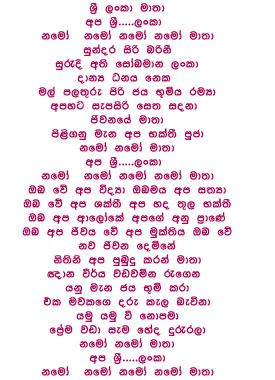
Fourth Schedule Articles 32, 53, 61, 107, 165 "I ........................ solemnly declare and affirm / swear - that I will faithfully perform the duties and discharge the functions of the office of ........................................ in accordance with the Constitution of the Democratic Socialist Republic of Sri Lanka and the law, and that I will be faithful to the Republic of Sri Lanka and that I will to the best of my ability uphold and defend the Constitution of the Democratic Socialist Republic of Sri Lanka. "
Fifth Schedule Article 114 (6)
Clerks
63[Deputy Fiscals]
Interpreters
Stenographers
Typists
Binders
Sixth Schedule Article 162 (2) Colombo City and Dehiwela-Mount Lavinia (Municipal Limits) ..... 1 Member Colombo District (excluding Colombo City and Dehiwela - Mount Lavinia) .... 2 Members Kalutara District.. .. .. 2 Members Kandy District.. .. .. 2 Members Matale District .. .. .. 1 Member Nuwara-Eliya District ......... 1 Member Galle District .. .. .. 2 Members Matara District .. .. .. 1 Member Hambantota District .. .. .. 1 Member Jaffna District .. .. ..1 Member Mannar and Vavuniya Districts.. .. .. 3 Members Batticaloa District .. .. 1 Member Trincomalee Mstrict .. .. .. 1 Member Ampara District .. ... 2 Members Kurunegala District .. .. 3 Members Puttalam District .. .. .. 1 Member Anuradhapura District . .. .. 3 Members Polonnaruwa District. .. .. 1 Member Badulla District .. .. .. 3 Members Moneragala District .. .. .. 1 Member Kegalle District .. .. .. 2 Members Ratnapura District .. .. .. 2 Members
"District" means the Administrative District established under the Administrative Districts Act (Chapter 392) having the limits specified thereunder as on July 21, 1977.
64Seventh Schedule Articles 157A and Article 161(d)(iii) "I ..................................................... do solemnly declare and affirm / swear that I will uphold and defend the Constitution of the Democratic Socialist Republic of Sri Lanka and that I will not, directly or indirectly, in or outside Sri Lanka, support, espouse, promote, finance, encourage or advocate the establishment of a separate State within the territory of Sri Lanka.”
65Eighth Schedule (Article 154A) Provinces
Western
North Western
Uva
Sabaragamuwa
Central
Eastern
Southern
North Central
Northern.
66 Ninth Schedule
Article 154 A LIST I
(Provincial Council List)
1. Police and Public order. - Public order and the exercise of police powers, to the extent set out in Appendix I, within the Province, but not including National Defence, National Security and the use of any armed forces or any other forces under the control of the Government of Sri Lanka in aid of the civil power, and not including the city of Colombo, Sri Jayewardenepura Kotte, and their environs the limits of which shall be specified by the President by Order published in the Gazette.
2. Planning - Implementation of provincial economic plans.
3. Education and Educational Services, - Education to the extent set out in Appendix III.
4. Local Government –
4 : 1 Local authorities for the purpose of local government and village administration, such as Municipal Councils, Urban Councils and Pradeshiya Sabhas, except that, the constitution, form and structure of local authorities shall be determined by law ;
4 : 2 Supervision of the administration of local authorities established by law, including the power of dissolution (subject to such quasi-judicial inquiries into the grounds for dissolution, and legal remedies in respect thereof, as may be provided by law, and subject to provisions relating to audit as may be provided by law) ;
4 : 3 Local authorities will have the Powers vested in them under existing law. Municipal Councils and Urban Councils will have the powers vested in them under the Municipal Councils Ordinance and the Urban Councils Ordinance, Pradeshiya Sabha will have the powers vested in them under existing law. It will be open to a Provincial Council to confer additional powers on local authorities but not to take away their powers ;
4 : 4 Gramodaya Mandalayas will have the powers vested in Gramodaya Mandalayas under existing law. It will be open to a Provincial Council to council to confer additional powers on Gramodaya Mandalayas.
5. Provincial Housing and Construction -
5 : 1 Implementing, co-ordinating, supervising and monitoring provincial housing development programmes and projects (other than National Housing Development Authority projects) including aided self-help housing projects, housing loans and the provision of building materials ;
5 : 2 The implementation of the Protection of Tenants Act and the Rent Act within a Province ;
5 : 3 Construction activity in respect of subjects in this List.
6. Roads and bridges and ferries thereon within the Province, other than -
(a) national highways ;
(b) bridges and ferries on national highways.
7. Social Services and Rehabilitation –
7 : 1 Probation and Child Care Services ;
7 : 2 The Rehabilitation of destitute persons and families ;
7 : 3 Rehabilitation and welfare of physically, mentally and socially handicapped persons ;
7 : 4 Relief of the disabled and unemployable.
8. Regulation of road passenger carriage services and the carriage of goods by motor vehicles within the Province and the Provisions of inter-provincial road transport services.
9. Agriculture and Agrarian Services –
9 : 1 Agriculture, including, agricultural extension, promotion and education for provincial purposes and agricultural services (other than in inter-provincial irrigation and land settlement schemes, State land and plantation agriculture) ;
9 : 2 Rehabilitation and maintenance of minor irrigation works ;
9 : 3 Agricultural research, save and except institutions designated as national agricultural research institutions.
10. Rural Development
11. Health –
11 : 1 The establishment and maintenance of public hospitals, rural hospitals, maternity homes, dispensaries (other than teaching hospitals and hospitals established for special purposes) ;
11 : 2 Public health services, health education, nutrition, family health, maternity and child care, food and food sanitation, environmental health ;
11 : 3 Formulation and implementation of Health Development Plan and of the Annual Health Plan for the Province ;
11 : 4 The provision of facilities for all institutions referred to in 1 above within the Province, excluding the procurement of drugs;
11 : 5 Awarding of Scholarships for Post-Graduate Education within Sri Lanka to personnel attached to the Institutions specified in 1 above.
12. Indigenous Medicine - Ayurveda, Siddha and Unani-
12 : 1 Establishment of Ayurvedic dispensaries and hospitals, grants to such dispensaries and hospitals ;
12 : 2 Establishment and maintenance of herbaria.
13 : 1 Resthouses maintained by local authorities ; and
13 : 2 Circuit bungalows presently administered by Government departments whose functions are exclusively specified in this List.
14. Pawnbrokers - Pawnbrokers other than pawnbrokers business carried on by Banks.
15. Markets, fairs.
16. Food supply and distribution within the Province.
17. Co-operatives –
17 : 1 Co-operative undertakings and the organization, registration, supervision and audit of co-operative societies within the province ;
17 : 2 Co-operative development within the Province including co-operative education and propaganda ;
17 : 3 Provincial Co-operative Employees Commission ;
17 : 4 Matters connected with employment, promotion, retirement and other connected matters of employees of co-operative societies within the Province.
18. Land. - Land, that is to say, rights in or over land, land tenure transfer and alienation of land, land use, land settlement and land improvement, to the extent set out in Appendix II.
19. Irrigation - Planning, designing, implementation, supervision and maintenance of all irrigation works, other than irrigation schemes relating to rivers running through more than one Province or inter provincial irrigation and land development schemes.
20. Animal husbandry. - Preservation, protection and improvement of stock and prevention of animal diseases within the Province.
21. Subject to the formulation and implementation of National Policy in regard to development and planning, the power to promote, establish and engage in agricultural, industrial, commercial and trading enterprises and other income-generating projects, within the Province without prejudice to the power of the Government and public corporations to have such enterprises and projects.
(This would include the promotion of scientific and industrial research within the Province and the preparation, co-ordination and the implementation of industrial development plans for the Province).
22. Reformatories, Borstal institutions and other institutions of a like nature and persons detained therein, arrangements with other Provinces for the use of such institutions.
23. Possession, transport, purchase and sale of intoxicating liquors.
24. Burials and burial grounds, cremations and cremation grounds, other than those declared by or under law made by Parliament to be national memorial cemeteries.
25 : 1 Libraries, Museums and other similar institutions controlled or financed by a Provincial Council;
25 : 2 Ancient and historical monuments and records other than those declared by or under law made by Parliament to be of national importance.
26. The regulation of mines and mineral development, to the extent permitted by or under any law made by Parliament, within the Province.
27. Incorporation, regulation and judicial winding up of corporations with objects confined to the Province, excluding trading corporations, banking, insurance and financial corporations.
28. Regulation of unincorporated trading, literary, scientific, religious and other societies and associations.
29 : 1 Theatres and dramatic performances, music, cinemas, entertainments and amusements, excluding the sanctioning of cinematograph films for exhibition and public performances.
29 : 2 Encouragement and development of sports (other than national sports associations).
30. Betting and gambling, other than imposition of licence fees and taxes.
31. Provincial debt.
32. Offences against statutes with respect to any of the matters specified in this List.
33. Fees in respect of any of the matters in this List, excluding fees taken in any court.
34. Development, conservation and management of sites and facilities in the Province for the generation and promotion of electrical energy (other than hydro-electric power and power generated to feed the national grid).
35. The borrowing of money to the extent permitted by or under any law made by Parliament ;
36 : 1 Turnover taxes on wholesale and retail sales within such limits and subject to such exemptions as may be prescribed by law made by Parliament ;
36 : 2 Betting taxes, and taxes on prize competitions and lotteries, other than National Lotteries and lotteries organized by the Government of Sri Lanka ;
36 : 3 Licence taxes, arrack, toddy rents, tapping licence fees, and liquor licence fees ;
36 : 4 Motor vehicle licence fees within such limits and subject to such exemptions as may be prescribed by law made by Parliament ;
36 : 5 Dealership licence taxes on drugs and other chemicals ;
36 : 6 Stamp duties on transfer of properties, such as lands and motor cars ;
36 : 7 Toll collections ;
36 : 8 Fines imposed by courts ;
36 : 9 Fees charged under the Medical Ordinance ;
36 : 10 Fees charged under the Motor Traffic Act ;
36 : 11 Departmental fees in respect of any of the matters specified in this List ;
36 : 12 Fees under the Fauna and Flora Protection Ordinance ;
36 : 13 Fees on lands alienated under the Land Development Ordinance and Crown Lands Ordinance ;
36 : 14 Court fees, including stamp fees on documents produced in court ;
36 : 15 Regulatory charges under the Weights and Measures Ordinance ;
36 : 16 Land revenue, including the assessment and collection of revenue, and maintenance of land records for revenue purposes ;
36 : 17 Taxes on lands and buildings including the property of the State to the extent permitted by law made by Parliament ;
36 : 18 Taxes on mineral rights within such limits and subject to such exemptions as may be prescribed by law made by Parliament ;
36 : 19 Licensing fees on the possession, transport, purchase and sale of intoxicating liquors ;
36 : 20 Other taxation within the Province in order to raise revenue for provincial purposes to the extent permitted by or under any law made by Parliament.
37. Protection of environment within the Province to the extent permitted by or under any law made by Parliament.
APPENDIX I
Law And Order
1. The subject devolved shall be described as follows : -
Public Order and the exercise of Police powers as set out in this Appendix within the Province, but not including-
(a) national defence ;
(b) national security ; and
(c) the use of any armed forces or any other forces under the control of the Government of Sri Lanka in aid of the civil power.
2. The I.G.P. shall be the head of the Sri Lanka Police Force, The Sri Lanka Police Force shall be divided into -
(a) the National Division (including Special Units) ; and
(b) a Provincial Division for each Province.
2 : 1 The National Division shall consist of the I.G.P., D.I.GG, S.S.PP, A.S.PP and other ranks recruited at the national level.
2 : 2 A Provincial Division shall consist of the D.I.G., S.S.PP, S.PP and A.S.PP all seconded from the National Division and Provincial Assistant Superintendents of Police, Chief Inspectors, Inspectors, Sub-Inspectors, Sergeants, and Constables recruited in the Province. Members of the Provincial Division shall be eligible for promotion to the National Division.
3. Recruitment to the National Division and promotions of Police Officers in the Provincial Divisions to the National Division shall be made by a National Police Commission composed of three members, namely -
(a) the I.G.P. ;
(b) a person nominated by the Public Service Commission in consultation with the President ; and
(c) a nominee of the Chief Justice.
3 : 1 The National Police Commission shall, before promoting any Police Officer serving in any Provincial Division to the National Division, call for a Confidential Report on such Officer from the relevant Provincial Police Commission and take the matters specified in such report into consideration in deciding whether to promote such Officer or not.
3 : 2 The Commission shall also be responsible for promotions, transfers and disciplinary control of members of the National Division other than the I.G.P. subject to paragraph 4 : 1 below.
3 : 3 It shall hear and determine appeals from officers seconded to Provincial Divisions against whom disciplinary action has been taken by Provincial Police Commissions.
3 : 4 It shall set standards for recruitment and promotion of Police Officers of all Divisions and such standards shall be uniform for all Provincial Divisions.
4. Recruitment to each Provincial Division shall be made by a Provincial Police Commission composed of three members, namely
(a) the D.I.G. of the Province ;
(b) a person nominated by the Public Service Commission in consultation with the President ; and
(c) a nominee of the Chief Minister of the Province.
4 : 1 A Provincial Police Commission shall be responsible for transfers, promotions and disciplinary control over officers in the Provincial Division ; for promotion of Officers of the National Division seconded to the Provincial Division up to the rank of S.S.P. ; and for transfer and disciplinary control over officers seconded to the Provincial Division, except the D.I.G. :
Provided that any Officer of the National Division seconded to any Provincial Division against whom disciplinary action has been taken by a Provincial Police Commission, shall have the right to appeal to the National Police Commission, whose decision on such appeal shall be final.
5. The National Police Commission or a Provincial Police Commission shall be entitled to delegate such of its powers as may be prescribed to such other person or authority as may be prescribed.
6. The I.G.P. shall appoint a D.I.G. for each Province with the concurrence of the Chief Minister of the Province. However, where there is no agreement between the Inspector-General of Police and the Chief Minister, the matter will be referred to the President, who, after due consultations with the Chief Minister, shall make the appointment.
7. The cadres of Police Officers of all ranks of the National Division shall be fixed by the Government of Sri Lanka. The cadre of Officers and other ranks of each Provincial Division shall be fixed by the Provincial Administration with the approval of the President, having regard to-
(a) the area of the Province ;
(b) population of the Province ; and
(c) such other criteria, as may be agreed to or prescribed.
These principles shall be uniformly applied to all Provincial Divisions.
7 : 1 The cadres of the Provincial Divisions shall be fixed on ascertained principles such as population, area, number of Police Stations involved and other relevant considerations. These principles shall be applied to all Provincial Divisions without distinction.
7 : 2 The salary scales and perquisites of office enjoyed by the various ranks in the National and Provincial Divisions shall be determined by the Government of Sri Lanka after consultation with the Chief Ministers of the Provinces. The salary scales and perquisites of office as enjoyed by members of the Provincial Divisions shall apply uniformly to all Provincial Divisions.
8. The nature, type and quantity of fire-arms and ammunition and other equipment for the National Division shall be determined by the National Police Commission. The nature, type and quantity of fire-arms and ammunition and other equipment for all Provincial Divisions shall be determined by the National Police Commission after consultation with the Provincial Police Commission and uniform standards and principles shall be applied for all Provincial Divisions.
9. Recruitment to the National Division shall be made at the ranks of P.C., S.I., and A.S.P.. Recruitment to the Provincial Division shall be made at the ranks of P.C., S.I., and P.A.S. P. (rank referred to in paragraph 2 : 2 above).
9 : 1 Recruitment to the National Division shall be made by the National Police Commission and recruitment to the Provincial Division shall be made by the Provincial Police Commission having regard to the standards of recruitment, and other criteria prescribed in this behalf:
Provided also that a recruit may, on appointment, set out his preferences as to the Division in which he wishes to serve and that he shall, if possible, be posted to the Division of his choice, with the consent of the Division concerned.
9 : 2 The Government of Sri Lanka shall be responsible for the training of all recruits to and of members of all Divisions of the Sri Lanka Police Force.
The President may, where he considers it necessary, provide for alternative training for members of any Provincial Division.
10. Members of the National Division and the Provincial Divisions shall wear the same uniforms and insignia of rank, provided that uniforms of the members of each Division shall bear a distinctive shoulder flash, indicating the Division to which he belongs.
10 : 1 There shall be one uniformed police force in each Province, comprising of the members of the Provincial Division and the officers seconded thereto. Members of the National Division shall ordinarily be in plain clothes provided that they may wear uniforms when performing any duties in respect of the maintenance or restoration of public order as set out in paragraph 12 : 2, 12 : 3 and 12 : 4. Provided also that the I.G.P. and such other Officers as may be specified shall ordinarily be attired in uniforms.
11. All Police Officers serving in units of the National Division and Provincial Divisions in any Province shall function under the direction and control of the D.I.G. of such Province.
11 : 1 The D.I.G. of the Province shall be responsible to and under the control of the Chief Minister thereof in respect of the maintenance of public order in the Province and the exercise of police powers in the Province as set out in this Schedule.
11 : 2 The provisions of paragraph 11 : 1 above are subject to the qualifications that –
(a) upon the declaration of an emergency in the Province, the President may assume such powers and responsibilities of the Chief Minister and the Provincial Administration in respect of public order within the Province as he may, by regulation, provide ; and
(b) where the President is of the opinion that the security of or public order in a Province is threatened by grave internal disturbance, he may, without the declaration of an emergency, but in consultation with the Chief Minister of such Province, and subject to the provisions of the Public Security Ordinance, by order, deploy in aid of the civil power, any unit of the National Division, in the Province for the purpose of restoring public order :
Provided that every such order shall cease to be in force, as soon as the President is satisfied that public order has been restored or on the expiry of thirty days from the date of the order, whichever is earlier.
12 : 1 The Provincial Division shall be responsible for the preservation of public order within the Province and the prevention, detection and investigation of all offences (except the offences specified in the Schedule) and subject to the powers of the Attorney-General in terms of the Code of Criminal Procedure Act, the institution of prosecutions in the relevant Courts in respect of such offences.
The National Division of the Sri Lanka Police Force shall be responsible for the prevention, detection and investigation of all offences specified in the Schedule and subject to the powers of the Attorney-General in terms of the Code of Criminal Procedure Act, for the institution of prosecutions in the relevant Courts in respect of such offences.
12 : 2 Where the Chief Minister seeks the assistance of the National Division to preserve public order within a Province, the I.G.P. shall deploy such personnel of the National Division as are necessary for the purpose, and place them under the control of the D.I.G. of the Province.
12 : 3 Where a State of Emergency is declared in the Province, the I.G.P. may deploy such units of the National Division as he deems necessary in any Province for the restoration and maintenance of public order within such Province.
12 : 4 Any offence which may ordinarily be investigated by a Provincial Division may be investigated by the C.I.D. or any other unit of the National Division –
(a) where the Chief Minister requests, that such investigation be undertaken by the C.I.D. or any other unit of the National Division ; and
(b) where the I.G.P. is of opinion that an investigation of such offence by the C.I.D. or any other unit of the National Division is necessary, in the public interest, and directs, after consultation with the Chief Minister, and the approval of the Attorney-General, that such offence be investigated by the C.I.D. or any other unit of the National Division.
13. The National Division shall perform all the functions vested in a Provincial Division, in any Province, for a period of one year or until a Provincial Division is established in such Province, whichever is earlier.
14. All gazetted officers of the National Division and Provincial Division shall be required to attain the prescribed standard in Sinhala and Tamil. All Officers of the rank of A.S.P. and above shall also be required to attain the prescribed standard of English.
Every recruit to the Sri Lanka Police Force shall have proficiency in his mother tongue. For the first promotion he shall acquire proficiency in a language other than his mother tongue. For the next promotion he shall acquire a knowledge of the third language. The three languages recognized for this purpose are Sinhala, Tamil and English.
SCHEDULE
List of Offences to be investigated by the National Police
1. Offences against the State.
2. Offences relating to the Navy, Army and Air Force.
3. Offences relating to the Elections.
4. Offences relating to Coins, Currency and Government Stamps.
5. Any Offence committed against the President.
6. Any Offence committed against a Public Officer, a Judicial Officer, or the Speaker, or the Prime Minister or a Minister, or a Member of the Judicial Service Commission, or a Member of the Public Service Commission or a Deputy Minister or a Member of Parliament or the Secretary General of Parliament or a Member of the President's Staff or a Member of the Staff of the Secretary General of Parliament.
7. Any Offence relating to property belonging to the State or a State Corporation or Company or Establishment, the whole or part of the capital whereof has been provided by the State.
8. Any Offence prejudicial to National Security or the maintenance of Essential Services.
9. Any Offence under any law relating to any matter in the Reserve List other than such offences as the President may, by order published in the Gazette, exclude.
10. Any Offence in respect of which Courts in more than one Province have jurisdiction.
11. International Crimes.
APPENDIX II
Land and Land Settlement
State land shall continue to vest in the Republic and may be disposed of in accordance with Article 33 (d) and written law governing this matter.
Subject as aforesaid, land shall be a Provincial Council Subject, subject to the following special provisions : -
1. State land -
1 : 1 State Land required for the purposes of the Government in a Province, in respect of a reserved or concurrent subject may be utilised by the Government in, accordance with the laws governing the matter. The Government shall consult the relevant Provincial Council with regard to the utilisation of such land in respect of such subject.
1 : 2 Government shall make available to every Provincial Council State land within the Province required by such Council for a Provincial Council subject. The Provincial Council shall administer, control and utilise such State land, in accordance with the laws and statutes governing the matter.
1 : 3 Alienation or disposition of the State land within a Province to any citizen or to any Organisation shall be by the President, on the advice of the relevant Provincial Council, in accordance with the laws governing the matter.
2. Inter-Provincial Irrigation and Land Development Projects.
2 : 1 Such projects would comprise irrigation and land development schemes-
(a) within the Province initiated by the State and which utilize water from rivers flowing through more than one Province; a Provincial Council however, may also initiate irrigation and land development schemes within its Province utilizing water from such rivers ;
(b) within the Province which utilize water through diversions from water systems from outside the Province ; and
(c) all schemes where the command area falls within two or more Provinces such as the Mahaweli Development Project.
2 : 2 These projects will be the responsibility of the Government of Sri Lanka.
2 : 3 The principals and criteria regarding the size of holdings of agricultural and homestead lands arising out of these projects will be determined by the Government of Sri Lanka in consultation with the Provincial Councils.
2 : 4 The selection of allotees for such lands will be determined by the Government of Sri Lanka having regard to settler selection criteria including degree of landlessness, income level, size of family and agricultural background of the applicants. The actual application of these principles, selection of allottees and other incidental matters connected thereto will be within the powers of the Provincial Councils.
2 : 5 The distribution of all allotments of such land in such projects will be on the basis of national ethnic ratio. In the distribution of allotments according to such ratios, priority will be given to persons who are displaced by the project, landless of the District in which the project is situated and thereafter the landless of the Province.
2 : 6 Where the members of any community do not, or are unable to take their entitlements of allotments from any such project, they would be entitled to receive an equivalent number of allotments in another Inter-Provincial Irrigation or Land Development Scheme. This unused quota should be utilized within a given time-frame.
2 : 7 The distribution of allotments in such projects on the basis of the aforesaid principles would be done as far as possible so as not to disturb very significantly the demographic pattern of the Province and in accordance with the principle of ensuring community cohesiveness in human settlements.
2 : 8 The administration and management of such projects will be done by the Government of Sri Lanka.
3. National Land Commission.
3 : 1 The Government of Sri Lanka shall establish a National Land Commission which would be responsible for the formulation of national policy with regard to the use of State land. This Commission will include representatives of all Provincial Councils in the Island.
3 : 2 The National Land Commission will have a Technical Secretariat representing all the relevant disciplines required to evaluate the physical as well as the socio-economic factors that are relevant to natural resources management.
3 : 3 National policy on land use will be based on technical aspects (not on political or communal aspects), and the Commission will lay down general norms in regard to the use of land, having regard to soil, climate, rainfall, soil erosion, forest cover, environmental factors, economic viability, &c.
3 : 4 In the exercise of the powers devolved on them, the powers shall be exercised by the Provincial Councils having due regard to the national policy formulated by the National Land Commission.
APPENDIX III
Education
1. Provision of facilities for all State Schools other than specified schools (Specified Schools will be National Schools, Special Schools for Service Personnel and schools for specified development schemes).
2. Supervision of the management of -
(a) all pre-schools ; and
(b) all State schools other than specified schools indicated above.
(in order to ensure standards the Ministry of Education will retain the right to inspect and supervise the management of schools).
3. The transfer and disciplinary control of all educational personnel, i.e. Teachers, Principals and Education Officers. Officers belonging to a National Service but serving the Provincial authority on secondment will have the right of appeal to the Public Service Commission. Officers belonging to the Provincial Public Service will have a right to appeal to the Public Service Commission against dismissal.
4. Recruitment into the Teaching Service of those with diplomas and degrees, from Colleges of Education and Universities, recognised as teaching qualifications.
5. Until adequate numbers of these categories are available recruitment into the Teaching Service will be on the results of recruitment examinations conducted by the Public Service Commission. On the results of these examinations interviews and selection will be conducted together with the Provincial Authorities.
6. Appointment of Principals of all schools other than those in 1A, B, C categories. (Criteria will be laid down by the Minister of Education).
7. Appointment of Principals of 1A, B, C schools will be by the Secretary to the Ministry of the Minister in charge of the subject of Education or the Public Service Commission.
8. Training of teachers and other educational personnel will come within the purview of the National Institute of Education. Provincial Authorities will indicate their needs to the National Institute of Education.
9. Appointment of Provincial Boards of Education which will have the advisory functions, will be the responsibility of the Minister of Education. However, this will be done with the concurrence of the Chief Minister of the Provincial Authority.
10. Provincial Authorities will establish School Boards conforming to the specifications laid down by the Ministry of Education.
11. Provincial Authorities will supervise the working of School Boards.
12. Preparation of plans (educational development plan and annual implementation plan) will be the responsibility of the Provincial Authority.
13. Implementation of the Annual Education Development Plan.
14. Appraisal of the performance of Principals, Teachers and Education Officers.
15. Conducting of in-service training programmes for which prior approval of the National Institute of Education has been obtained.
16. Conducting of local examinations approved by the Commissioner-General of Examinations.
17. Implementation of non-formal education programmes.
18. Registration and supervision of pre-schools.
19. Obtaining the approval of the National Institute of Education for local variations in the primary curriculum and selected subjects in the secondary curriculum.
20. Construction and maintenance of educational buildings, libraries and playgrounds.
21. Procuring and distribution of teaching aids, visual aids and audio visual materials, furniture and other equipment.
22. Procuring and distribution of science equipment other than certain specified items indicated by the Ministry.
23. Production and distribution of school textbooks after approval by the Ministry.
24. Organization and development of school libraries in accordance with guidelines given by the National Library Services Board.
(Above based on the recommendations of Committee I of the Political Parties Conference)
LIST II
(Reserved List)
National Policy on all Subjects and Functions.
Defence and National Security : Internal Security Law and order and prevention and detection of crime except to the extent specified in item 1 of List I.
This would include -
(a) Defence of Sri Lanka and every part thereof including preparation for defence and all such acts as may be conducive in times of war to its prosecution and after its termination, to effective demobilisation ;
(b) Naval, military and air forces; any other armed forces of the Government of Sri Lanka ;
(c) Deployment of any armed force of the Government of Sri Lanka or any other force subject to the control of the Government of Sri Lanka or any contingent or unit thereof in any Province in aid of the civil power ; powers, jurisdiction, privileges and liabilities of the members of such forces while on such deployment ;
(d) Delimitation of cantonment areas, local self-government in such areas, the constitution and powers within such areas of cantonment authorities and the regulation of house accommodation (including the control of rents) in such areas ;
(e) Naval, military and air force works ;
(f) Arms, firearms, ammunition and explosives ;
(g) Atomic energy and mineral resources necessary for its production ;
(h) Industries declared by Parliament by law to be necessary for the purpose of defence or for the prosecution of war ;
(i) Criminal Investigation Department ;
(j) Preventive detention for reasons connected with Defence, Foreign Affairs, or the security of Sri Lanka, persons subjected to such detention ; and
(k) Extension of the powers and jurisdiction of members of a police force belonging to any Province to any area outside that Province, but not so as to enable the police of one Province to exercise powers and jurisdiction in any area outside that Province without the consent of the Provincial Council in which such area is situated ; extension of the powers and jurisdiction of members of a police force belonging to any Province to railway areas outside that Province.
Foreign Affairs
This would include -
(a) Foreign Affairs ; all matters which bring the Government of Sri Lanka into relation with any foreign country ;
(b) Diplomatic, consular and trade representation ;
(c) United Nations Organization ;
(d) Participation in international conferences, associations and other bodies and implementing of decisions made thereat ;
(e) Entering into treaties and agreements with foreign countries and implementing treaties, agreements and conventions with foreign countries ;
(f) War and peace ; and
(g) Foreign jurisdiction.
Posts and Telecommunications ; Broadcasting ; Television
This would include -
(a) Posts and telegraphs ; telephones ; wireless, broadcasting and other like forms of communications ; and
(b) Sanctioning of cinematograph films for exhibition.
Justice in so far as it relates to the judiciary and the courts structure
This would include -
(a) Constitution, organization, jurisdiction and powers of the Supreme Court (including contempt of such Court), and the fees taken therein; persons entitled to practise before the Supreme Court, Court of Appeal and other Courts ;
(b) Constitution, Organisation, jurisdiction and powers of the Court of Appeal, and the fees taken therein ; and
(c) Jurisdiction and powers of all courts, except the Supreme Court and the Court of Appeal.
Finance in relation to national revenue, monetary policy and external resources ; customs
This would include -
(a) Public debt of the Government of Sri Lanka ;
(b) Currency, coinage and legal tender ; foreign exchange ;
(c) Foreign loans ;
(d) Central Bank ;
(e) National Savings Bank ;
(f) Lotteries organised by the Government of Sri Lanka or a Provincial Council ;
(g) Banking ;
(h) Bills of exchange, cheques, promissory notes and other like instruments;
(i) Insurance ;
(j) Stock exchanges and futures markets ;
(k) Audit of the accounts of the Government of Sri Lanka and of the Provinces ;
(l) Taxes on income, capital and wealth of individuals, companies and corporations ;
(m) Customs duties, including import and export duties, and excise duties;
(n) Turnover taxes and stamp duties, except to the extent specified in List I ;
(o) any other tax or fee not specified in List I.
Foreign Trade ; Inter-Province Trade and Commerce
This would include-
(a) Trade and commerce with foreign countries ; import and export across customs frontiers ; definition of customs frontiers ; and
(b) Inter-province trade and commerce.
Ports and Harbours
This would include -
(a) Ports declared by or under law made by Parliament or existing law to be major ports including their delimitation, and the constitution and powers of port authorities therein ; and
(b) Port quarantine, including hospitals connected therewith ; seamen's and marine hospitals.
Aviation and Airports
This would include-
Airways ; aircraft and air navigation ; provision of aerodromes ; regulation and Organisation of air traffic and of aerodromes ; provision for aeronautical education and training and regulation of such education and training provided by Provinces and other agencies.
National Transport
This would include-
(a) Railways ;
(b) Highways declared by or under law made by Parliament to be national highways; and
(c) Carriage of passengers and goods by railway, land, sea or air, or by national waterways in mechanically propelled vessels.
Rivers and Waterways ; Shipping and Navigation ; Maritime zones including Historical Waters, Territorial Waters, Exclusive Economic zone and Continental Shelf and Internal Waters ; State Lands and Foreshore, Except to the Extent specified. in Item 18 of List I.
This would include –
(a) Piracies and crimes committed on the high seas or in the air ; offences against the law of nations committed on land or the high seas or in the air ;
(b) Shipping and navigation on inland waterways, declared by Parliament by law to be national waterways, as regards mechanically propelled vessels ; the rule of the road on such waterways ;
(c) Maritime shipping and navigation, including shipping and navigation on tidal waters ; provision of education and training for the mercantile marine and regulation of such education and training provided by Provinces and other agencies ;
(d) Lighthouses, including lightships, beacons and other provision for the safety of shipping and aircraft ;
(e) Regulation and development of inter province rivers ; and river valleys to the extent to which such regulation and development under the control of the Government of Sri Lanka is declared by Parliament by law to be expedient in the public interest ;
(f) Fishing and fisheries beyond territorial waters ; and
(g) Property of the Government of Sri Lanka and the revenue therefrom, but as regards property situated in a province, subject to statutes made by the Province save in so far as Parliament by law otherwise provides.
Minerals and Mines
This would include-
(a) Regulation and development of oilfields and mineral oil resources ; petroleum and petroleum products ; other liquids and substances declared by Parliament by law to be dangerously inflammable ; and
(b) Regulation of mines and mineral development to the extent to which such regulation and development under the control of the Government of Sri Lanka is declared by Parliament by law to be expedient in the public interest.
Immigration and Emigration and Citizenship
This would include-
(a) Citizenship, naturalization and aliens ;
(b) Extradition ; and
(c) Admission into, and emigration and expulsion from, Sri Lanka passports and visas.
Elections Including Presidential, Parliamentary, Provincial Councils and Local Authorities
This would include-
Elections to Parliament, Provincial Councils, Local Authorities and to the Office of President ; the Department of Elections.
Census and Statistics
This would include-
(a) Census ; and
(b) Inquiries, surveys and statistics for the purposes of any of the matters in this List.
Professional Occupations and Training
This would include-
(a) Institutions, such as Universities, declared by Parliament by law to be institutions of national importance ;
(b) Institutions for scientific or technical education by the Government of Sri Lanka wholly or in part and declared by Parliament by law to be institutions of national importance ;
(c) Provincial agencies and institutions for -
(i) professional, vocational or technical training, including the training of police officers ; or
(ii) the promotion of special studies or research; or
(iii) scientific or technical assistance in the investigation or detection of crime ; and
(d) Co-ordination and determination of standards in institutions for higher education or research and scientific and technical institutions.
National Archives ; Archaeological Activities and Sites and Antiquities declared by or under any law made by Parliament to be of National Importance This would include-
Ancient and historical monuments and records, and archaeological sites and remains declared by or under law made by Parliament to be of national importance. All Subjects and Functions not Specified in List I or List III including –
(a) Pilgrimages to places outside Sri Lanka ;
(b) Incorporation, regulation and winding up of trading corporations, including banking, insurance and financial corporations but not including co-operative societies ;
(c) Incorporation, regulation and winding up of corporations, whether trading or not, with objects not confined to one province, but not including universities ;
(d) Patents, inventions and designs ; copyright, trade marks and merchandise marks ;
(e) Establishment of standards of weight and measure ;
(f) Establishment of standards of quality for goods to be exported out of Sri Lanka or transported from one province to another ;
(g) Industries, the control of which by the Government of Sri Lanka is declared by Parliament by law to be expedient in the public interest;
(h) Regulation of labour and safety in mines ;
(i) Manufacture, supply and distribution of salt by agencies of the Government of Sri Lanka ; regulation and control of manufacture, supply and distribution of salt by other agencies ;
(j) Cultivation, manufacture, and sale for export, of opium ;
(k) Industrial disputes concerning employees of the Government of Sri Lanka ;
(l) Institutions such as Museums and War Memorials financed by the Government of Sri Lanka wholly or in part and declared by Parliament by law to be institutions of national importance ;
(m) The Survey of Sri Lanka, the Geological, Botanical, Zoological and Anthropological Surveys of Sri Lanka ; Meteorological organizations ;
(n) National Public Services ; National Public Service Commission ;
(o) Pensions, that is to say, pensions payable by the Government of Sri Lanka or out of the Consolidated Fund ;
(p) Salaries and allowances of Members of Parliament, and the Speaker and Deputy Speaker of Parliament ;
(q) Powers, privileges and immunities of Parliament and of the members and the Committees of Parliament ; enforcement of attendance of persons for giving evidence or producing documents before Committees of Parliament or Commissions appointed by Parliament ;
(r) Emoluments, allowances, privileges, and rights in respect of leave of absence, of the President and Governors ; salaries and allowances of the Ministers of the Government of Sri Lanka ; the salaries, allowances and rights in respect of leave of absence and other conditions of service of the Auditor-General ;
(s) Inter-Province migration ; inter-province quarantine ;
(t) Offences against laws with respect to any of the matters in this List; and
(u) Fees in respect of any of the matters in this List, but not including fees taken in any Court.
LIST III
(Concurrent List)
1. Planning -
1 : 1 Formulation and appraisal of plan implementation strategies at the provincial level ;
1 : 2 Progress control ;
1 : 3 Monitoring progress of public and private sector investment programmes ;
1 : 4 The evaluation of the performance of institutions and enterprises engaged in economic activities ;
1 : 5 The presentation of relevant data in the achievement of plan targets ;
1 : 6 The dissemination of information concerning achievement of plan targets ;
1 : 7 Publicity of implementation programmes ;
1 : 8 Manpower planning and employment Data Bank ;
1 : 9 Nutritional planning and programmes.
2. and 3. Education and Educational Services. - Education, except to the extent specified in items 3 and 4 of List I.
4. Higher Education -
4 : 1 The establishment and maintenance of new Universities.
4 : 2 The establishment of degree awarding institutions under the Universities (Amendment) Act, No. 7 of 1985, and other institutions for tertiary, technical and post-school education and training.
5. National Housing and Construction. -The promotion of integrated planning and implementation of economic, social and physical development of urban development areas.
6. Acquisition and requisitioning of Property.
7. Social Services and Rehabilitation-
7 : 1 Relief, rehabilitation and resettlement of displaced persons ;
7 : 2 Relief of distress due to floods, droughts, epidemics or other exceptional causes and rehabilitation and resettlement of those affected;
7 : 3 Restoration, reconstruction and rehabilitation of towns, villages, public institutions and properties, industries, business places, places of worship and other properties destroyed or damaged, grant of compensation or relief to persons of institutions who have sustained loss or damage and the reorganization of civil life.
8. Agricultural and Agrarian Services –
8 : 1 Establishment and promotion of agro-linked industries, the establishment and maintenance of farms and supervision of private nurseries ;
8 : 2 Soil conservation ;
8 : 3 Plant pests.
9. Health -
9 : 1 Schools for training of Auxiliary Medical Personnel ;
9 : 2 The supervision of private medical care, control of nursing homes and of diagnostic facilities within a Province ;
9 : 3 Population control and family planning ;
9 : 4 Constitution of Provincial Medical Boards.
10. Registration of births, marriages and deaths.
11. Renaming of Towns and Villages.
12. Private lotteries within the Province.
13. Festivals and Exhibitions.
14. Rationing of food and maintenance of food stocks.
15. Co-operatives, - Co-operative Banks.
16. Surveys - For the purpose of any of the matters enumerated in the Provincial or Concurrent List.
17. Irrigation -
17 : 1 Water storage and management, drainage and embankments, flood protection, planning of water resources ;
17 : 2 Services provided for inter-provincial land and irrigation schemes, such as those relating to rural development, health, education, vocational training, co-operatives and other facilities.
18. Social Forestry and protection of wild animals and birds.
19. Fisheries. - Other than fishing beyond territorial waters.
20. Animal Husbandry -
20 : 1 Production, processing, distribution and sale of livestock and livestock products ;
20 : 2 Veterinary training services and research, inclusive of the provision of science laboratories and science equipment ;
20 : 3 Animal breeding, care and health,
20 : 4 The establishment of pastures.
21. Employment -
21 : 1 Employment planning at Provincial level ;
21 : 2 Special Employment programmes relating to the Province ;
21 : 3 Promotion of youth employment activities relating to the Province ;
21 : 4 Technical Manpower Development Programmes in relation to the Province.
22. Tourism. - Development and control of the Tourist Industry in the Province.
23. Trade and commerce in, and the production, supply and distribution of –
(a) the products of any industry where the control of such industry by the Government is declared by Parliament by law to be expedient in the public interest, and imported goods of the same kind as such products ; and
(b) foodstuffs and cattle fodder.
24. Newspapers, books and periodicals and printing presses.
25. Offences against statutes with respect to any matters specified in this List.
26. Fees in respect of any of the matters in this List, excluding fees taken in any Court.
27. Charities and charitable institutions, charitable and religious endowments and religious institutions.
28. Price control.
29. Inquiries and statistics for the purpose of any of the matters in this List or in the Provincial Council List.
30. Adulteration of foodstuffs and other goods.
31. Drugs and Poisons.
32. Extension of electrification within the Province and the promotion and regulation of the use of electricity within the Province.
33. Protection of the environment.
34. Archaeological sites and remains, other than those declared by or under any law made by Parliament to be of national importance.
35. Prevention of the extension from one Province to another of infectious or contagious diseases or pests affecting human beings, animals or plants.
36. Pilgrimages.
Notes of Amendments 1. Substituted by Seventh Amendment to the Constitution Sec. 2 (a) and the first Schedule for "‘Twenty four”. 2. Substituted by Seventh Amendment to the Constitution Sec. 2 (b) for “territorial waters”. 3. Renumbered as para (1) of Article 18 by the Thirteenth Amendment to the Constitution Sec. 2 (a)
4. Added by the Thirteenth Amendment to the Constitution Sec. 2 (b)
5. Substituted by Sixteenth Amendment to the Constitution Sec. 2 (1) for “or a member of a local authority”.
6. Substituted by Sixteenth Amendment to the Constitution Sec. 2 (2) for “or in such local authority”.
7. Original Article 22 replaced by the Sixteenth Amendment to the Constitution Sec. 3.
8. Original Article 23 replaced by the Sixteenth Amendment to the Constitution Sec. 3.
9. Original para (1) repealed and substituted by the Sixteenth Amendment to the Constitution Sec. 4 (1).
10. Substituted by the Sixteenth Amendment to the Constitution Sec. 4 (2) for “in either of the National Language”.
11. Substituted by the Sixteenth Amendment to the Constitution Sec. 4 (3) (a) for “the appropriate National Language”.
12. Substituted by the Sixteenth Amendment to the Constitution Sec. 4 (3) (b) for “either of the National Languages”.
13. Substituted by the Sixteenth Amendment to the Constitution Sec. 4 (4) for “the use of a Language other than a National Language”.
14. Inserted by the Sixteenth Amendment Sec. 5. 15. Inserted by the Third Amendment to the Constitution Sec. 2 (1)
16. Original para (4) repealed and substituted by the Third Amendment to the Constitution Sec. 2 (2)
17. Inserted by the Eighth Amendment to the Constitution Sec. 2.
18. Substituted by the Fourteenth Amendment to the Constitution Sec. (2) for “relating to the election of the President”.
19. Substituted by the Third Amendment to the Constitution Sec. (3) for “One month”. 20. Original Article 62 (1) repealed and substituted by the Fourteenth Amendment to the Constitution Sec. 2. 21. Substituted by the Fourteenth Amendment to the Constitution Sec. (4) for “duly approved by the People at a Referendum”.
22. Substituted for (vii), (viii), (ix), (x) by the Ninth Amendment Sec. (2).
23. Substituted by the Seventh Amendment to the Constitution Sec. (3) for “Twenty-four”.
24. 96A Inserted by the Fourteenth Amendment to the Constitution, Sec 5, and repealed by the Fifteenth Amendment to the Constitution Sec. 2.
25. Amended by the Fourteenth Amendment to the Constitution, Sec (b), and by the Fifteenth Amendment to the Constitution Sec. (3).
26. Original Article 99 repealed and replaced by the Fourteenth Amendment to the Constitution, Sec (7).
27. Substituted by the Fifteenth Amendment to the Constitution Sec. 4 (1) for “less than one eighth of the total votes”.
28. (14) repealed by the Fifteenth Amendment to the Constitution Sec. 4 (2).
29. Inserted by the Fourteenth Amendment to the Constitution Sec. 8.
30. Inserted by the Fifteenth Amendment to the Constitution Sec. 5.
31. Substituted by the Sixth Amendment to the Constitution Sec. 3 for “by election or otherwise32. Original para (1) repealed and substituted by the Eleventh Amendment to the Constitution Sec. 2.
33. Inserted by the Seventh Amendment to the Constitution Sec. 4.
34. Substituted by the Eleventh Amendment to the Constitution Sec. 3, for “the appointment of judicial officers.”
35. Inserted by the Eleventh Amendment to the Constitution Sec. 4.
36. Substituted by the Eleventh Amendment to the Constitution Sec. 5 (1) for “the power to make all transfers.”
37. Substituted by the Eleventh Amendment to the Constitution Sec. 5 (2), for “the Registrar of the Court of Appeal, the Registrar of any Court of First Instance.” 38. Substituted by the Fourteenth Amendment to the Constitution Sec. 9 (3), for “election petitions.”
39. Substituted by the Fourteenth Amendment to the Constitution Sec. 9 (1), for “election of the President.”
40. Substituted by the Fourteenth Amendment to the Constitution Sec. 9 (2), for “election of the President shall be.”
41. Words “and the appointment of senior attorneys-at-law.” Omitted by the Eighth Amendment to the Constitution Sec. 3.
42. Substituted by the Thirteenth Amendment to the Constitution Sec. 3 (a), for “committed by any Court of First Instance.”
43. Substituted by the Thirteenth Amendment to the Constitution Sec. 3 (b), for “of which such Court of First Instance.”
44. Inserted by the First Amendment to the Constitution Sec. 2 w.e.f. Sept. 7th 1978.
45. Original para (2) repealed and substituted by the Eleventh Amendment to the Constitution Sec. 6. 46. Chapter XVIIA Articles 154A to 154T inserted by the Thirteenth Amendment to the Constitution Sec. 4. 47. Inserted by the Thirteenth Amendment to the Constitution Sec. 5.
48. Paras (8) and (9) repealed by the Tenth Amendment to the Constitution Sec. 2 (1).
49. Paras (10) and (11) renumbered as (8) and (9) by the Tenth Amendment to the Constitution Sec. 2 (2).
50. Substituted by the Tenth Amendment to the Constitution Sec. 2 (3) for “contained in paragraph (6),(7), (8) of this Article.” 51. Inserted by the Sixth Amendment to the Constitution Sec. 3. 52. Substituted by the Third Amendment to the Constitution Sec. 4, for “shall hold office.”
53. Original para (ii) repealed and substituted by the Second Amendment to the Constitution Sec. 2.
54. Substituted by the Sixth Amendment to the Constitution Sec. 4 (1), for “to fill such vacancy. Upon receipt of such nomination, the Commissioner.”
55. Added by the Fifth Amendment to the Constitution Sec. 2 (d).
56. Substituted by the Sixth Amendment to the Constitution Sec. 4 (2)(a) for "within thirty days of his being required to do so." 57. Substituted by the Sixth Amendment to the Constitution Sec. 4 (2) (d), for “vacancy, then the Commissioner of Elections.”
58. Added by the Sixth Amendment to the Constitution sec. 4(3).
59. Original para (e) repealed and substituted by the Fourth Amendment to the Constitution Sec. 2.
60. Inserted by the Eighth Amendment to the Constitution Sec. 4. 61. Substituted by the Thirteenth Amendment to the Constitution Sec. 6, for “and includes orders.” 62. Inserted by the Seventh Amendment Sec. 5. 63. Substituted by the Eleventh Amendment to the Constitution Sec. 7 for “Fiscals .” 64. Substituted by the Sixth Amendment to the Constitution Sec. 5. 65. Added by the Thirteenth Amendment to the Constitution Sec. 7. 66. Added by the Thirteenth Amendment to the Constitution Sec. 7. |
