TAMIL EELAM STRUGGLE FOR FREEDOM Boundaries of Tamil Eelam Nadesan Satyendra
November 1993
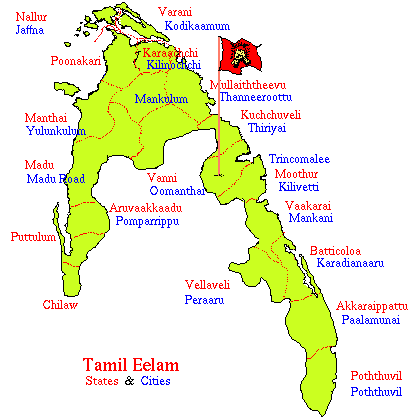
Speaking in Zurich, on Maha Veerar Naal, in November 1990, the late Sathasivam Krishnakumar, (Kittu) a founding member of the LTTE said: ''I was once asked by an Englishman connected with the British Refugee Council: 'You say Tamil Eelam, but where are the boundaries of this Tamil Eelam that you talk about? Show me.' I was taken aback by the directness of the question. I thought for a while, searching for an appropriate response. Then I replied: 'Take a map of the island. Take a paint brush and paint all the areas where Sri Lanka has bombed and launched artillery attacks during these past several years. When you have finished, the painted area that you see - that is Tamil Eelam.'''
Kittu's answer evoked spontaneous and sustained applause from the hundreds of young Tamils who had crowded into that hall in Zurich that evening. It was Kittu, the intellectual, abstracting from his own experience - and touching the hearts and minds of his listeners with the authenticity of his abstraction. Kittu had made his point in his own inimitable fashion: no government subjects territory which has its own people to aerial bombardment and indiscriminate artillery attack. During the JVP insurrection which resulted in the death or disappearance of 60,000 Sinhala youth at the hands of the Sri Lankan government's para military forces, Sri Lanka did not bomb the Sinhala areas - it did not bomb its own people. Today, the indiscriminate bombing of civilian population centres in the Tamil homeland continues unabated. The British Refugee Council publication, Sri Lanka Monitor, in a recent hard hitting comment on Sri Lanka's sustained aerial bombardment of Tamil civilians in Jaffna said: ' When defence sources say two LTTE arms factories were destroyed in another air raid on 30 July in Vaddukkottai, it means Jaffna student Thayaparan Muhunthan, 20, was blown apart and ten others including two-year old Sunthararam badly injured... Over 1,000 civilians have been killed in the three years bombing of Jaffna and almost 1,500 have died from gruesome injuries. Another 1,000 children died needlessly in 1992 because Jaffna hospitals lack basic drugs and medical equipment to save them. ... There were no warnings, no air-dropped leaflets announcing operations. Why should there be? After all, no one is watching. There will be no international protest or outcry... Daily life in Jaffna is conditioned by the distant drone of aircraft engines and the run to the bunkers behind almost every house. A phalanx of cyclists waits under trees by the side of the road gauging the intentions of the aircraft no more than silver specks in the glare. By night the crump of shells from Karainagar or Palaly thuds through the darkness triggering a nightmare chorus of howling dogs. The Sri Lankan airforce lack the technology and advanced intelligence to pinpoint legitimate targets. The LTTE for all their ingenuity lack anti-aircraft defences...''
 `That the Sri Lankan airforce lacks the technology and advanced intelligence to pinpoint legitimate targets has ofcourse been known for sometime now. `That the Sri Lankan airforce lacks the technology and advanced intelligence to pinpoint legitimate targets has ofcourse been known for sometime now.
That this was coupled with a callous disregard for civilian casualties was shown up in a recording in July 1990 of a conversation between two pilots of Sri Lankan airforce: 'Just one more bomb left, what shall I do? asked one pilot from a bomber. 'Drop it anywhere, machan' was the immediate response from the pilot of the reconnaissance helicopter. Sri Lanka is engaged in a war of attrition. Sri Lanka believes that continued indiscriminate bombing will weaken the will of the Tamil people to resist. But that would be an error. The suffering that the Tamil people have undergone and continue to undergo today, has served only to harden their determination to resist the would be alien invader of their homeland. Suffering is a great teacher. That, after all, was the lesson that Gautama, the Buddha taught. | 
