Sri Lanka's War on Eelam Tamils INDICTMENT AGAINST SRI LANKA 
 இனம் ஒன்று அழிவதா, இதை நாம் பொறுப்பதா... இனம் ஒன்று அழிவதா, இதை நாம் பொறுப்பதா...
".... suffering in common unifies more than joy does. Where national memories are concerned, griefs are of more value than triumphs, for they impose duties, and require a common effort. A nation is therefore a large-scale solidarity, constituted by the feeling of the sacrifices that one has made in the past and of those that one is prepared to make in the future..." What is a nation? - Ernest Renan, 1882 |
Nadesan Satyendra  Ethnic cleansing is about assimilating a people. It is about destroying the identity of a people, as a people. And it often occurs in stages. The preferred route of a conqueror is to achieve his objective without resort to violence - peacefully and stealthily. But when that fails, the would be conqueror turns to murderous violence and genocide to progress his assimilative agenda. Ethnic cleansing is about assimilating a people. It is about destroying the identity of a people, as a people. And it often occurs in stages. The preferred route of a conqueror is to achieve his objective without resort to violence - peacefully and stealthily. But when that fails, the would be conqueror turns to murderous violence and genocide to progress his assimilative agenda.
In the island of Sri Lanka, the record shows that during the past fifty years and more, the intent and goal of all Sinhala governments (without exception) has been to secure the island as a Sinhala Buddhist Deepa. Rule by a permanent ethnic majority within the confines of a single state is the dark side of democracy. The Sinhala Buddhist nation masquerading as a multi ethnic 'civic' 'Sri Lankan' nation set about its task of assimilation and 'cleansing' the island of the Tamils, as a people, by — depriving a section of Eelam Tamils of their citizenship,
- declaring the Sinhala flag as the national flag,
- colonising parts of the Tamil homeland with Sinhala people,
- imposing Sinhala as the official language,
- discriminating against Tamils students seeking University admission,
- depriving Tamil language speakers of employment in the public sector,
- dishonouring agreements entered into with the Tamil parliamentary political leadership,
- refusing to recognise constititutional safeguards against discrimination,
- later removing these constitutional safeguards altogether,
- giving to themselves an authocthonous Constitution with a foremost place for Buddhism,
- and changing the name of the island itself to the Sinhala Buddhist name of Sri Lanka - appropriately enough, on the 'tenth day of the waxing moon in the month of Vesak in the year two thousand five hundred and fifteen of the Buddhist Era'.
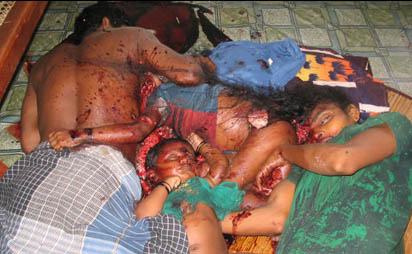
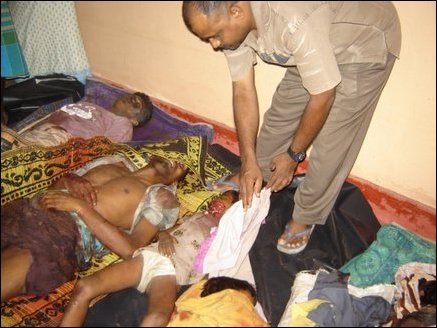
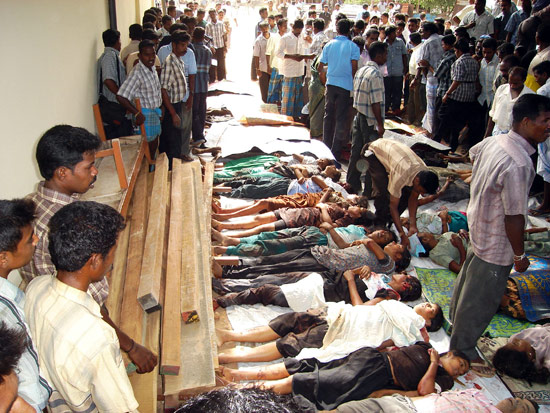
When these attempts at ethnic cleansing were resisted by the Tamil people by non violent means and parliamentary struggle, Sinhala governments resorted to violence in 1956, in 1958, in 1961 and again in 1977 - a murderous violence directed to terrorise the Tamils into submission. The inevitable rise of Tamil armed resistance to State terror was then met with enactment of laws which were an 'ugly blot on statute book of any civilised country', with arbitrary arrest and detention, torture, extra judicial killings and massacres, indiscriminate aerial bombardment and artillery shelling, wanton rape, and genocide - together with press censorship, disinformation and murder of journalists. And the impunity granted to Sinhala armed forces, para military groups, goondas and Sinhala thugs, exposed the encouragement, support and direction given by successive Sri Lanka governments for the crimes committed against the Tamil people. Today, (in 2006) the President Rajapakse government seeks to pursue the Sinhala assimilative agenda by reneging on the 2002 Oslo Declaration, by refusing to recognise the existence of the Tamil homeland, and by perpetuating a Sri Lankan state structure within which the Tamil people may continue to be ruled by a permanent Sinhala majority. At the same time the genocidal intent of the President Rajapakse government is reflected in the war crimes committed by the Sri Lankan armed forces under the President's command and by the Sri Lanka para military. In the shadow of a ceasefire, they have raped, murdered Tamil Parliamentarians, Tamil journalists, executed Tamil students with impunity, arbitrarily arrested and detained Tamil civilians, abducted Tamil refugee workers, orchestrated attacks on Tamil civilians and Tamil shops, bombed Tamil civilian population centres and displaced thousands of Tamils from their homes. The gross, consistent, and continuing violations of the rights of the Tamil people, by the Sri Lankan government and its agencies during the past several decades, include grave breaches of the Universal Declaration of Human Rights, the International Covenant on Civil and Political Rights, the Genocide Convention, and the Geneva Conventions relating to the humanitarian law of armed conflict. These violations by Sri Lanka have been well documented by several human rights organisations and independent observers as well as by eye witnesses - and have been the subject of hundreds of statements and interventions at the United Nations Commission on Human Rights. This publication brings together extracts from some of these reports - including those that cover Genocide '58, Genocide'83 , the Genocidal War '95/'01, Sri Lanka's Continuing War - in the Shadow of a Ceasefire. The Record Speaks... - Plantation Tamils deprived of citizenship - 1948/50
- Sinhala Lion Flag imposed as National Flag by majority will
- Sinhala colonisation of Tamil Homeland
- Enactment of Sinhala Only Law - 1956
- Tamil Parliamentarians attacked & 150 Tamils killed - 1956
- Genocide - Genocide '58
- Sinhala army attacks Tamil Satyagrahis - 1961
- Tamils squeezed out of Higher Education - 1971
- Discrimination in Education in Sri Lanka - paper presented by Professor C Jeyaratnam Eliezer
- Repeal of Constitutional safeguards for minorities - 1972
- Eleven Tamils killed at 4th International Tamil Conference in Jaffna - 1974
- Suppression of peaceful Tamil resistance -1972 to 1975
- Organised pogrom against Tamils - 1977
- Rise of the armed resistance of the Tamil people
- Tamil resistance met with Sri Lankan state terrorism - 1979
- Destruction of Jaffna Public Library - 1981
- Continued attacks on Tamil civilians - July/August 1981
- Anti Tamil, anti Hindu offensive in Mullaitivu - 1982
- Violation of the right to free elections - 1982
- Interference with the judiciary and violation of the Rule of Law - 1982/83
- Tamils detained without charge or trial - 1979/83
- Sri Lanka Terrorism Act -'ugly blot on statute book of any civilised country'
- Torture - almost universal practise of Sri Lankan authorities says ICJ
- Genocide - Genocide '83...
- Chunnakam massacre and extra judicial killings of Tamils - 1984
- Events affecting the Judiciary - 1977 to 1984
- The plea that went unheeded - K.V.Nadarajah, August 1984
- Case Study of Torture, Sri Lanka Style - 1984
- Sri lanka Army terrorises another Jaffna school - November 1984
- Sinhala army murders Christian priests - 1984/85
- Arbitrary killings and torture - 1985
- Synopsis of extra judicial killings by an independent law group - 1979 to May 1985
- Sri Lanka Navy murders passengers on Kumithini - May 1985
- Amnesty Reports on 163 Extra Judicial Killings of Tamils in May 1985
- An Episode of Persecution - Paul Nallanayagam on Special Task Force and Extra Judicial Killings
- The Massacre in Tiriyai - the village that died on 15 June 1985
- 52 Tamil villages in Trincomalee area razed to the ground in two months - September 1985
- Amnesty File on Sri Lanka Torture - October 1985
- Amnesty confronts Sri Lanka's denial of torture - December 1985
- Iruthayapuram Massacre: eye witness account - January 1986
- Akkaraipattu Massacre & Arbitrary killing of Tamils - 1986
- The Kokkadaicholai Massacre - 1987
- Security forces continue to kill, chain and incarcerate non combatant Tamils - 1987
- UN Commission on Human Rights calls for Red Cross intervention - 1987
- Indian army intervenes at invitation of Sri Lanka government - 1987
- Thileepan's fast - and Jaffna, September to November 1987
- Diwali Day massacre at Jaffna General Hospital - November 1987
- India's war in Jaffna - Eduardo Marino's Report to International Alert
- Indian army's war crimes - 1987
- Rape of Tamil women by Indian Army - 1987/88
- Annai Poopathy's fast for freedom - 1988
- Detention without Trial, Torture - 1988
- Torture & Reprisal attacks by India and Sri Lanka - 1989
- India's My Lai - the Valvettiturai Massacre - 1989
- Sri Lanka's Deputy Defence Minister on the rule of law...
- Kannapuram Massacre, July 1990
- Planned genocidal attack on Tamils in the East - 1990
- 180 Tamils butchered at Saththurukondan - September 1990
- Hundreds of Tamils 'Disappear' after detention by Sri Lanka - 1990
- Sri Lanka bombs Jaffna Hospital & other Tamil civilian centres - 1990
- Calculated disinformation campaign by Sri Lanka government
- Amnesty launches 3 month campaign against Sri Lanka - 19 September 1990
- Thousands of Tamils extra judicially executed says Amnesty - 1990
- Tamil detainees systematically tortured -1991
- Kokaddicholai massacre - June 1991
- On the use of Governmental Aggression to Suppress a Minority's Quest for Self Determination - Deanne Hodgin, July 1991
- Human Rights violations continue at 'an alarming rate' - 1992
- India's Act of Piracy, January 1993
- New spate of disappearances & extra judicial killings - 1993
- The torture of Arulapu Jude Arulrajah - October 1993
- Over 1,000 Tamil civilians killed in the three years bombing of Jaffna says British Refugee Council, July 1993
- 200 Tamils civilians killed in air and navy attacks in 1993 alone, September 1993
- "This is organised State terrorism" say Bishop D.J.Ambalavanar, Bishop Thomas Saundranayagam , and Nallai Thiru Sampandar Atheenam
- Churches and Temples Bombed, Network January 1994
- Sri Lanka airforce strafes Tamil villages
- Sri Lanka Airforce Bombs Schools in Jaffna
- Sri Lanka Airforce targets Tamil civilian population, March 1994
- Hospitals bombed in Tamil Homeland
- Genocide Genocidal War - 1995 to 2001
- Sri Lanka's Undeclared War on Eelam Tamils in the Shadow of a Ceasefire
|